GUIDE
X API Pricing 2026: The True Cost of Official vs. Third-Party APIs
X API pricing in 2026: official pay-per-use costs vs third-party Twitter APIs, with a TCO calculator, compliance risk, and a use-case decision tree.
Per our own spec, 60 of 99 endpoints bill $0.0008, 24 are free, and 15 sit between $0.0016 and $0.01. Every price ships inside our published OpenAPI document as an x-cost-usd field, so any figure in this post can be checked against the contract that bills it rather than taken on trust.
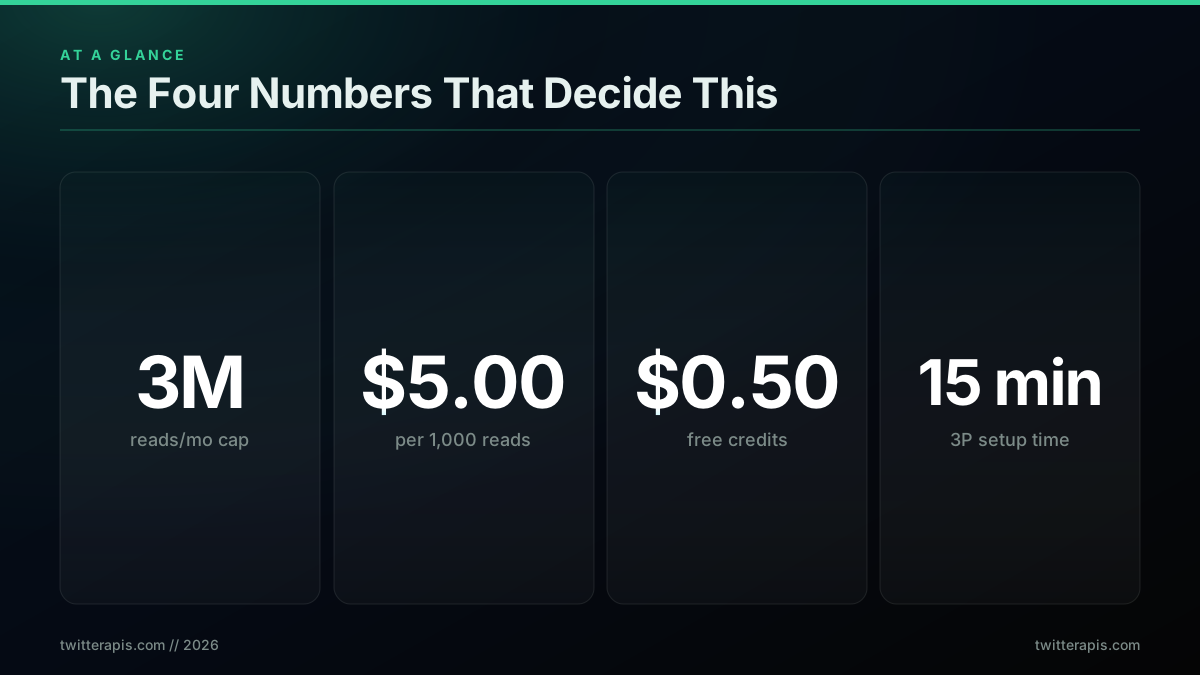
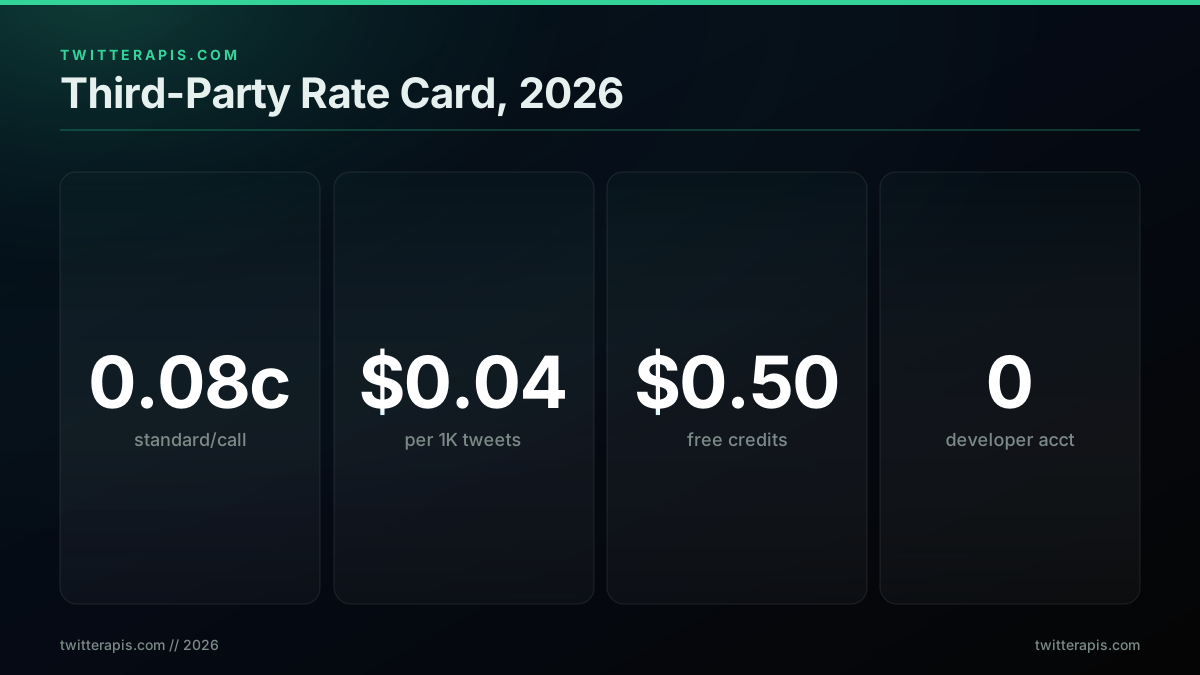
The official X API charges $0.005 per post read and $0.015 per post created (X API pricing) under its 2026 pay-per-use model, capped at 3 million reads a billing cycle before an Enterprise contract kicks in at a price X does not publish. A managed third-party Twitter API such as twitterapis.com charges $0.0008 per call returning about 20 tweets, an effective $0.04 per 1,000 tweets, with no fixed monthly ceiling. The right route depends on your workload, not on which number is smaller.
TL;DR: Sticker price favors third-party APIs by roughly 125x per record, but sticker price is not total cost. Add OAuth integration hours, retry and rate-limit engineering, and ongoing maintenance, and the official route's true monthly cost still runs far above a managed third-party route at every volume tier this guide models. The official API keeps three things a Bearer key cannot replace: user-delegated OAuth actions, the Ads API, and full-archive search. Everything else, reading, searching, and monitoring public data at volume, is where a third-party API wins on both price and total cost of ownership. Run your own numbers through the calculator and decision tree below before you pick a route.
Most pricing comparisons in this category stop at the rate card. This one does not. We priced three volume tiers across both routes, built a total-cost-of-ownership model that adds integration and maintenance time to the raw per-call price, checked the compliance and reliability tradeoffs the rate card does not show, and mapped five real workloads to the route that actually fits. Where the numbers below are twitterapis.com's own rates, they come straight from our pricing page; where they are the official X API's rates, they come from X's published pay-per-use pricing.
What's the Difference Between the Official X API and Third-Party Twitter APIs?
The official X API is the first-party interface X Corp publishes directly, using OAuth 2.0 for user-delegated actions, a normalized response shape, and 2026's pay-per-use billing model. A third-party Twitter API is any independent service, including twitterapis.com, that returns the same underlying tweet, user, timeline, and search objects through its own infrastructure, typically behind a single Bearer key with a denormalized, batch-friendly response shape. Both routes reach the same public data. They diverge on price, setup friction, rate ceilings, and who is contractually accountable for terms alignment.
The two routes at a glance
- Official X API
- Pay-per-use, meteredFirst-party terms and signed compliance endpoints. Pricing model has changed roughly once a year since 2023.
- Managed third-party
- Per-call, no monthly minimumVendor absorbs upstream changes and re-stabilises the API contract you depend on.
- The axis a rate card hides
- Compliance riskDepends on the provider sub-type, not on price. A managed API and a raw scraper are not the same risk.
- The planning risk
- Pricing instabilityFour model changes in three years is a real problem for any team budgeting past a quarter.
The practical difference shows up first in the response shape. The official API returns one object per call in most cases; a well-built third-party call commonly returns a batch of 15 to 25 tweets plus author data in a single response. That batching, not a discount war, is the entire reason the per-record price gap is as wide as it is, and it is why comparing "per call" price alone across routes is misleading. Divide by objects returned, not by requests made, and the picture gets clearer fast. For the platform-specific rate breakdown underneath this framing, our Twitter API cost guide and the live cost calculator both normalize the math the same way this guide does. For a field-by-field look at how the official v2 response shape lines up against a batched third-party call, our Twitter API v2 comparison breaks the two response shapes down side by side.
How Much Does the Official X API Cost in 2026?
The official X API's 2026 pay-per-use model charges $0.005 per post read, $0.015 per post created ($0.20 if the post contains a link), and $0.001 per owned-account read (X API pricing) since an April 20, 2026 update, with post reads capped at 3 million per monthly billing cycle before an Enterprise contract is required. Legacy Basic ($200/month) and Pro ($5,000/month) subscriptions (X API pricing) remain in place only for existing subscribers as X winds them down, and X publishes no Enterprise price for the current program: crossing the cap opens a contact form.
What the official route cost before pay-per-use
The Basic subscription that pay-per-use replaced was priced at $200 a month with a fixed usage ceiling. That is the number a hobbyist project was measured against before metered billing existed, and it is why pay-per-use genuinely lowers the entry cost for a small experiment while getting more expensive, fast, at real volume.
X's own developer account confirmed the mechanics of that ceiling directly when it announced the end of the legacy Basic tier:

Developers
@XDevelopers
Important update for X API developers: Legacy Basic plans (monthly & annual) are being deprecated. All Basic subscribers will be automatically migrated to the new Pay-Per-Use plan after June 1, 2026. Full details: https://t.co/X3GJ2wvFC2
The full context for that migration, including the exact billing mechanics X posted, is in X's Developer Community announcement thread. The practical read for anyone still on a legacy plan: budget for pay-per-use now, because the subscription floor under your current spend is going away regardless of your usage pattern. For a narrower drill-down on how these specific rates moved through 2026, see our X API pricing change tracker and the Twitter API alternatives comparison for the third-party side of the same math.
One detail worth pinning down before you model a budget: the $0.015 write price and the $0.005 read price are list rates for standard endpoints, not a flat charge on every possible call. X's own X API documentation separates post creation, post lookup, recent search, and user lookup into distinct billable actions, and a real integration usually mixes several of them. A monitoring bot that searches, then hydrates author profiles, then checks engagement counts is paying three different per-action prices on a single logical "check," which is why a rate card that quotes one number rarely predicts a real monthly bill. Model the actual endpoint mix your code calls, not the headline read price, and the official route's true number climbs faster than the sticker suggests. That endpoint-level accounting is also what makes the batched third-party response shape matter so much: one call that returns search results, author objects, and engagement fields together collapses three official billable actions into one third-party record.
| Tier | Price | Who it applies to |
|---|---|---|
| Post read (standard) | $0.005/read ($5.00 per 1,000) | New pay-per-use accounts, 2026 |
| Post created (write) | $0.015/post ($0.20 with a link) | New pay-per-use accounts, 2026 |
| Owned-account read | $0.001/read | Since April 20, 2026, your own account's data only |
| Legacy Basic | $200/month flat | Existing subscribers only, being phased out |
| Legacy Pro | $5,000/month flat | Existing subscribers only |
| Enterprise | No published price | Required past the 3M-read monthly cap |
Is There a Free Tier for the X API in 2026?
There is no standing free tier on the official X API in 2026. X ran a $500-voucher closed beta (X announcement) for pay-per-use starting in October 2025, but that was a launch promotion for selected developers, not an ongoing allowance, and it closed once pay-per-use went to general availability.
Announcing our beta launch: X API pay-per-use model. We are expanding a closed beta to both new and power users who want to ship amazing apps on X. All selected users will receive a $500 voucher to build with the X API.
— @XDevelopers, source (https://x.com/XDevelopers/status/1980412193624785337)
New developers signing up today go straight to metered pay-per-use billing with no free allocation. Our own is the Twitter API free breakdown tracks this specific question in more depth and reaches the same conclusion. On the third-party side, the closest equivalent currently available is twitterapis.com's $0.50 in free credits on signup, about 625 standard calls, with no card required and no developer-account approval step to clear first.
What Do Third-Party Twitter APIs Cost Compared to the Official X API?
Third-party Twitter APIs run substantially cheaper per record than the official pay-per-use rate. twitterapis.com's standard call costs $0.0008 and returns roughly 20 tweets, an effective $0.04 per 1,000 tweets, against the official API's $5.00 per 1,000 standard reads (X API pricing), a gap of roughly 125x on raw price before any total-cost adjustment.
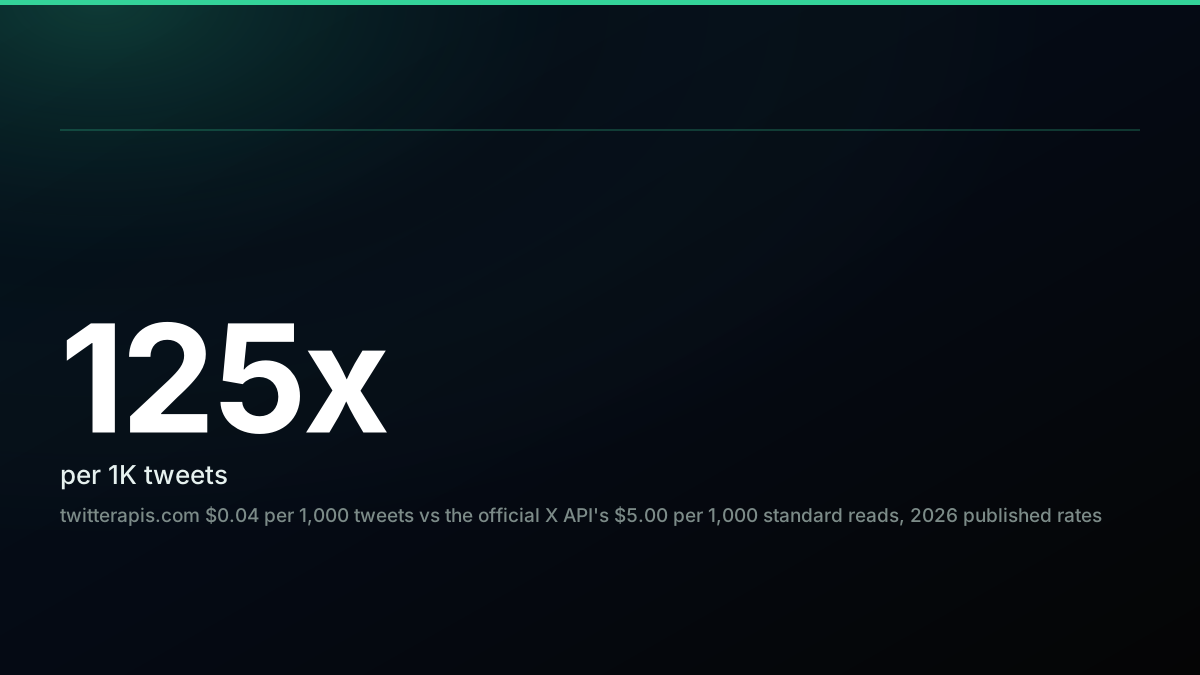
That gap narrows only for owned-account data, where the official API's $0.001 owned-read rate (X API pricing) applies specifically to your own account's tweets and followers, not to third-party reads of the wider platform. Outside that narrow case, the batching economics hold across the category: a managed third-party call that returns a batch of objects is cheaper per record almost by construction, because you are not paying the per-object official rate 20 separate times.
Twitter API plans are a joke!
That is the community's blunt read on the official rate card, and it is the demand signal behind most of the "how do I avoid the official price" traffic this cluster sees. Pricing across the third-party category itself is not uniform, though; a marketplace listing on RapidAPI or a general-purpose scraper actor on Apify prices very differently from a managed REST provider running its own infrastructure. Our cheapest Twitter API ranking tracks eight providers on real published per-1,000-tweet cost, not list price, and our Apify comparison and RapidAPI alternative posts break down those specific sub-types.
The Real Cost of Ownership: What the Sticker Price Doesn't Show
The sticker price on either route is not what a production integration actually costs. Total cost of ownership adds the one-time integration time and the ongoing maintenance time to the raw per-call price, and on the official API that overhead is large enough to change the comparison at low volume even though the raw per-record price gap looks enormous.
Here is the model, run at a representative, estimated $75-per-hour blended engineering rate, an assumption we are disclosing explicitly rather than presenting as a universal constant; substitute your own rate and the ratios below still hold directionally. The official API's OAuth 2.0 setup, developer-account application, app and project configuration, and token-refresh handling commonly takes engineering teams four to eight hours to get production-ready; we model six hours one-time plus roughly one hour a month of ongoing retry, backoff, and token-refresh maintenance. A managed third-party route replaces that entire subsystem with a single Bearer header; we model fifteen minutes one-time setup plus roughly fifteen minutes a month of maintenance.
true_monthly_cost = raw_api_cost
                   + (one_time_setup_hours * hourly_rate) / 12
                   + (monthly_maintenance_hours * hourly_rate)
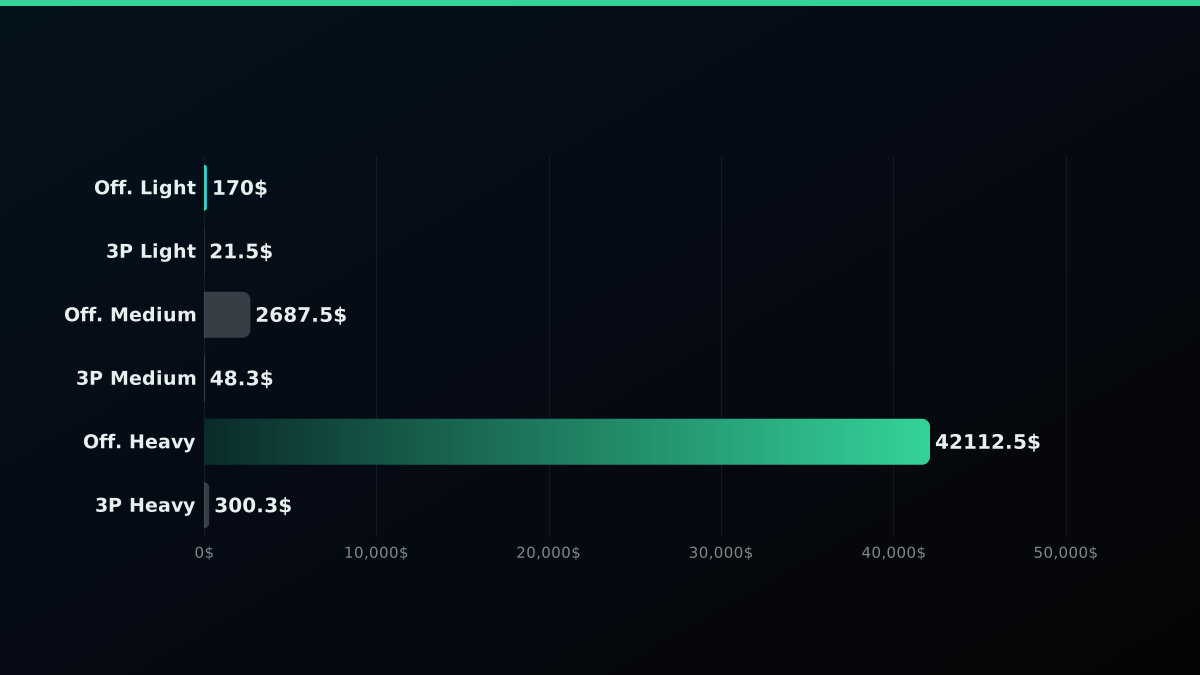
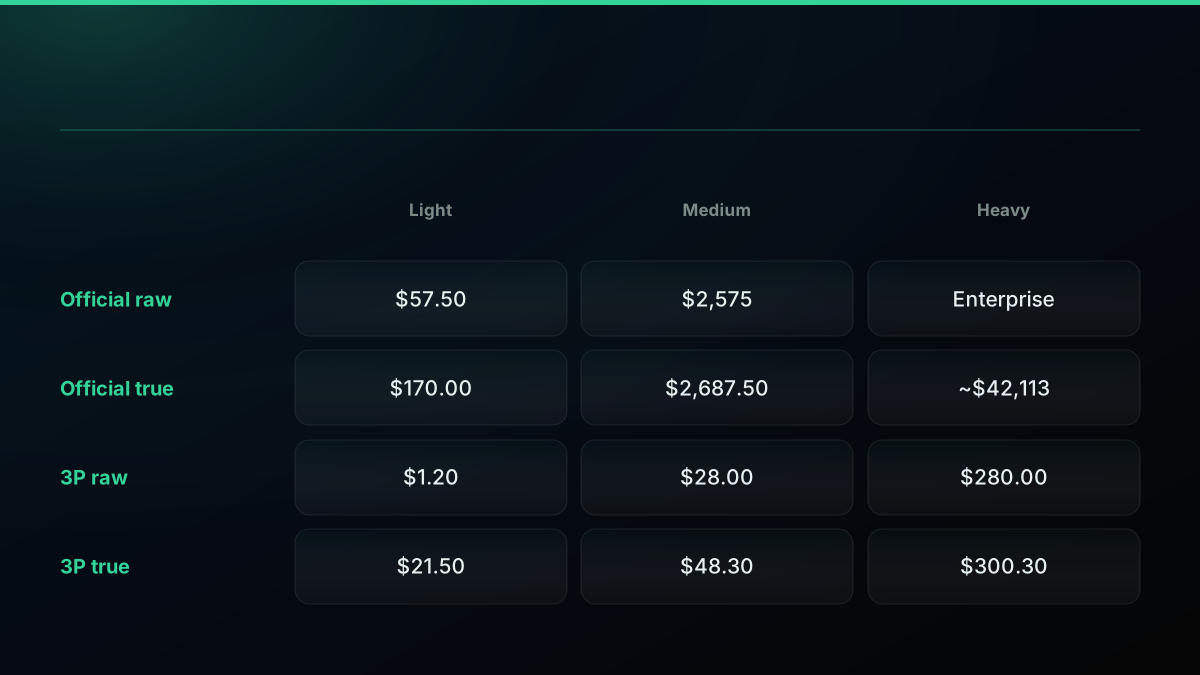
Run that formula across three volume tiers, light (10,000 reads and 500 posts a month), medium (500,000 reads and 5,000 posts a month), and heavy (5,000,000 reads and 50,000 posts a month, which exceeds the official API's 3-million-read cap and forces an Enterprise contract):
| Volume tier | Official raw cost | Official true cost | Third-party raw cost | Third-party true cost |
|---|---|---|---|---|
| Light | $57.50/mo | $170.00/mo | $1.20/mo | $21.50/mo |
| Medium | $2,575.00/mo | $2,687.50/mo | $28.00/mo | $48.30/mo |
| Heavy | Requires Enterprise, no published price | Not quotable | $280.00/mo | $300.30/mo |
The overhead line matters most at the light tier, where it is the majority of the official route's true cost, an estimated $112.50 of a $170.00 total. At medium and heavy volume the raw per-call spend dominates and the overhead becomes a rounding error, which is the honest way to read this table: OAuth overhead is a fixed tax that hurts a small project disproportionately and barely registers on a large one. For your own workload's exact numbers, run it through the live cost calculator rather than trusting the three tiers modeled here, and see our Twitter API cost benchmark for how these per-call figures were normalized against real provider rate cards.
Free Twitter monitoring workflow for n8n (avoiding the $5k/month API)
That $5,000-a-month figure lines up almost exactly with what this guide's own medium-tier official estimate would look like at heavier monitoring volumes, which is the real-world confirmation behind the workaround culture this whole cluster is built around. A workaround is not automatically the right answer, though, it just means the true-cost math above is worth running before committing to either route.
What This Cost Model Doesn't Capture
The true-cost table above is directionally reliable, not a quote. Three things sit outside it, and each one can move a specific team's real number without changing which route wins on the workloads this guide covers.
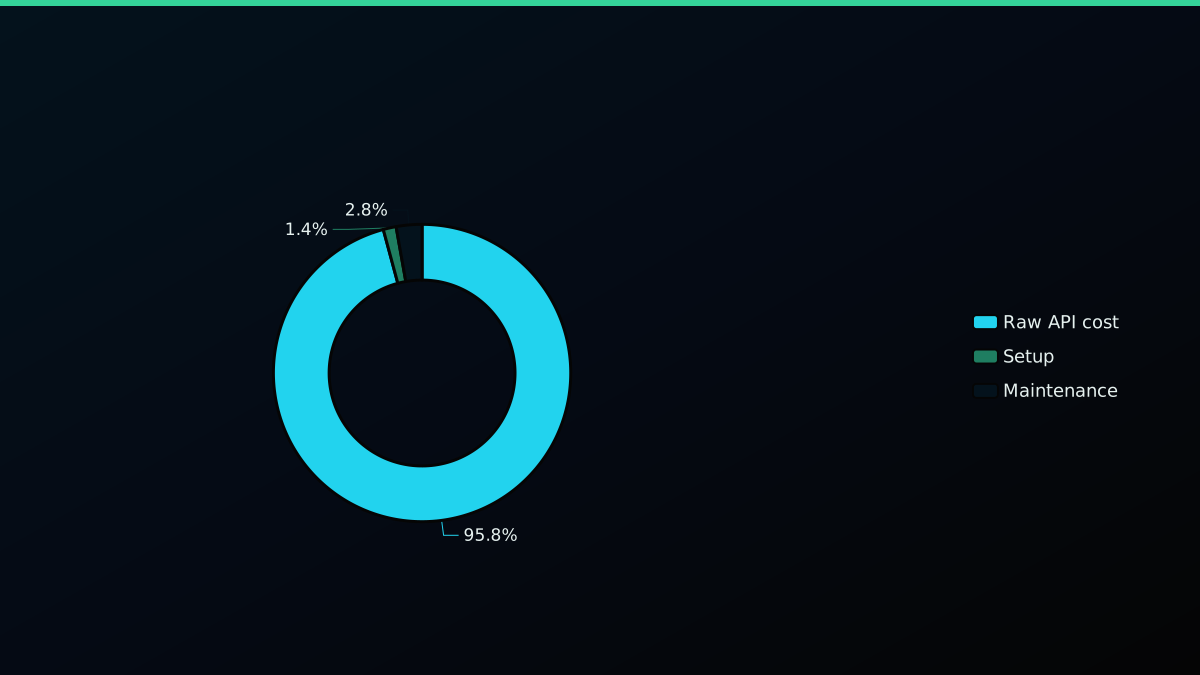
Engineering rate is the biggest lever. The model runs at an estimated $75 an hour; a team paying $150 an hour doubles every overhead line in the table, which widens the official route's disadvantage at light and medium volume rather than narrowing it, since the setup and maintenance hours are the same regardless of rate. A team with an already-built internal OAuth library, reused across other integrations, pays closer to the third-party route's overhead on setup, though the ongoing per-month token-refresh and retry-handling maintenance still recurs on every project that touches the official API independently.
Retry-and-backoff engineering is folded into the flat one-hour and fifteen-minute monthly maintenance figures, and that flattening hides a real difference. A read-heavy monitor hitting the official API's per-endpoint rate windows at volume needs a genuine backoff strategy, exponential retry, jitter, a dead-letter path for calls that never succeed, not just a token refresh. A third-party route with no fixed monthly ceiling still needs the same 429 handling, but hits it far less often in practice because there is no hard monthly wall forcing a burst-then-throttle pattern near the end of a billing cycle. Neither route's maintenance line in the table above prices this asymmetry explicitly; a team running a genuinely high-frequency monitor should budget more monthly maintenance hours on the official route than this guide's flat estimate assumes.
The table cannot put a number on the heavy tier's official row, because X publishes no Enterprise price at all. Past the 3-million-read cap X routes you to a contact form, and contracts are negotiated individually on volume, endpoint mix, and support tier in ways no public source discloses. A figure of about $42,000 a month circulates widely, but it traces to 2023 press reporting on X's old tiered plan rather than to anything X publishes for the current pay-per-use program. Treat the heavy-tier official row as a directional signal that Enterprise-scale official access is expensive relative to a per-call third-party route at the same volume, not as a number to budget against.
Why Did X/Twitter API Pricing Get So Expensive?
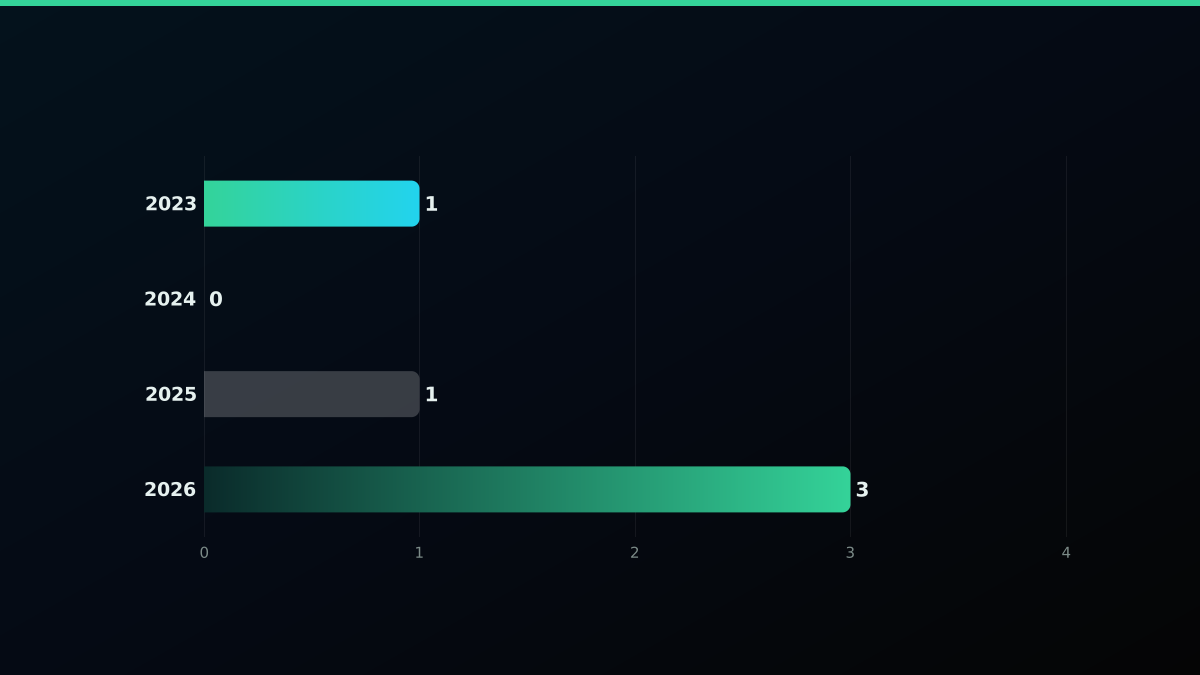
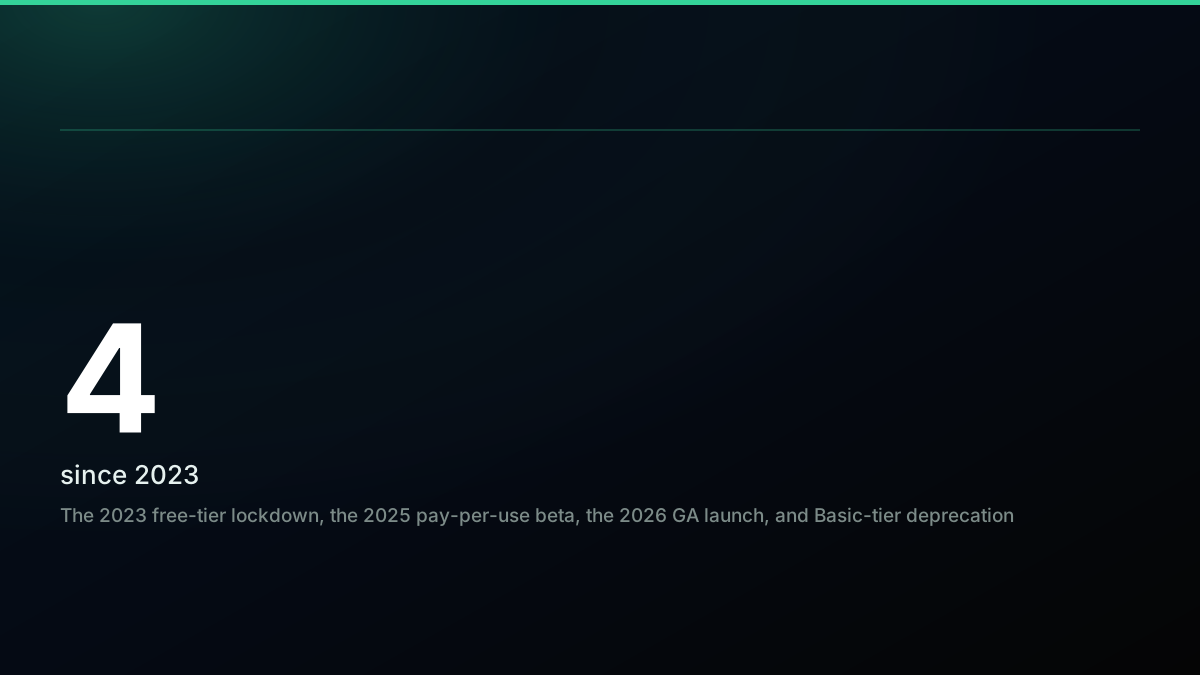
X restricted its long-standing free API tier in 2023 and introduced paid Basic and Pro subscriptions, then replaced those fixed tiers with pay-per-use, which went to closed beta in October 2025 and general availability in February 2026, followed by an owned-read price cut in April 2026 and the Basic-tier deprecation announced in May 2026. That is four distinct pricing-model changes in roughly three years, close to once a year, and the shift toward metered pay-per-use billing is the platform explicitly reframing programmatic access as a paid, usage-tracked activity rather than a flat subscription.
X API pricing model changes since 2023
- 2023Free tier restricted, paid Basic and Pro introduced
The long-standing free API tier is closed to most use and replaced with fixed paid subscriptions.
- Oct 2025Pay-per-use enters closed beta
- Feb 2026Pay-per-use reaches general availability
Metered billing becomes the default path for self-serve developers and agents.
- Apr 2026Owned-read price cut
- May 2026Basic-tier deprecation announced
Four distinct pricing-model changes in roughly three years, close to once a year.
Developers
@XDevelopers
Officially launching X API Pay-Per-Use The core of X developers are indie builders, early stage products, startups, and hobbyists It’s time to open up our X API ecosystem and instill a new wave of next generation X apps We’re so back. https://t.co/FS66GuIYJD
That framing, indie builders and hobbyists as the target audience, sits in real tension with the numbers developers actually report paying once they scale past a toy project. One widely shared developer take makes the tension explicit:

Enzo 🆃🆂🆇
@enzo_tsx
My opinion about the X api: This new pricing structure is clearly enterprise-focused, prohibitively expensive for indie devs, and effectively shuts out experimentation and small projects. It’s a major step away from the open, developer-friendly Twitter API that used to encourage
Both things are true at once. Pay-per-use genuinely lowers the entry cost for a small experimental project compared to a $200-a-month Basic subscription (X API pricing) with a fixed usage ceiling, since a hobbyist project reading a few thousand tweets a month now pays a few dollars instead of a flat $200. It also gets materially more expensive, fast, for anything that reads at real volume, because the per-record rate does not fall as usage grows the way a flat subscription's effective per-record cost does. Whether pay-per-use is "friendlier" depends entirely on which side of that curve your project sits on, and the light-tier row in the total-cost table above is the honest answer for a small project specifically.
Compliance and Account-Suspension Risk: What Third-Party Access Actually Costs You
Compliance risk is the axis a rate card never shows, and it is not the same axis as price. The official X API is fully aligned with X's first-party terms by definition and offers signed compliance endpoints for regulated data handling. Third-party access sits outside that first-party alignment, and the actual risk depends heavily on the provider's sub-type: a managed API running its own structured read infrastructure carries a very different risk profile than a raw scraper routed through rotating residential proxies.
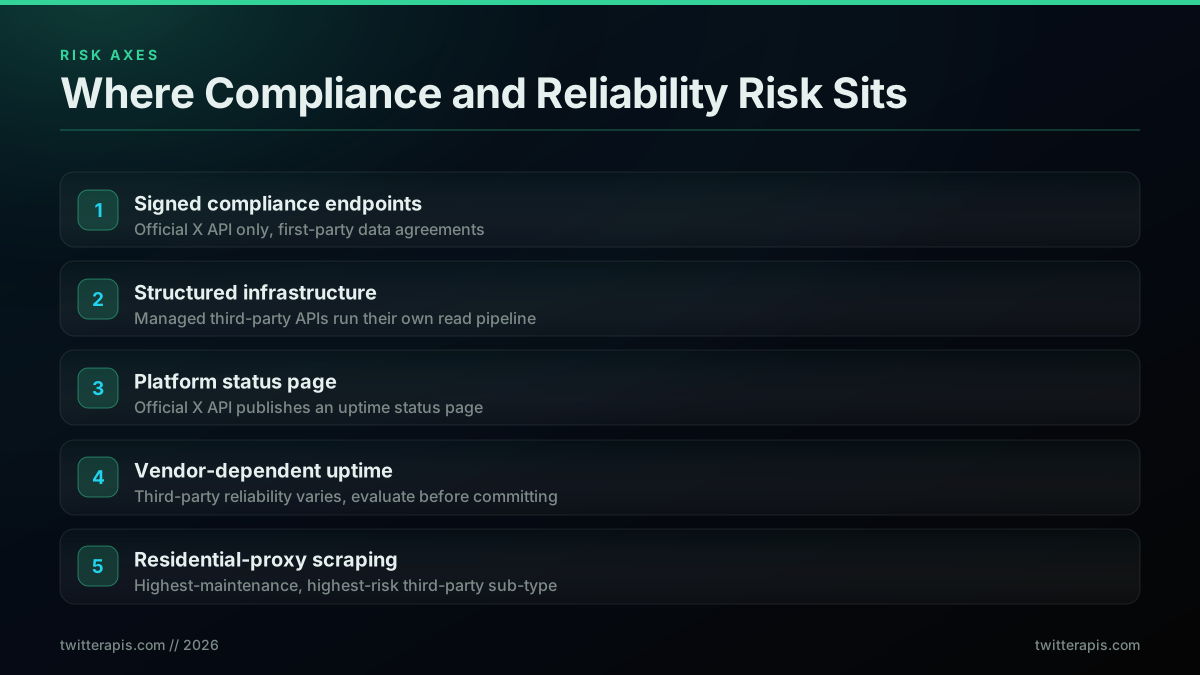
The honest failure mode to plan for is not abstract. If a production integration depends on a specific access method and that method stops working, the cost is not the API bill, it is the downtime while you re-point the integration at a different data source. That risk concentrates almost entirely in the scraper sub-type, where a single upstream change can silently break every dependent job at once with no vendor buffering the disruption. A managed provider running structured infrastructure absorbs upstream changes on its side and re-stabilizes the API contract you actually depend on, which is the entire value of paying a vendor instead of running your own scraper. Evaluate any specific provider's stated data-sourcing method and your organization's own risk tolerance before routing a revenue-critical pipeline through it, and reserve the official route for any workload where a signed data-handling agreement is a contractual requirement rather than a nice-to-have. Our residential proxies for Twitter scraping breakdown covers the highest-maintenance, highest-exposure sub-type in more depth for teams that still need that specific approach.
AI-agent and MCP-based tooling is a specific, growing category of workload: it needs Twitter data as a live input but has no natural path to a human-approved OAuth flow. twitterapis.com's own MCP server targets exactly that use case with a single Bearer key rather than an interactive OAuth grant, which is structurally simpler for an autonomous agent to hold and rotate than a refreshable OAuth session tied to a human account.
Start building with TwitterAPIs
$0.0008 a call, about $0.04 per 1,000 tweets at 20 tweets a page. $0.50 free credits. No credit card required.
How Reliable Is Each Route? Uptime, SLAs, and the Pattern Since Pay-Per-Use Launched
Reliability splits by route type rather than by official-versus-third-party as a single axis. The official X API publishes a platform status page and an SLA-backed enterprise tier; a managed third-party REST provider offers vendor-stated reliability that ranges from strong to unremarkable; a thin marketplace wrapper or an unmaintained scraper is the least reliable option in the category regardless of its price.
What the official route does not buy you is pricing stability. Since the 2023 free-tier lockdown, X has changed its API pricing model roughly once a year: the 2023 shift to paid Basic and Pro tiers, the October 2025 pay-per-use beta, the February 2026 general-availability launch, and the owned-read discount and Basic-tier deprecation both landing in 2026. A platform that rewrites its pricing model on close to an annual cadence is a genuine planning risk for any team budgeting more than a quarter out, independent of whether any single price point is currently good or bad.

Chris Park
@chrisparkX
X API has achieved all time high usage with our new flagship Pay-Per-Use model. 📈 PPU is now the default way to build with X for self serve developers & agents. As a result, we are unwinding our legacy fixed X API tiers - starting with Basic.
That confirms the pattern directly from an X team account: pay-per-use is not a side option, it is the platform's stated default, and further legacy-tier unwinding should be treated as likely rather than hypothetical. A third-party route is not immune to the same category of change, but a managed provider's whole job is absorbing platform-side volatility on its end so your integration contract stays stable; that is a genuine reliability argument for the third-party route that has nothing to do with price.
Is a Third-Party Twitter API Reliable If X Tightens Enforcement or Changes Its Terms?
This is a different risk than the pricing-model changes covered above; it is about access itself, not the price of access. The official X API is not exposed to this risk category at all, it is the first-party route, immune by definition to a third-party access method breaking. Third-party reliability under enforcement pressure depends entirely on how the specific provider sources its data, not on "third-party" as a single risk bucket.
A managed API running its own structured read infrastructure, rather than reselling another vendor's access or running a raw scraper, is built specifically to absorb upstream changes on its side of the integration. If X adjusts an endpoint or a rate structure that affects how a provider like this sources data, the provider's job is to re-stabilize its own backend so the API contract you depend on stays the same shape from your side: no re-integration, no re-point of your production code, no incident ticket on your end. That buffering is the actual value proposition of paying a managed vendor instead of building and running your own scraper. You are paying, in part, to not be the one who has to react first when something upstream changes.
A thin marketplace listing or an unmaintained scraper carries the opposite risk profile. It typically has no infrastructure of its own to re-stabilize, no support contract backing it, and no commercial incentive forcing a fast fix when something upstream breaks, since the operator's cost of walking away from an unmaintained project is close to zero. If continuity matters to your production workload, this distinction, structured infrastructure versus resale or scraping, is worth more than a few cents of per-call price difference. It is also the single most useful question to ask any third-party vendor before committing a revenue-critical pipeline to it: what happens on your end, specifically, the day X changes something your integration depends on? A vendor that cannot answer that question concretely is telling you something about its own operational maturity, independent of what its rate card says.
When Should You Use the Official X API Instead of a Third-Party Provider?
Use the official X API whenever your workload needs a first-party capability a Bearer key structurally cannot replace: acting on behalf of signed-in users through user-delegated OAuth, the Ads and campaign API for advertising data, full-archive search past the standard seven-day recent-search window, or any use case where a signed data-handling agreement is a compliance requirement rather than a preference.
If your project sits on that list, the price and setup-time disadvantages do not change the answer, because no amount of savings buys back a capability the third-party category does not offer at all. Getting an official developer key is a documented, if heavier, process; the walkthrough below covers the current 2026 steps end to end.
https://www.youtube.com/watch?v=aZz9D0FdevA
That video is a fair, current picture of what the official on-ramp actually involves in 2026, developer-account approval through to a first working pay-per-use call.
When Should You Use a Third-Party Twitter API Instead of the Official X API?
Use a third-party Twitter API for reading, searching, or monitoring public data at volume, for fast setup with no developer-account approval, and whenever cost per record and total cost of ownership matter more than first-party terms alignment. This is the majority use case in the category: data pipelines, research corpora, sentiment models, monitoring bots, and AI-agent workflows that never act on behalf of a signed-in end user.
Cost and control drive a real build-versus-buy decision here, and it maps to a broader pattern: once official-API cost or the marketplace-listing markup gets high enough, developers route toward either a managed provider or their own infrastructure. A managed route gets you most of the "build your own" cost advantage without the ongoing maintenance burden. Within the third-party category, a managed REST provider is the default recommendation over a marketplace listing or a raw scraper specifically because it holds the price and setup advantages while buying back most of the reliability a self-run pipeline would sacrifice.
Build or Buy: Is a Self-Hosted Scraper or n8n Workflow Cheaper Long-Term?
A self-hosted scraper or an n8n workflow can undercut both the official API and a managed provider on raw infrastructure cost, but it moves the entire maintenance and enforcement-risk burden onto you, which is why most teams that start there eventually route back to a managed API. The cheapest option on a spreadsheet is rarely the cheapest option once a scraper breaks at 2 a.m. and a production job silently stops writing rows.
The build-your-own path is genuinely popular, and the reasons are legitimate. Developers priced out of the official rate card and unwilling to pay marketplace markups reach for n8n workflows, Apify actors, or a hand-rolled scraper on a cheap VPS. This n8n scraping workflow walkthrough is representative of the genre: chain a scraper node to a scheduler and you have a monitoring pipeline for the price of a server. On paper it beats every route in this guide's cost table, and that on-paper win is exactly why the workaround culture around this cluster is so active.
Monitoring X/Twitter mentions in 2026 without the enterprise price tag. What's actually working for you?
The long-term math is where the build path gets expensive in ways the spreadsheet misses. A self-hosted scraper is the residential-proxy sub-type this guide already flagged as the highest-maintenance route: it needs proxy rotation, anti-bot mitigation, a parser update every time a page structure shifts, and a human on call when it breaks. The failure mode is not gradual. One developer running a viral project that hit three million views in eight days posted that they had to shut it down because their scraping layer could not absorb the traffic and the official API was too expensive to fall back on. Their infrastructure cost was near zero right up until the moment it became the entire problem.
That is the build-versus-buy decision stated honestly: a self-hosted scraper trades a predictable monthly bill for unpredictable engineering interrupts, and it works right up until platform enforcement or a traffic spike turns a side project into an incident. A managed third-party API sits in the middle: it keeps most of the raw-cost advantage of building your own while absorbing the proxy, parser, and enforcement maintenance on the vendor's side. Even developers comfortably paying the official rate feel the pull toward more accessible routes; as one put it, "we pay almost 1k/month using the X API" while pointing peers toward cheaper providers. The clean rule: buy the maintenance you would otherwise do yourself, and reserve the build path for the rare case where you genuinely need data infrastructure no vendor sells.
Are Third-Party Twitter APIs Compliant With X's Terms of Service?
Compliance depends on the specific provider and the specific use case, not on "third-party" as a single category. Reading public data for research, analytics, or monitoring is the lowest-risk, most common third-party use case; write actions such as posting, following, or messaging on accounts you do not directly control carry materially more exposure regardless of which API layer performs them.
Evaluate any provider you are considering on how it sources its data (structured infrastructure versus a raw scraper), whether it publishes a compliance or data-handling policy, and whether its pricing and access model matches the workload you are actually running, read-heavy monitoring is a very different risk surface than automated posting at scale. Providers vary widely on this axis even within the "managed REST API" sub-type, so treat a specific vendor's stated posture as the input, not a generic assumption about third-party access as a whole.
What Are the Rate Limits on the Official X API vs Third-Party APIs?
The official pay-per-use API caps post reads at 3 million per monthly billing cycle, combined with per-endpoint rolling rate windows, and there is no gradual overage tier between that cap and an Enterprise contract. A managed third-party route like twitterapis.com imposes no fixed monthly ceiling; usage cost scales linearly, so a large one-time backfill or an unplanned traffic spike does not hit a hard wall the way it would on the capped official plan.
The practical difference shows up in how developers talk about the problem: the question is rarely about a single request's rate limit, it is about whether a large job survives to completion. On the official API, a job's ceiling is fixed by the 3-million-read monthly cap and the per-endpoint windows, both platform-imposed. On a per-call third-party route, the ceiling is however many workers you choose to run against a documented rate limits guide, which is an engineering choice inside your control rather than a platform-imposed wall. For the official API's endpoint-by-endpoint windows specifically, our Twitter API rate limit guide has the full table.
There is a second, easy-to-miss consequence of the two limit models: they fail differently, and they need different guardrails. The official API's per-endpoint windows are documented in X's rate-limit reference, and they reset on a rolling basis, so a burst that trips a 15-minute window recovers on its own without any billing consequence, while the 3-million-read monthly cap does the opposite: it accrues silently all month and then stops your reads cold with no warning tier in front of it. A team that only instruments the per-request 429 path and forgets the monthly counter gets blindsided at the worst possible time, near a billing-cycle boundary when traffic is often highest. The per-call third-party model removes the monthly cliff entirely and replaces it with a smooth spend curve, which is easier to reason about but shifts the whole burden of cost control onto your own budgeting. Neither model is strictly safer; they simply move the failure from one place to another, and the right instrumentation follows wherever the hard edge actually sits on the route you chose. Pick the route first, then build the guardrail that route's failure mode actually demands, rather than porting the other route's monitoring wholesale.
Does the Official X API Support Historical or Full-Archive Tweet Search?
Standard recent-search access on the official X API covers roughly the last seven days of posts; anything older falls outside that window by default and returns nothing. Full-archive search, querying back to the platform's earliest posts, has historically sat behind a separate, more restrictive access tier (Academic Research access, later folded into higher commercial tiers) rather than being available on the standard read endpoint by default. Under the 2026 pay-per-use restructuring, full-archive search remains a distinct, separately gated capability rather than something the standard per-read price automatically unlocks; confirm current archive-endpoint access in your own developer console before assuming a pay-per-use account includes it, since gating a capability behind a separate grant is exactly the kind of detail that changes with the pricing-model rewrites this guide has tracked above.
Third-party providers vary widely on archive depth, and this is one axis where "third-party" is not a single answer the way "cheaper" often is. Some managed APIs serve only forward-looking or recently-indexed data, effectively a live window rather than a deep archive. Others maintain a broader historical index built up over a longer operating history. If your workload is genuinely historical, a multi-year sentiment study, an academic corpus, a longitudinal brand-tracking project, a specific vendor's documented archive depth is the number to verify first, not its price. A low per-call rate that only reaches back a few weeks is the wrong tool for that job regardless of what it costs, and no total-cost-of-ownership math fixes a data-coverage gap.
The cheapest pay-as-you-go Twitter API. Try it free.
$0.0008 a call, about $0.04 per 1,000 tweets at 20 tweets a page. $0.50 free credits. No credit card required.
Can You Get Real-Time Twitter/X Data Without Paying for Official API Access?
Yes. A managed third-party REST API priced per call, rather than by official-API subscription or pay-per-use billing, is a standard route to real-time public Twitter and X data. twitterapis.com's standard rate is $0.0008 per call with $0.50 in free credits at signup, which covers meaningful monitoring or search volume before any spend hits the official API's billing surface at all.
This is not the same as "free at unlimited scale," and treating it that way is the failure mode worth naming directly. A small monitoring job genuinely runs close to free on a third-party route's free-credit allowance; a production pipeline at real volume still accrues real cost on either route, just at a much lower rate on the third-party side. Size your expectation to your actual usage, not to the headline "free credits" framing.
What Happens If You Exceed Your X API Pay-Per-Use Budget or Monthly Read Cap?
Hitting the official API's 3-million-read monthly cap blocks further post reads until the next billing cycle resets or until you move to an Enterprise contract; there is no intermediate overage tier that lets you simply pay more per call past that point. A per-call third-party route has one flat rate ceiling and no spend ceiling, so "exceeding budget" there is purely a self-imposed spend-control question, not a hard technical wall.
That difference changes what "monitoring your usage" actually means on each route. On the official API, the operational task is watching the read counter against a fixed monthly cap and having an Enterprise-contract conversation ready before you hit it. On a third-party route, the operational task is a budget alert against your own spend, since the provider itself will keep serving calls past any threshold you have not explicitly capped on your end. Build the guardrail you actually need for your route, not the one that matches the other route's failure mode.
Which Third-Party Twitter API Providers Are Cheapest Per Tweet in 2026?
Per-tweet cost varies meaningfully across third-party providers depending on whether you are pricing a managed REST API, a marketplace listing, or a raw scraper plus proxy setup. twitterapis.com's own published rate lands at $0.04 per 1,000 tweets on the standard endpoint tier, which is the number this guide has used throughout its comparisons against the official API's $5.00 per 1,000 rate.
For a full side-by-side across eight named providers, including marketplace listings and scraper-based options, our cheapest Twitter API ranking is the dedicated resource; it tracks real published per-1,000-tweet cost rather than headline call pricing, which is the number that actually matters once you account for how many objects each provider's call returns. If you are migrating off a specific existing provider, our migrating from twitterapi.io guide covers that specific path step by step.
The Decision Tree: Which Route Fits Your Use Case?
Five real workload shapes cover most of the traffic to this comparison, and each one has a different right answer once you weigh price, compliance, and reliability together rather than picking the cheapest line item in isolation.
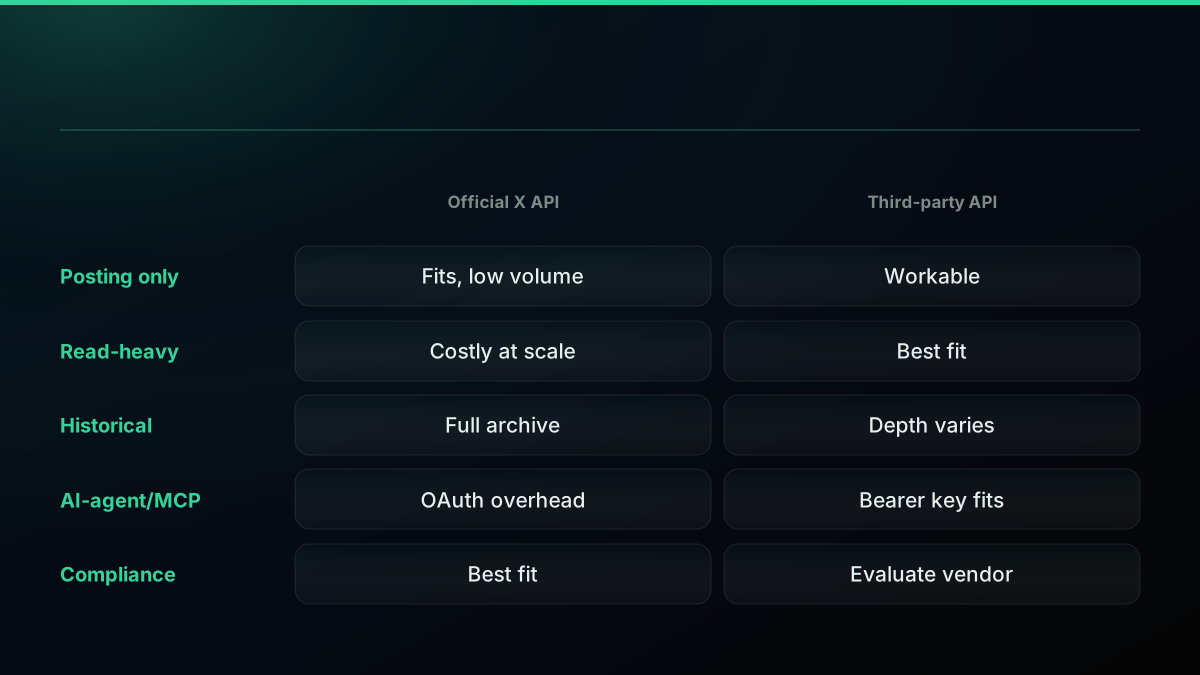
Posting-only apps that act on behalf of a single verified account you control fit the official API well; the OAuth overhead this guide modeled earlier is a one-time cost, and a low posting volume rarely approaches the pay-per-use write price in any meaningful way. Read-heavy monitoring, the most common workload in this category, is where a third-party route wins decisively on both raw price and total cost of ownership, and where the official API's 3-million-read cap turns into an operational liability rather than a comfort. Historical or full-archive research genuinely needs official-API depth in many cases, since full-archive search past the standard window is an official-only capability on most third-party providers; check a specific vendor's archive depth before assuming otherwise. AI-agent and MCP-based workflows favor a third-party Bearer key almost by default, since an autonomous agent has no natural path to a human-in-the-loop OAuth consent flow, which is exactly the gap our MCP server is built to close. Compliance-sensitive industries, regulated data handling, contractual data-provenance requirements, should default to the official API's signed compliance endpoints unless a specific third-party vendor can document an equivalent posture in writing.
The Enterprise-tier sticker shock is a common reaction among developers pricing this route, and it is also a useful gut check: if your workload is trending toward that price point on the official route, run it through the third-party true-cost model earlier in this guide before assuming Enterprise is your only option. Most workloads that look like they need Enterprise-scale official access are actually read-heavy monitoring jobs that fit the third-party route far better on every axis except first-party terms alignment.
How to Actually Get X API Credentials and Get Started
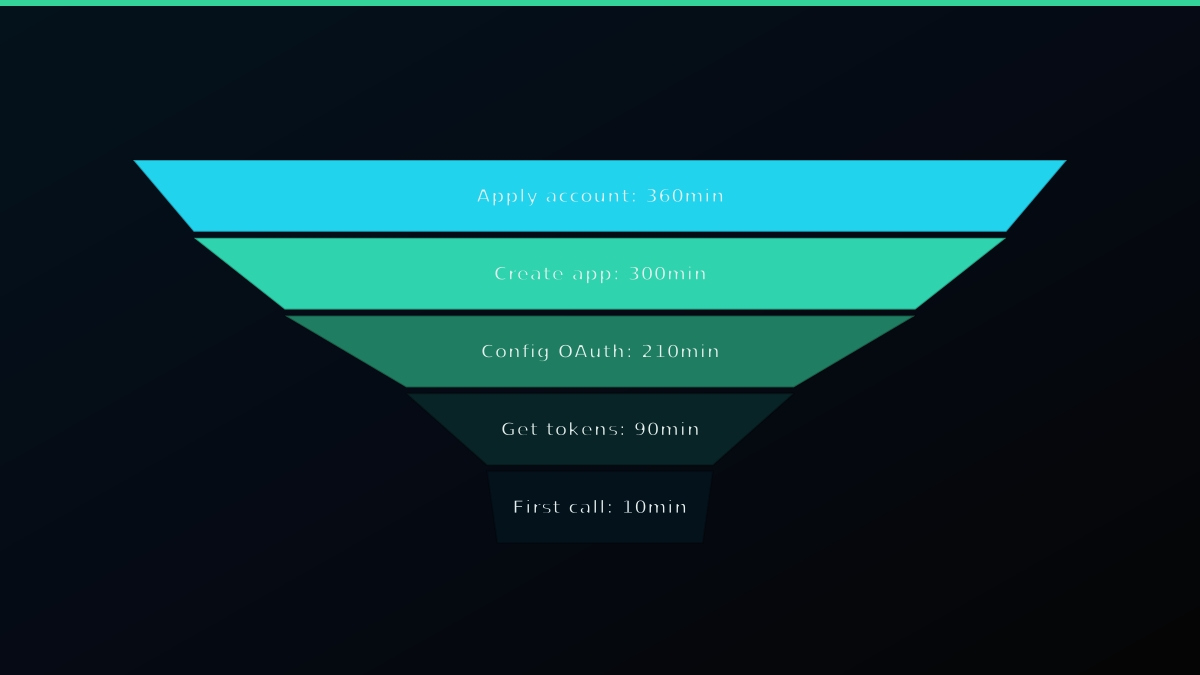
Getting official X API credentials in 2026 means applying for a developer account, describing your use case, creating a project and an app in the developer console, configuring OAuth 2.0, generating your keys and tokens, and finally loading pay-per-use credits before your first billable call goes through. Most teams report four to eight hours to get this fully production-ready, most of it in OAuth configuration and token-refresh handling rather than the API call itself.
# Official X API: step 1, obtain an app-only bearer token
curl -u "$CONSUMER_KEY:$CONSUMER_SECRET" \
  --data "grant_type=client_credentials" \
  "https://api.x.com/oauth2/token"
# Official X API: step 2, an authenticated recent-search request
curl -H "Authorization: Bearer $APP_BEARER_TOKEN" \
  "https://api.x.com/2/tweets/search/recent?query=from:nasa&max_results=100"
For a walkthrough of the full console flow with screenshots, our own how to get a Twitter API key guide covers the current 2026 steps end to end. If your goal is simply reading public data rather than acting on behalf of users, the alternative is a single signup with no application-review step:
# Managed third-party REST: no application review, one signup call
curl -X POST "https://api.twitterapis.com/v1/signup" \
  -H "Content-Type: application/json" \
  -d '{"email": "you@example.com"}'
Auth in Practice: OAuth vs a Single Bearer Header
The clearest way to feel the difference between the two routes is to read the auth code side by side, since the actual data-fetching line ends up nearly identical on both. Start with the official route's Python client, which wraps the OAuth 2.0 exchange but still requires four credentials up front:
# Official X API: a client wraps OAuth, but you still supply four credentials
import tweepy
client = tweepy.Client(
    consumer_key=CK, consumer_secret=CS,
    access_token=AT, access_token_secret=ATS,
)
tweets = client.search_recent_tweets("from:nasa", max_results=100)
For user-delegated write actions, that flow expands into the full OAuth 2.0 PKCE dance: scopes, a callback URL, and a refresh loop for a token that expires roughly every two hours. Now the managed third-party route, which replaces all of that with a single Bearer header:
# Managed third-party REST: one header, denormalized JSON back
import requests
r = requests.get(
    "https://api.twitterapis.com/twitter/tweet/advanced_search",
    headers={"Authorization": f"Bearer {API_KEY}"},
    params={"query": "from:nasa"},
)
tweets = r.json()["tweets"]
The search call itself is a wash between the two routes, a plain REST request either way once auth is handled. What differs is everything before it: an auth subsystem you build and maintain on the official route, versus a header you send on the third-party route. Both routes still need to respect rate limits with a real backoff strategy on a 429 Too Many Requests response, which is a materially smaller engineering job than defending against active anti-scraping mitigations, and it is the same backoff code regardless of which route you picked:
# Both routes: honor the rate limit with a simple backoff
import time
def call_with_backoff(fn, tries=5):
    for i in range(tries):
        resp = fn()
        if resp.status_code != 429:
            return resp
        time.sleep(2 ** i)
    raise RuntimeError("rate limited after retries")
If your workload never acts on behalf of a signed-in user, the OAuth subsystem in the first snippet is pure overhead you are paying for and getting nothing back on. Our Python tutorial and Node.js tutorial both build from the single-header pattern for exactly this reason, and our advanced search operators guide shows what the query surface looks like once auth stops being the bottleneck.
A Worked Migration: Moving a Read-Heavy Monitor Off the Official API
This guide's medium-tier row, 500,000 reads and 5,000 posts a month, maps to a common real shape: a monitoring bot that searches a set of keywords or accounts on a schedule and writes matches to a database. Here is what migrating that specific workload off the official API actually involves, step by step, priced against the numbers this guide already established.
Start by auditing your real read volume, not your rate-limit ceiling. Pull thirty days of request logs and count actual reads, since most monitoring jobs over-provision against the official API's per-endpoint windows and run at a fraction of their theoretical cap. At 500,000 reads a month the official route's raw cost is an estimated $2,575, climbing to a true cost of $2,687.50 once setup and maintenance are folded in, per the table earlier in this guide.
Next, map your endpoints one for one. A recent-search-driven monitor built on the official API's tweets/search/recent endpoint maps directly to a third-party advanced-search endpoint returning the same tweet, author, and engagement fields in a single batched call:
# Before: official API, one call, OAuth app-only bearer token
import tweepy
client = tweepy.Client(bearer_token=APP_BEARER_TOKEN)
results = client.search_recent_tweets(
    query="(\"data pipeline\" OR \"rate limit\") -is:retweet",
    max_results=100,
)

# After: managed third-party REST, one Bearer header, same query shape
import requests
r = requests.get(
    "https://api.twitterapis.com/twitter/tweet/advanced_search",
    headers={"Authorization": f"Bearer {API_KEY}"},
    params={"query": "(\"data pipeline\" OR \"rate limit\") -is:retweet"},
)
results = r.json()["tweets"]
Run both paths in parallel for a full day before cutting over, writing matches from each into separate staging tables and diffing the results. A monitoring job's correctness bar is recall, not exact duplication, so the check that matters is whether the third-party route surfaces the same tweets the official route does for your specific query shape, not whether every field name lines up byte for byte. Once the diff looks clean, point the write path at the third-party results and decommission the OAuth app-only token, its refresh job, and the backoff handler built specifically for the official API's rate windows.
At this volume tier the true-cost gap runs from $2,687.50 a month on the official route to $48.30 a month on a managed third-party route, and the migration itself, at roughly six hours of engineering time by this guide's own estimate, pays for itself inside the first billing cycle. The bigger ongoing win is what disappears from the maintenance backlog: no more token-refresh cron job, no more rate-window backoff tuning, no more watching the 3-million-read monthly cap as volume grows.
Billing, Currency, and Availability for UK, Canada, Australia, and New Zealand Developers
X operates the official API globally, and pay-per-use billing runs in US dollars regardless of where the developer account is registered. A card issued in the UK, Canada, Australia, or New Zealand pays in USD converted at your card network's rate, and it is your card issuer, not X, that applies any foreign-transaction fee on that conversion; check your specific card's terms before assuming the sticker price in this guide is the final number on your statement. Tax treatment (VAT in the UK, GST in Canada, Australia, and New Zealand) on a US-billed developer service varies by jurisdiction and by whether the buyer is a registered business, so confirm the specific treatment with your own accountant rather than assuming either route handles it identically. The same USD-denominated billing pattern is standard across API-first developer platforms generally, twitterapis.com included, so this is not a friction point unique to the official route.
Developer-console signup for the official API is available internationally, though the account-review step that gates a new developer application can take longer to clear for accounts outside the US in practice, since review capacity and fraud-screening rules are rarely distributed evenly by region on any platform running that kind of manual gate. A managed third-party route with no application-review step sidesteps that variable entirely, which matters more for a UK, Canadian, Australian, or New Zealand developer specifically when speed to a first working call is the actual priority rather than a philosophical preference for first-party access.
Support and documentation are English-first on both routes, so language is not a practical barrier for any of these four markets. Time zone is the more relevant operational detail: if you are debugging a production issue at 9 a.m. in Auckland or Sydney, official-API support windows anchored to US business hours will lag your working day more than a vendor with a documented, timezone-explicit support commitment would. Ask about support-hour coverage directly when evaluating a third-party vendor if your team is based outside North America. It rarely shows up on a pricing page, but it is a real operational cost the first time something breaks at 2 a.m. your vendor's local time and you are still waiting on a reply at the start of your own working day.
Run your own numbers before committing to a route. Price your real monthly volume against both rate cards in the cost calculator, check the endpoint-by-endpoint windows in the rate limits guide, and compare specific vendors in the API alternatives comparison if a managed third-party route fits your workload. The framework survives the next pricing change; a single memorized price point does not, and given the roughly-annual cadence this guide tracked above, there will be a next one.
// sources
Where these numbers come from
Each row is a figure in this post and the artefact it was read from. Prices and limits on this platform move, so check the date on the source before you plan against it.
- X API pricing page
- The two list rates the decision compares against a per-call provider: $0.005 per post read and $0.015 per post created under the 2026 pay-per-use model.
- X Developer Community thread on legacy Basic plans moving to pay-per-use
- The announcement the post points to for the migration off legacy subscription plans, and the reason it tells anyone still on one to budget for pay-per-use regardless of usage pattern.
- X API documentation index
- Backs the point that post creation, post lookup, recent search, and user lookup are separate billable actions, so a single logical check in a monitoring bot pays three different per-action prices.
- X rate-limit reference
- The per-endpoint rolling windows the post sets against the monthly read cap, the distinction behind its argument that the two limit models fail differently and need different guardrails.
- RFC 7636, OAuth 2.0 Proof Key for Code Exchange
- The specification for the PKCE exchange the post describes as the real cost of user-delegated write actions on the official route: scopes, a callback URL, and a refresh loop.
- RFC 6750, OAuth 2.0 Bearer token usage
- Defines the single Bearer header the post presents as the third-party route's replacement for the whole official auth subsystem in the side-by-side code comparison.
Frequently Asked Questions
The official X API is X Corp's own developer platform: pay-per-use pricing, a developer-account signup, OAuth 2.0 for user actions, and direct access under X's terms of service. Third-party Twitter APIs, including twitterapis.com, are independent services that return the same public tweet, user, and timeline data through their own infrastructure, usually with a single Bearer key, no developer-account approval, and a much lower price per record. Both reach the same underlying objects; they diverge on price, setup time, rate ceilings, and who owns the compliance risk.
No standing free tier. X ran a $500-voucher closed beta for pay-per-use in October 2025, but that voucher program was a launch promotion, not an ongoing free allowance. New developers default straight to pay-per-use pricing today. On the third-party side, twitterapis.com gives $0.50 in free credits (about 625 standard calls) at signup with no card required, which is the closest thing to a free tier currently available in this category.
X restricted its long-standing free API tier in 2023 and introduced paid Basic and Pro subscriptions, then replaced those fixed tiers with a pay-per-use model that went to closed beta in October 2025 and general availability in February 2026. Basic subscribers were auto-migrated to pay-per-use after June 1, 2026. That is four distinct pricing-model changes in roughly three years, close to once a year, which is why developers increasingly treat official-API pricing as a moving target rather than a fixed cost.
Use a third-party API for reading, searching, or monitoring public data at volume, for fast setup with no developer-account approval, and whenever cost per record and setup time matter more than first-party terms alignment. Data pipelines, research corpora, sentiment models, and monitoring bots that never act on behalf of end users fit this profile, and the official API's 3-million-read monthly cap becomes a real liability at that kind of volume.
The official pay-per-use API caps post reads at 3 million per monthly billing cycle plus per-endpoint rolling windows, and going past the cap requires an Enterprise contract rather than simply paying more per call. A managed third-party route like twitterapis.com has no fixed monthly ceiling; usage scales linearly with cost, so a large backfill or a viral spike does not hit a hard wall, only your own rate of spend.
On the official API, hitting the 3-million-read monthly cap blocks further post reads until the next billing cycle or until you move to an Enterprise contract; there is no gradual overage tier in between. On a per-call third-party route, there is no fixed cap, spend keeps scaling with usage, so the practical control is a budget alert on your own account rather than a platform-imposed wall.
As of 2026 the official X API defaults to pay-per-use: $0.005 per post read, $0.015 per post created ($0.20 if the post contains a link), and $0.001 per owned-account read since an April 20, 2026 update. Post reads are capped at 3 million per monthly billing cycle before an Enterprise contract is required. Legacy Basic ($200/month) and Pro ($5,000/month) subscriptions still cover existing subscribers, and X publishes no Enterprise price at all: past the cap you are routed to a contact form rather than a rate card.
Substantially less per record. twitterapis.com charges $0.0008 per standard call that returns roughly 20 tweets, an effective $0.04 per 1,000 tweets, versus the official API's $5.00 per 1,000 standard reads. That is roughly a 125x gap on raw price. The batching behind one call returning many tweets is the whole lever; a third-party call that looks pricier per request is usually far cheaper once you divide by the objects it returns.
Use the official X API when your app acts on behalf of signed-in users through OAuth, when you need the Ads API, when you need full-archive search older than seven days, or when a signed first-party data agreement is a hard requirement. A third-party Bearer key cannot substitute for user-delegated OAuth, and those capabilities are official-API-only regardless of price.
It depends on the provider and the sub-type. A managed API running its own structured read infrastructure is a different risk profile from a raw scraper routed through residential proxies. Third-party access sits outside X's first-party terms alignment by definition, so evaluate each vendor's stated data-sourcing method and your own organization's risk tolerance before committing a production integration to it, and prefer the official route when a signed compliance agreement is a contractual requirement.
Yes, through a managed third-party REST API priced per call rather than by subscription. twitterapis.com's standard rate is $0.0008 per call with $0.50 in free credits on signup, which covers small monitoring jobs without touching the official API's pay-per-use billing at all. It is not free at unlimited volume, but the entry cost is close to zero for a prototype or a low-volume workflow.
Pricing varies by provider and by whether you are comparing a managed REST API, a marketplace listing, or a raw scraper. twitterapis.com's standard rate is $0.04 per 1,000 tweets. For a full ranked comparison across providers including marketplace listings on RapidAPI and Apify's scraper actor, see our dedicated per-1,000-tweet cost ranking, which tracks real published rates rather than list prices.
Check out similar blogs
More guides on the Twitter/X API, scraping, and pricing.
Official X API vs Third-Party Twitter APIs: The 2026 Decision Guide
A neutral, seven-axis decision framework for choosing between the official X API and a third-party Twitter API in 2026, with a runnable decision matrix and the cases where each route genuinely wins.
Fastest Twitter API in 2026: 7 Providers Ranked by Real Response Time and Throughput
Which Twitter (X) API is actually fastest in 2026? We measured our own response time, pulled every published benchmark, and ranked 7 providers by real per-tweet latency, throughput, and the wall-clock time to finish a 100,000-tweet job.
Twitter API v2 vs TwitterAPIs: What Actually Differs in 2026
Twitter API v2 vs TwitterAPIs decoded across five real axes: unit price, access, auth, response shape, and throughput ceiling. Same data, different economics.
Twitter API Reliability, Measured: What Actually Fails Across 5.16 Million Calls
Every vendor publishes an uptime promise. Nobody publishes the failure distribution. Here is what broke across 5,155,699 production calls, by status code, by endpoint and by week.
What the Twitter Firehose Actually Was, and What You Get Instead in 2026
The firehose was a real product with a precise meaning: every public post, in realtime, unsampled. It is not what anybody sells you today. Here is what the word meant, what replaced it, and what complete coverage costs on per-call reads.
What a 1 Million Tweet Dataset Actually Costs in 2026: Every Route Priced
Ten results rank for the cost of a tweet dataset and one states a price. We fix the quantity at a million tweets and cost every route, with each number's source named.
Twitter API Cost by Workload: What Sentiment Analysis, Bot Detection and Lead Scoring Actually Bill
Every vendor publishes a per-call rate. Nobody publishes the call graph a workload needs, so the buyer cannot turn a price sheet into a monthly bill. Here are the call graphs, priced.
Twitter Competitor Analysis in 2026: Build the Dashboard or Buy Rival IQ
Nine of the ten pages ranking for this are dashboards selling you the answer. We show the calls that produce the metrics, price both sides, and find the crossover.