GUIDE
RapidAPI Twitter Alternative: Direct API vs Marketplace
Weighing a RapidAPI Twitter alternative? See how marketplace listings stack up against the official X API and TwitterAPIs on cost, uptime, billing, and switching effort.
Per our own spec, 62 of 109 endpoints bill $0.0008, 24 are free, and 23 sit between $0.0016 and $0.01. Every price ships inside our published OpenAPI document as an x-cost-usd field, so any figure in this post can be checked against the contract that bills it rather than taken on trust.

A RapidAPI Twitter integration almost always starts as the path of least resistance. X's developer portal looks heavy, the marketplace listing looks light, and within five minutes you have a key that returns tweets. The trouble shows up later, and it shows up in threes: a listing that stops responding for most of a week, an invoice that doubles between billing cycles, a JSON field that quietly renames itself in the middle of a sprint. After the second or third time, the framing flips. You stop asking which marketplace listing to pick and start asking what a sane RapidAPI Twitter alternative looks like once real traffic depends on it.
That second question is the one this guide is built around. It walks through what the RapidAPI marketplace is actually doing under the hood for X data, the cases where it earns its keep, the cases where it quietly costs you, and how the math changes when you call a direct endpoint such as TwitterAPIs instead. None of this is an attack on RapidAPI. It is a genuinely useful product and the marketplace removes real onboarding friction. The claim is narrower than that: once a workload is in production, the marketplace tier sits between you and the data as a layer of risk you are free to take out.
TL;DR: RapidAPI is a marketplace that stacks its own cut on top of each publisher's X listing, so listed reads usually land in an estimated $0.10 to $0.50 per 1,000 range (sampled from live RapidAPI listing pages, June 2026) and the same publisher is frequently cheaper on their own domain. A direct endpoint like TwitterAPIs at $0.0008 a call, about $0.04 per 1,000 tweets on a full 20-tweet page per its published rate card, drops both the marketplace cut and the dark-listing plus schema-drift exposure, which is why teams tend to leave the marketplace the first time a listing goes quiet or a bill jumps.
Want the full field of X API options rather than just RapidAPI? The Twitter API alternatives page sets every option side by side, the best Twitter API for scraping ranks the providers built specifically for data pulls, and the Apify vs TwitterAPIs comparison covers the actor-marketplace path that sits alongside RapidAPI. This post stays narrow on one comparison: the marketplace layer versus a direct endpoint.
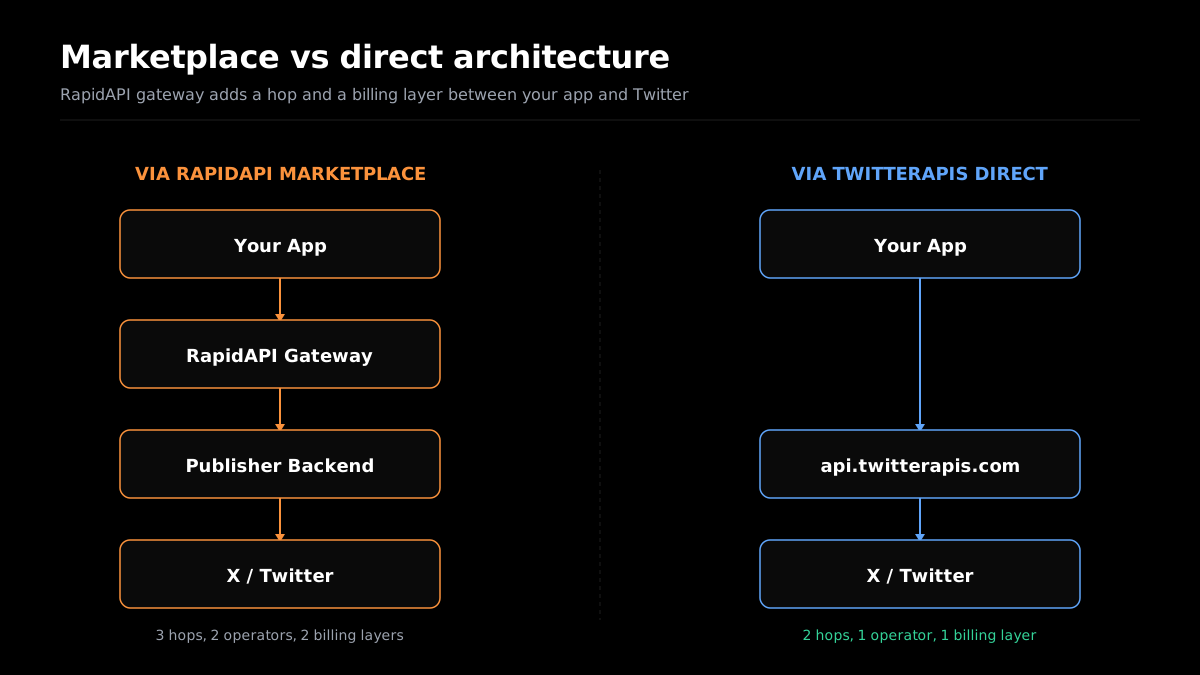
The Marketplace Model In Plain Terms
Strip away the branding and RapidAPI is a reseller for APIs. Independent developers (the marketplace calls them publishers) put their APIs up for sale; you register once, browse the catalog, pick a plan, and route your calls through RapidAPI's shared auth layer. RapidAPI bills you, skims its cut, and forwards the rest to the publisher.
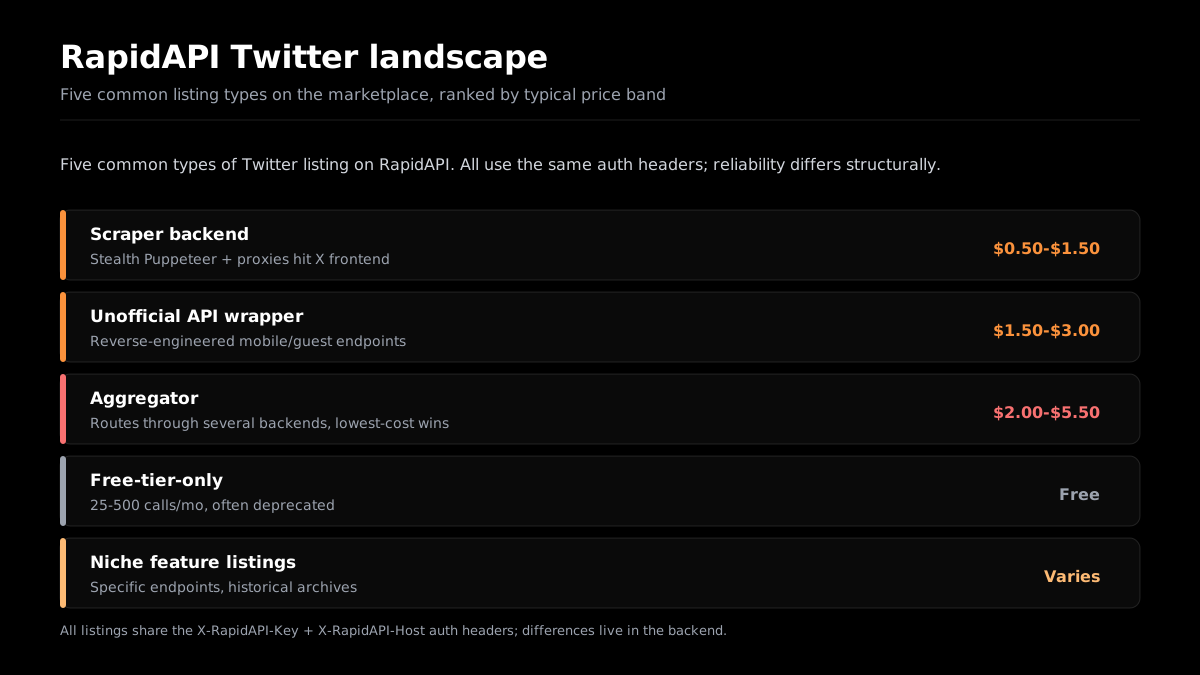
Narrow the lens to X and Twitter data and the catalog mostly sorts into three shapes:
- Browser-farm scrapers. The publisher runs a pool of stealth headless browsers (Puppeteer, Playwright, or Selenium behind rotating proxies) that load the X web app and harvest the rendered data. The listing wraps that pipeline in a tidy REST surface. The guide to scraping tweets walks through what this category does under the hood, and the residential proxy guide covers the proxy layer these scrapers lean on.
- Internal-endpoint wrappers. The publisher reverse-engineers the guest or mobile endpoints X uses behind the scenes, then bolts on auth, retries, and pagination. The listing exposes those repackaged endpoints through RapidAPI.
- Backend aggregators. The publisher fans each request across several sources (their own scrapers, other third-party APIs, archived corpora) and returns whichever answers first or cheapest.
Every one of these sits behind the same https://rapidapi.com/... URL convention and the same X-RapidAPI-Key and X-RapidAPI-Host header pair. To your HTTP client they are indistinguishable. To your error budget and your finance spreadsheet they are anything but.
Three Ways To Pull X Data
Anyone reading X or Twitter data in 2026 is really choosing between three lanes. The clearest mental model is to line up the reseller layer (RapidAPI) against the source itself (the official X API) against a single-purpose direct endpoint (TwitterAPIs), and read across the rows.
| Dimension | RapidAPI marketplace listings | Official X API v2 | TwitterAPIs |
|---|---|---|---|
| Who runs it | A third-party publisher | X (xAI) | The TwitterAPIs team |
| Auth | X-RapidAPI-Key + X-RapidAPI-Host pair | OAuth 2.0 PKCE or Bearer | One Bearer header |
| Time to first call | About 5 minutes | Days to weeks (account approval) | Under 5 minutes |
| Free allowance | Listing-dependent (often 25 to 500 calls/month) | None on public v2 since Feb 2023 | $0.50 credit, no card |
| Read pricing | $0.15 to $5.50 per 1,000 results, varies by listing | About $5.00 per 1,000 standard reads | $0.04 per 1,000 tweets |
| Price visibility | Shown on the listing, marketplace cut folded in | Shown in the Developer Console | Shown on the pricing page |
| Volume ceiling | Per-tier cap (often 100K to 1M/month) | 3M post reads/cycle, then Enterprise | None, you pay per call |
| Pager owner | The publisher | X infrastructure | The TwitterAPIs team |
| Coverage | A few listings span several social platforms | X only | X only |
| Schema stability | Varies, can shift with publisher updates | Stable v2 contract | Stable, flat JSON |
| Endpoint count | Listing-defined, reads only as a rule | Read plus OAuth writes | 65 read + 44 write = 99 total |
Each of those rows turns into a real decision the night something breaks at 3 AM. The marketplace is genuinely the quickest to wire up, but the operating model underneath it changes the moment paying customers sit downstream of your calls.
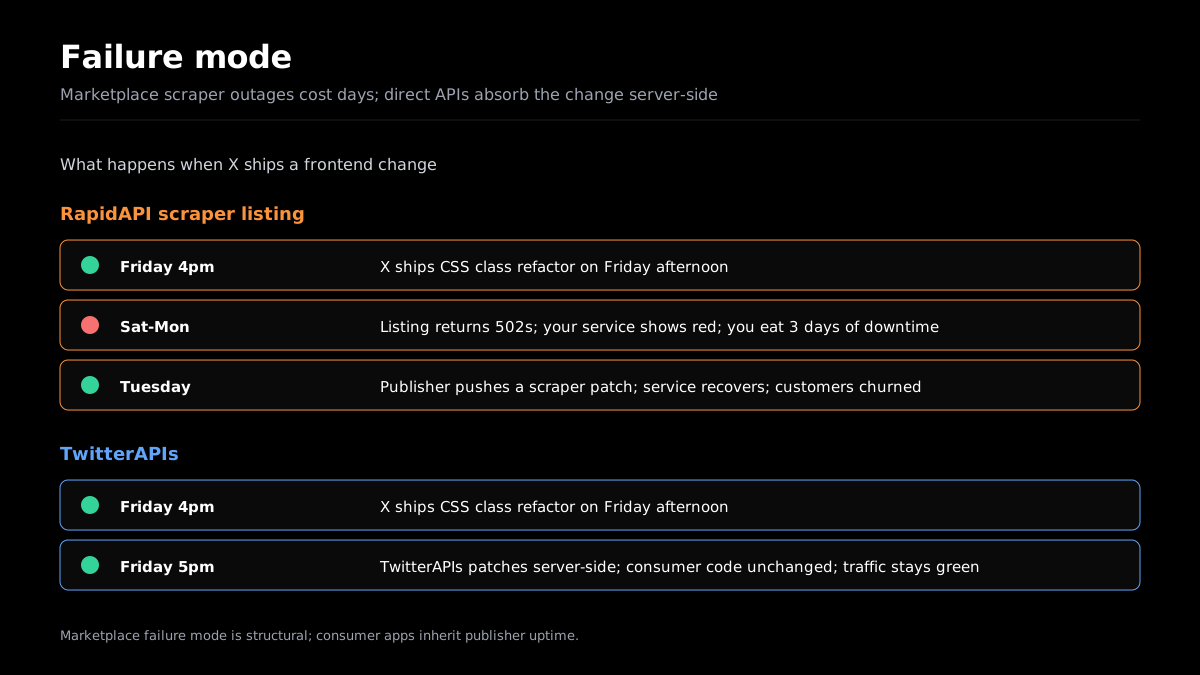
Where the routes diverge most sharply is the failure path. The cleanest way to see it is to imagine X shipping a frontend change late on a Friday, and notice that your choice of lane is what decides whether your weekend stays quiet.
The Price Gap, With Real Numbers
Cost is the easiest dimension to pin down, so it is worth doing first. The figures below pull from live RapidAPI listing pages read in June 2026, the X API pricing reference that X maintains, and the TwitterAPIs published rate card. Where a number moves around (marketplace listings reprice often), the live link is included so you can check it yourself.
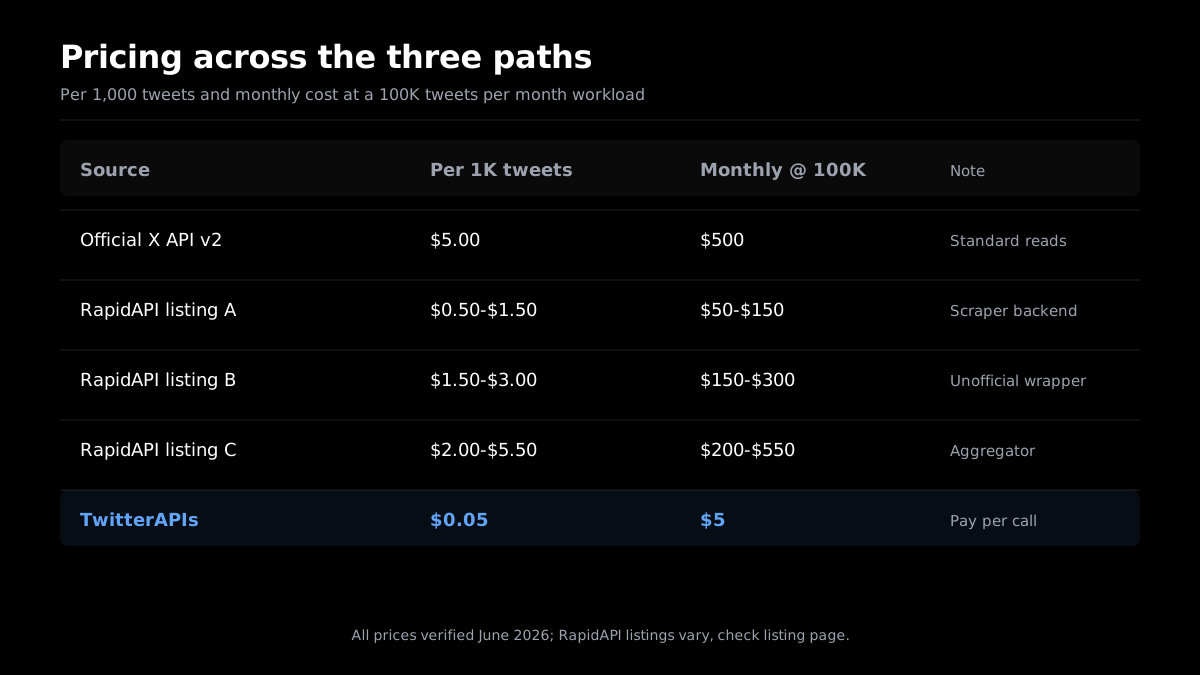
Cost Per 1,000 Tweets
| Source | Per 1,000 tweets | Notes |
|---|---|---|
| Official X API v2 (standard reads) | About $5.00 | $0.005 per post read pay-as-you-go; confirm in the Developer Console |
| RapidAPI listing A (popular scraper) | $0.50 to $1.50 | Tiered by monthly call volume; check the listing |
| RapidAPI listing B (internal-endpoint wrapper) | $1.50 to $3.00 | Per-call billing plus a result counter |
| RapidAPI listing C (aggregator) | $2.00 to $5.50 | Pricier because it pays several backends |
| TwitterAPIs | $0.04 | $0.0008 per call at ~20 tweets per call. See pricing |
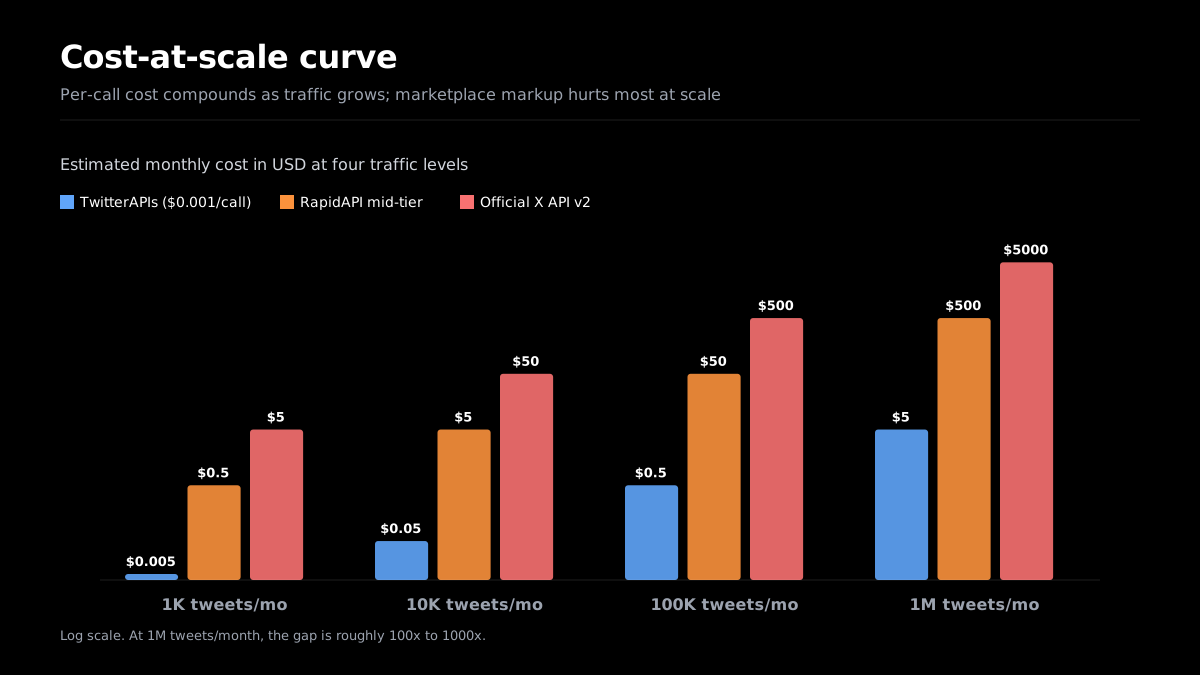
The point is not that every marketplace listing runs 10x to 100x pricier than TwitterAPIs. It is that the marketplace band is wide and unpredictable, and that the spread only gets worse as your volume climbs. For the full ranked field across providers, the cheapest Twitter API providers breakdown and the broader Twitter API cost guide both put real per-1,000-tweet numbers side by side.
The Bill At 100,000 Tweets A Month
Take a plausible mid-size load of 100,000 tweets a month (a single-brand sentiment board built along the lines of the Twitter sentiment analysis in Python walkthrough, a modest creator tracker, or a research tool) and the monthly numbers shake out like this:
| Source | Monthly cost at 100K tweets |
|---|---|
| Official X API v2 | $500 |
| RapidAPI listing A | $50 to $150 |
| RapidAPI listing B | $150 to $300 |
| RapidAPI listing C | $200 to $550 |
| TwitterAPIs | $5 |
To tie the math to your own endpoint mix (search versus profile lookup versus timeline pulls), the cost calculator returns a side-by-side estimate in seconds. Enter a monthly volume and it splits the cost out by operation. The methodology behind those figures, including how each provider's per-call billing is normalized, is documented in the Twitter API cost benchmark.
The Line Item Nobody Quotes: Failed Calls
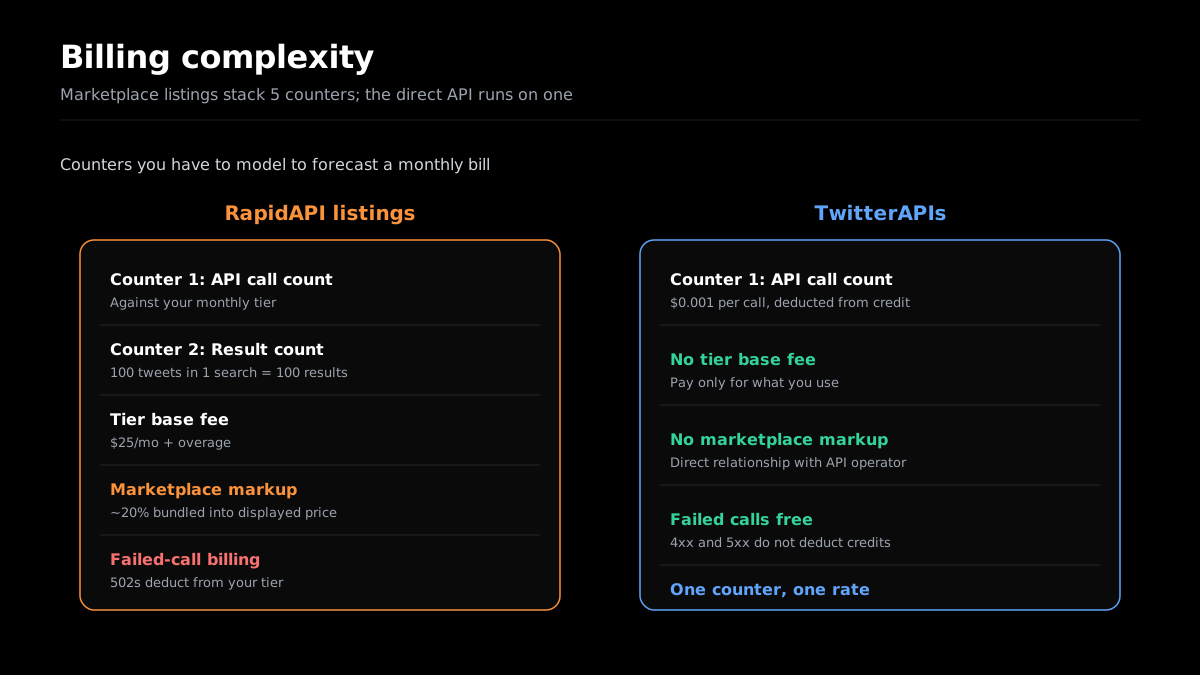
One cost that never appears on a pricing page is the cost of calls that fail. Marketplace listings generally charge against your tier whether the response came back clean or not, so a 502 from the upstream publisher still spends your allowance. At a 5 percent failure rate that is 5,000 wasted attempts on every 100,000-call month, billed in full. TwitterAPIs counts only successful responses; a 4xx or 5xx does not draw down your credit balance.
Five Structural Cracks
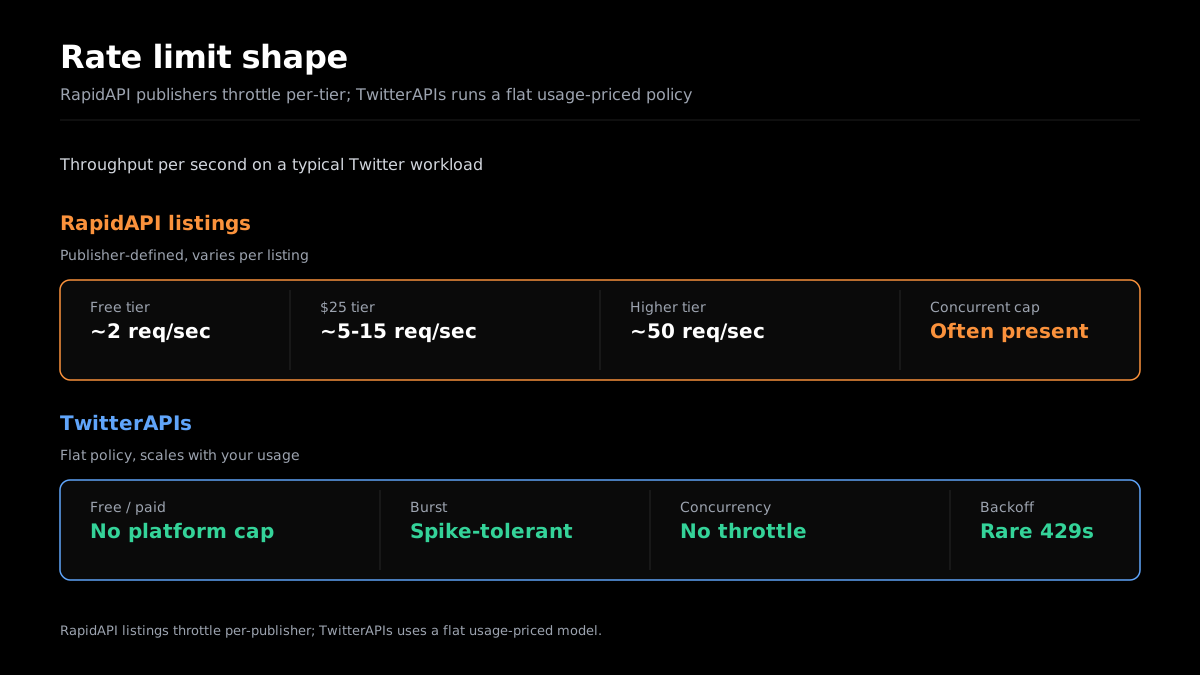
The five production risks the marketplace introduces are all properties of the model itself, not flaws in one unlucky listing: reliability you inherit from a publisher with no SLA (multi-day outages after an X frontend change are routine), a two-layer bill with a roughly 20 percent marketplace cut folded over the publisher rate, unversioned schema drift when a publisher reshapes a response without warning, per-listing rate caps usually buried in a docs tab, and zero room to negotiate as you scale. None of the five is visible at signup.
Crack 1: Uptime You Did Not Choose
Every listing is run by someone else, and RapidAPI's status page covers the marketplace platform, not the listings riding on it. When a scraper listing goes dark for three days because X shipped a frontend change and the publisher is unreachable, RapidAPI stays green while your error budget bleeds red.
Here is how it tends to play out. A scraper breaks Friday afternoon when X refactors a CSS class. The publisher's issue tracker fills up over the weekend. A fix lands Tuesday. The whole time, your service returned 502s, your customers churned, the marketplace billed for the failed attempts, and by Wednesday the listing is green again with a one-line changelog note. This is not a hypothetical; it recurs two to four times a year on the most popular X scraper listings, visible in marketplace reviews and mirrored issue trackers. It is a property of the arrangement, not a knock against any single publisher.
Crack 2: A Bill With Two Floors
Every marketplace call pays two parties: the publisher and RapidAPI's cut. Both land on your invoice, but they rarely surface separately at the listing level. The recurring patterns:
- Tiered plans. A listing might quote approximately $25 per month for 10,000 calls, with a RapidAPI overage rate of $0.005 per call above that. The $25 already blends publisher revenue with the marketplace fee, and the overage rate usually steps up once you blow past the tier.
- Per-result with a marketplace markup. A listing might show approximately $0.20 per 1,000 results. The marketplace fee (commonly about 20 percent of publisher revenue) is baked in, so the publisher's own number is closer to $0.16 while the marketplace shows $0.20.
- Two counters at once. Several X listings bill per call and per result. A search returning 100 tweets costs one call against your tier plus 100 results against a separate meter. Two meters on one request makes a monthly forecast a guessing game.
Net result: forecasting marketplace spend means reading each listing's fine print and then modeling two counters in a spreadsheet. A direct endpoint collapses that to one meter (calls) at one rate.
Crack 3: Schema Changes With No Version Tag
The official X API ships a stable v2 contract. TwitterAPIs keeps its endpoint reference at docs.twitterapis.com and announces changes ahead of time. Marketplace listings share no versioning convention at all. A publisher can rename fields, drop them, or rework pagination with no marketplace-level changelog, and you find out when a deploy fails or your warehouse rejects a row because a JSON column changed type. The defense is to pin your code against a captured snapshot of each listing's response and run weekly integration tests against it, which is real engineering effort the marketplace tier quietly hands you.
Crack 4: Rate Limits Set By Someone Else
Each listing carries its own throttle, and it usually lives in the listing's docs tab rather than its pricing tab. Common shapes:
- A hard ceiling of 5 requests per second per consumer
- 100 requests per minute on free, 1,000 per minute on the paid tier
- Concurrency caps that strangle parallel scraping jobs
For context on how the source itself throttles, X documents its own ceilings in the X API rate-limit reference, and the per-listing caps above sit independently on top of that.
RapidAPI exposes some of this in the API console, but not uniformly across listings. Tripping an undocumented limit at 11 PM during a traffic spike, with the publisher's inbox unwatched until Monday, is a familiar story. The Twitter API rate limit guide lays out how the various ceilings stack so you can design headroom in rather than discovering it during an incident.
Crack 5: No Seat At The Pricing Table
Marketplace pricing is the publisher's to set and is not open to negotiation for consumers. Grow to the point where a custom rate would make sense and there is no number to call; you either stay on the published tier or leave the marketplace entirely. Direct endpoints (TwitterAPIs included) open a volume conversation once you cross a usage threshold, and it happens in one channel because there is no intermediary to route around.
For early experiments these five are survivable. For production traffic with paying customers behind it, each one compounds into recurring cost or recurring risk.
What The Marketplace Gets Right
It would be dishonest to skip the upside. RapidAPI's real strengths are consolidation, discovery, and a frictionless start. One billing relationship can cover many publishers, one dashboard shows uniform auth and usage across all of them, and most listings hand you a free tier of 25 to 500 calls a month so you can sanity-check a response shape before paying anyone. For small personal builds or teams stitching together several non-Twitter APIs under one invoice, those are real wins.
One invoice for many APIs. A team that needs X data plus weather plus FX rates can subscribe to three listings under a single RapidAPI account, with one invoice and one set of usage charts. For a small team that consolidation carries genuine operational value.
A browsable catalog. RapidAPI lists tens of thousands of APIs. If you are surveying a category, it doubles as a discovery engine: you can compare three X scrapers in one tab, skim consumer reviews, and pick one without three separate signups.
A single auth pattern. Every listing uses the same two headers, so once that pattern is wired into your HTTP client, adding another API is close to a one-line config change. During prototyping that is genuinely pleasant.
Built-in usage telemetry. RapidAPI ships per-API usage charts, call logs, and tier-utilization graphs. Publishers do not always match that depth on their own sites, so during development the marketplace dashboard can be the better observability surface.
A real trial. Most listings include a free tier of 25 to 500 calls a month, enough to validate a listing's shape and reliability before committing. That zero-friction trial is the marketplace's strongest onboarding lever.
These benefits are not in dispute. The thesis here is not that the marketplace is bad. It is that the same layer that makes onboarding smooth also carries risk you will eventually want to shed.
Who Answers The Pager
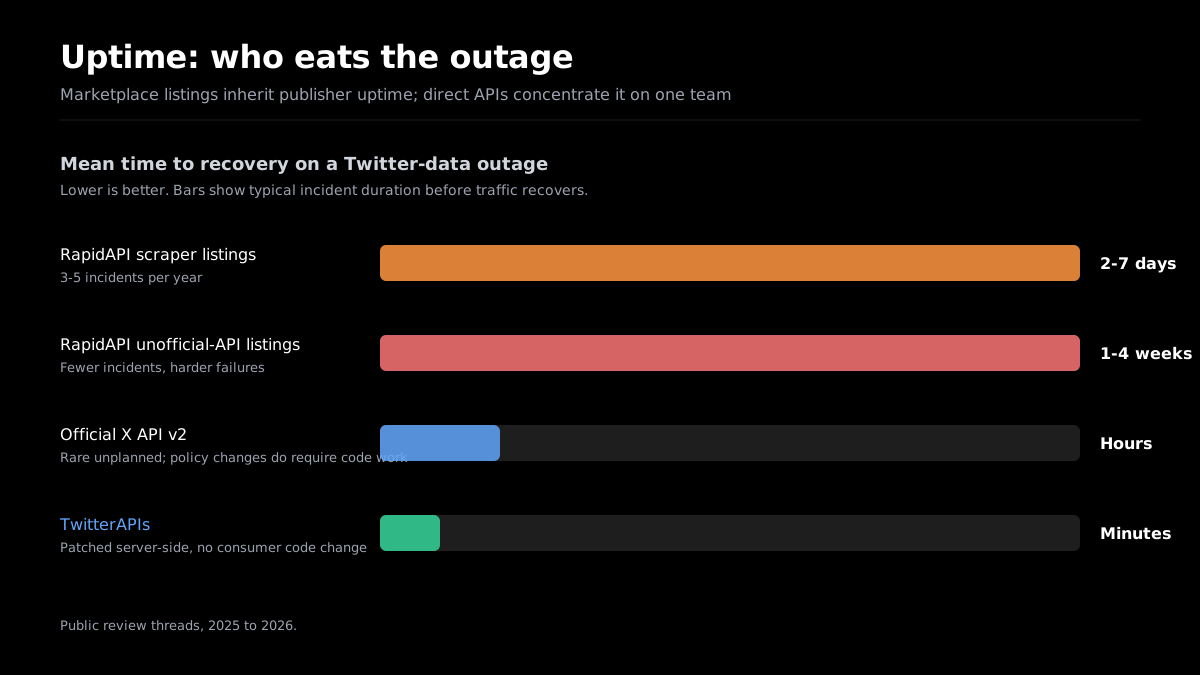
Pull together public review threads and marketplace consumer reports across 2025 and early 2026 and a pattern emerges. The most popular X scraper listings average three to five multi-day outages a year, recovering in two to seven days, almost always after X ships a frontend change the publisher is slow to track. Mid-tier listings built on internal-endpoint wrappers break less often but take longer to recover, often one to four weeks, when X tightens guest-session policy.
 Where to verify each of these:
- Listing review threads surface multi-day outages directly on the listing page, and RapidAPI's status page tracks the marketplace platform independently of the listings on it.
- The X API v2 has X's own status page plus the Developer Community forum for incident chatter.
- TwitterAPIs publishes uptime at
docs.twitterapis.comand runs one team responsible for both endpoint upkeep and the infrastructure under it.
The recurring shape across 2025 and early 2026, drawn from public threads:
- Popular X scraper listings: three to five multi-day outages a year, usually after an X frontend change, with recovery in two to seven days.
- Mid-tier listings (internal-endpoint wrappers): fewer outages, but harder ones when X tightens guest sessions, with recovery in one to four weeks.
- Official X API v2: outages are rare, but scheduled policy moves (the February 2023 free-tier removal, the April 20, 2026 pricing update covered in the X API pricing change breakdown) force code changes on consumers.
- TwitterAPIs: tracked uptime above 99.9 percent through 2026, with maintenance owned by one team that ships patches server-side and asks nothing of your code.
Developer forums keep this conversation live in real time. Threads on r/webdev, r/SaaS, and r/learnpython regularly surface multi-day outages on X listings, with developers swapping failover tactics and posting write-ups of their moves to direct endpoints. The arc repeats: pick the marketplace for speed, eat a multi-day outage on a popular listing, rotate to another listing or jump to a direct endpoint. Most teams loop through that two or three times before settling on a direct integration.
Two write-ups capture that arc cleanly. The first is a r/webdev developer who hit the same expensive-data wall and rebuilt around a cheaper direct pull, which is the exact marketplace-to-direct move modeled throughout this guide:
X / Twitter data is too expensive, so I fixed it
The second comes out of the n8n automation community, where a developer open-sourced a tweet-posting setup that routes around the official X API entirely, the same failover instinct that pushes teams off a single marketplace listing once it goes quiet:
Open-sourced the setup we use to post tweets without paying for X's API
The whole conversation traces back to February 2023, when X removed its long-standing free tier (the X API overview still frames the access tiers that replaced it). Teams that had been calling the official endpoint for nothing suddenly had to either pay $5 per 1,000 tweets on the new paid plan or go to the marketplace, and RapidAPI absorbed a big slice of that displaced traffic because its pay-per-call options sat under $1 per 1,000 results. The question of whether any free path survives at all is covered in is the Twitter API free in 2026. The announcement came from @XDevelopers, and it is the single event that pushed all of that traffic toward marketplace listings:
https://twitter.com/XDevelopers/status/1621026986784337922
About six weeks later, in March 2023, @XDevelopers launched the paid access tiers that every direct-versus-marketplace comparison since has had to size itself against:
https://twitter.com/XDevelopers/status/1641222782594990080
For a walkthrough of that same pricing shift and the mechanics of moving off the official API to something cheaper, this Build In Public review covers the practical side:
https://www.youtube.com/watch?v=1H0Ci11p-6I
And a separate CodeRevolution TV breakdown of the new paid tiers, closer to the per-call math, the migration routes teams take afterward, and what moving from free access to the $100-a-month entry plan actually cost developers at the time:
https://www.youtube.com/watch?v=67ya4PWE9i4
Both videos land on the same tradeoff this guide unpacks: once failure-mode cost is in the model, the marketplace is rarely the cheapest lane.
Switching In An Afternoon
Moving from a RapidAPI X listing to TwitterAPIs is an under-one-hour job in four moves: register at /signup for a key and $0.50 in free credits, trade the two X-RapidAPI-* headers for a single Authorization: Bearer header and repoint the base URL to api.twitterapis.com, remap the response parser to the new JSON shape, then run 48 hours of dual-write tests before flipping over and cancelling the old plan.
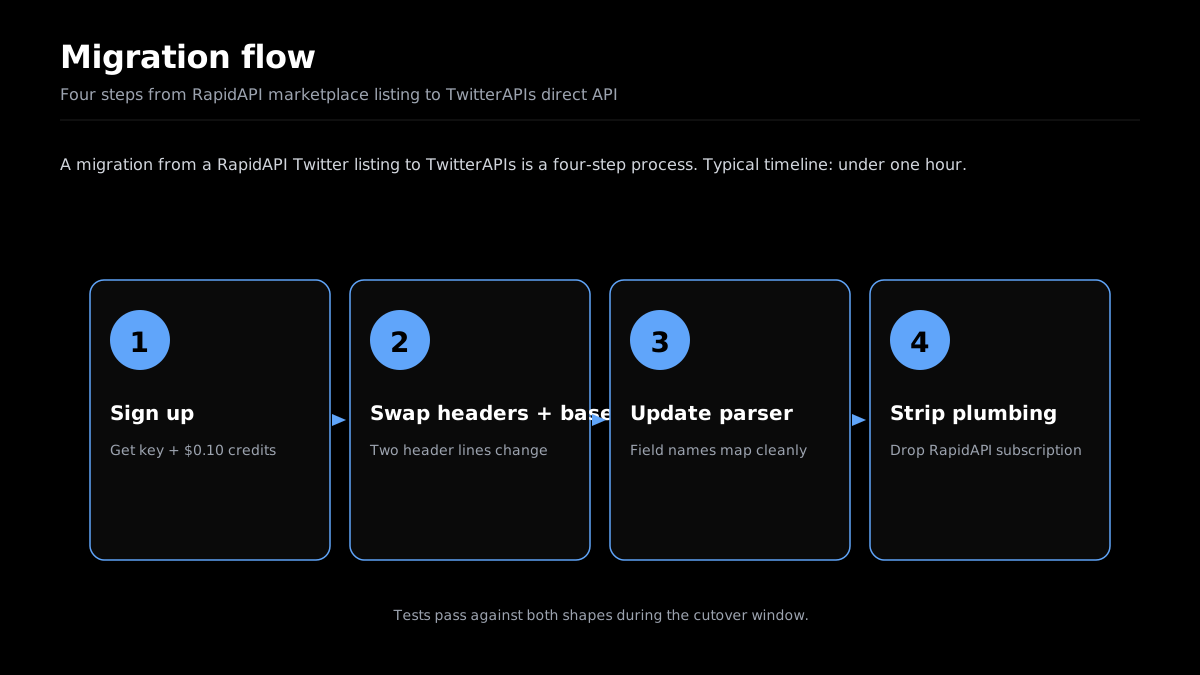
Move 1: Register And Grab The Key
Open the signup page. You get $0.50 in credits (about 12,500 tweets, or roughly 625 calls) with no credit card attached. Copy the key out of the dashboard. If you are coming straight from the official portal, the how to get a Twitter API key walkthrough contrasts the two onboarding paths step by step.
Move 2: Repoint The URL And Swap The Header
What you start with on RapidAPI:
const response = await fetch(
  "https://twitter-api45.p.rapidapi.com/search.php?query=ai+agents&search_type=Latest",
  {
    headers: {
      "X-RapidAPI-Key": process.env.RAPIDAPI_KEY,
      "X-RapidAPI-Host": "twitter-api45.p.rapidapi.com",
    },
  }
);
const payload = await response.json();
const posts = payload.timeline;
What it becomes on TwitterAPIs:
const response = await fetch(
  "https://api.twitterapis.com/twitter/tweet/advanced_search?query=ai+agents&product=Latest",
  {
    headers: { Authorization: `Bearer ${process.env.TWITTERAPIS_KEY}` },
  }
);
const payload = await response.json();
const posts = payload.tweets;
Three edits in total: the host header drops away, the auth header changes, and one query parameter renames itself (product in place of search_type). The fetch pattern around them is untouched.
The Python edit is equally small. Starting point on RapidAPI:
import os
import requests

endpoint = "https://twitter-api45.p.rapidapi.com/search.php"
headers = {
    "X-RapidAPI-Key": os.environ["RAPIDAPI_KEY"],
    "X-RapidAPI-Host": "twitter-api45.p.rapidapi.com",
}
query = {"query": "ai agents", "search_type": "Latest"}
resp = requests.get(endpoint, headers=headers, params=query, timeout=15)
posts = resp.json()["timeline"]
Same logic on TwitterAPIs:
import os
import requests

endpoint = "https://api.twitterapis.com/twitter/tweet/advanced_search"
headers = {"Authorization": f"Bearer {os.environ['TWITTERAPIS_KEY']}"}
query = {"query": "ai agents", "product": "Latest"}
resp = requests.get(endpoint, headers=headers, params=query, timeout=15)
posts = resp.json()["tweets"]
If you would rather smoke-test with raw curl before touching any application code:
curl -s "https://api.twitterapis.com/twitter/tweet/advanced_search?query=ai+agents&product=Latest" \
  -H "Authorization: Bearer $TWITTERAPIS_KEY" | jq '.tweets | length'
A healthy call prints a positive integer (the number of tweets on the page). A null or 0 usually means a query-string encoding slip; an HTTP error carries the reason in a JSON error field on the body.
Move 3: Remap The Parser
Marketplace listings differ, but a frequent shape is a normalized payload with the timeline sitting under one top-level array. TwitterAPIs returns a flat payload where each tweet carries its author inline.
| Field | Typical RapidAPI listing | TwitterAPIs |
|---|---|---|
| Tweet text | tweets[].text or timeline[].full_text | tweets[].text |
| Author handle | tweets[].user.screen_name | tweets[].author.username |
| Author followers | not always present | tweets[].author.followers_count (inline) |
| Likes | tweets[].favorite_count | tweets[].favorite_count |
| Retweets | tweets[].retweet_count | tweets[].retweet_count |
| Pagination | next_cursor or listing-specific | next_cursor |
Pagination behaves much the same: cursor in, cursor out, keep following until it comes back null. Most teams write one small mapping function from the marketplace shape into their internal tweet model, then point that same function at the TwitterAPIs shape during the switch, so tests pass against both shapes through the cutover window.
A minimal mapper in JavaScript:
function toTweet(raw, provider) {
  if (provider === "rapidapi") {
    return {
      id: raw.id_str || raw.id,
      body: raw.text || raw.full_text,
      handle: raw.user?.screen_name,
      likes: raw.favorite_count ?? 0,
      reposts: raw.retweet_count ?? 0,
    };
  }
  // TwitterAPIs flat shape
  return {
    id: raw.id,
    body: raw.text,
    handle: raw.author?.username,
    likes: raw.favorite_count ?? 0,
    reposts: raw.retweet_count ?? 0,
  };
}
With that one function in place, the rest of your code calls toTweet(raw, "twitterapis") and never reaches for a provider-specific field again.
Move 4: Pull Out The Marketplace Plumbing
Once you have cut over, delete the marketplace account headers, the listing-specific retry logic, and any code that papered over a listing's quirks (deduplication, schema patching, polling for async results where the listing did that). Clean out the environment too: drop RAPIDAPI_KEY and RAPIDAPI_HOST. Cancel the subscription once TwitterAPIs is steady in production.
A Note On Aggregator Listings
If you were on a RapidAPI aggregator (the kind that fans out to several backends), the switch also untangles your observability. With the aggregator, an error could have come from any of several upstreams and the listing did not always tell you which. With TwitterAPIs, errors come from one place and follow plain HTTP semantics: 200 is success, 429 is rate-limited (rare here), 4xx is your request, 5xx is the endpoint. Ordinary error handling applies.
For a longer Python walkthrough of these mechanics on async batch jobs, see the Python Twitter API tutorial. If your stack is JavaScript rather than Python, the Twitter API Node.js tutorial ships the same patterns for the Node runtime. For the equivalent move off the twitterapi.io competitor, see the migration guide.
When Staying On RapidAPI Is The Smart Move
Four situations where keeping the marketplace is the right call: multi-platform products consolidating X, LinkedIn, and several other data sources under one invoice (the consolidation pays for the markup); very low volume hobby projects where a free tier beats any paid plan; a niche need where one specific listing exposes a historical archive or capability a direct endpoint has not matched; and procurement rules where finance only approves marketplace vendors.
Many platforms, one invoice. If your product pulls X plus LinkedIn plus Reddit plus weather plus FX, and folding five vendors into one marketplace beats running five billing relationships, the consolidation has real value. The premium you pay is the price of that consolidation.
Tiny volume. Call X data 500 times a month for a side project and the gap between TwitterAPIs (about $0.40 a month) and a marketplace free tier ($0 if you fit inside it) simply does not matter. Pick whatever is faster to set up, which is often the free tier.
A listing-only capability. A handful of X listings expose features a direct endpoint has not built yet. If your use case leans on one of those (some listings, for example, stitch together a historical archive), staying put is the pragmatic move until a direct provider catches up.
Procurement constraints. Some larger companies have a workflow that clears marketplace vendors but not direct ones. If finance requires you to buy through a marketplace, that is a constraint upstream of any engineering preference, and the marketplace is a legitimate answer inside it.
For everything else (production pipelines, live dashboards, customer-facing analytics, anything where downtime costs revenue), a direct endpoint takes out a layer of risk the marketplace adds.
Start building with TwitterAPIs
$0.0008 a call, about $0.04 per 1,000 tweets at 20 tweets a page. $0.50 free credits. No credit card required.
Traps That Stretch A One-Hour Job Into A One-Day Job
Teams moving from a RapidAPI X listing to TwitterAPIs hit a short list of avoidable snags. None is a blocker, but each can add a day if you miss it.
Trap 1: Leaving the old subscription running forever. The defensive instinct is to keep the old integration alive while the new one settles. For the first 48 hours that is correct. Past that, paying two bills eats the savings the move was meant to bank. Set a reminder to cancel the RapidAPI plan seven days after cutover, and actually cancel it on day seven.
Trap 2: Carrying over the wrong retry logic. Marketplace listings often return a generic 4xx when the upstream scraper is degraded, which is hard to tell apart from a genuine request error, so teams write retry loops that retry every 4xx. TwitterAPIs uses standard status codes: 429 is rate-limited (rare), 4xx is your request, 5xx is worth retrying. Tighten the loop to retry only 5xx and 429:
def fetch_with_backoff(endpoint, headers, query, attempts=3):
    import time, requests
    for n in range(attempts):
        r = requests.get(endpoint, headers=headers, params=query, timeout=15)
        if r.status_code < 400:
            return r.json()
        if r.status_code in (429, 500, 502, 503, 504):
            time.sleep(2 ** n)
            continue
        # any other 4xx is a caller error, so fail fast
        r.raise_for_status()
    raise RuntimeError(f"gave up after {attempts} attempts")
Anything outside {429, 5xx} raises immediately, so a malformed query fails loudly instead of quietly eating the retry budget.
Trap 3: Underrating the pagination differences. Listings paginate every which way: a cursor here, a since_id there, offset-and-limit somewhere else. TwitterAPIs uses one cursor pattern across endpoints. When you move, test pagination across the full range, not just page one.
Trap 4: Forgetting to drop the throttle code. If your old listing capped you at 5 requests per second, your code almost certainly has a sleep loop. TwitterAPIs sets one flat ceiling of 600 requests a minute per key, so a sleep loop tuned to 5 requests per second is far tighter than it needs to be. Retune it to the real ceiling during the move.
Trap 5: Treating a direct endpoint like a marketplace listing. Listings rotate as publishers churn and reprice. TwitterAPIs is a direct endpoint with a stable contract, so you do not need to architect around a provider that might vanish next quarter. Build for one provider, not for a revolving door.
For a baseline on the official X API v2 endpoints (auth model, request shapes, cap structure), the X developer pricing reference is the source of truth. With the official baseline in mind, the marketplace listings and the TwitterAPIs direct option are both easier to size against the same requirements.
What Changes After You Cut Over
Teams that have left RapidAPI X listings for a direct endpoint report four fairly consistent shifts: recovery from an X upstream incident drops from days to minutes because patches land server-side without any code change on your end; the monthly bill becomes forecastable on one counter at one rate; engineering time spent babysitting the integration falls because the "publisher pushed a breaking change" failure mode is gone; and a volume-pricing conversation opens up once monthly tweet counts cross 1M.
- Recovery shrinks to minutes. Because TwitterAPIs maintains endpoint health server-side, an X change is patched without touching your code. There is no "wait for the publisher to repair their scraper" window.
- The bill becomes predictable. One counter (calls), one rate ($0.0008), one relationship. The spreadsheet gets shorter.
- Maintenance hours drop. No more weekend tickets about the X scraper throwing 502s again, so the on-call rotation gets quieter.
- Leverage appears at scale. Cross 1M tweets a month and the TwitterAPIs team will talk volume rates, with no marketplace cut to carve around and no publisher relationship to triangulate.
None of that is "TwitterAPIs is magic." It is the ordinary consequence of pulling a reseller layer out of a production pipeline; any direct endpoint run with similar discipline would deliver much the same. TwitterAPIs simply happens to be the cheapest pay-as-you-go direct option for X data in 2026, which is why it keeps surfacing at the top of RapidAPI alternative searches.
For teams running write workloads, TwitterAPIs covers 44 write actions (like and unlike, retweet and unretweet, bookmark and unbookmark, follow and unfollow, delete, tweet creation, media upload, and DM send) at $0.0008 per call for the simple writes, with tweet creation and DM send at $0.0016. If those writes are the core of your build, the how to build a Twitter bot in 2026 guide ties them together end to end, and the export Twitter followers via API walkthrough covers the follower-graph reads many bots pair with them. Those write calls take a bring-your-own auth_token and ct0 per request, which the endpoint uses to act on behalf of the account and never stores. DM sending is covered too, at $0.0016 per call under the same bring-your-own credentials, so DM-related work stays inside this endpoint set. For teams that need to pair TwitterAPIs with the official X API for specific OAuth or compliance flows (the X OAuth 2.0 reference documents that user-delegated model), the X API v2 comparison covers when each is the right tool.
The community conversation around RapidAPI alternatives has stayed busy on X through 2025 and 2026. Developer threads keep circling the same questions: what does the response shape look like, what are the rate limits, what does it cost at a specific volume, and do write actions exist. Those answers are folded into the TwitterAPIs best practices guide so a new account starts on the right defaults instead of a back-and-forth thread.
RapidAPI Alternatives: The 12-Provider Comparison
Most of this post argues one specific swap, a marketplace listing for a direct Twitter API. That is the right answer for a Twitter workload, but "RapidAPI alternative" is a broader search than that, and people arrive here holding a shortlist assembled from generic marketplace-alternative lists. This section is the wider field, sorted by what each option is actually for, so you can cross off the ones that cannot help before you evaluate them.
| # | Option | What it is | Carries Twitter/X data? |
|---|---|---|---|
| 1 | API Direct | Buy from the API's own vendor, no intermediary | Yes, if the vendor serves it |
| 2 | Official X API | First-party X endpoints | Yes, at first-party prices |
| 3 | Dedicated Twitter API vendors | Purpose-built X data providers | Yes |
| 4 | AWS Data Exchange for APIs | Data products billed through AWS | No X data product |
| 5 | Azure API Center and marketplace | Microsoft's API catalog and billing | Not for X data |
| 6 | Google Cloud Apigee | Enterprise API gateway and management | It is a gateway, not a source |
| 7 | Postman API Network | Discovery and testing, not resale | No, discovery only |
| 8 | APILayer | First-party API portfolio | No X product |
| 9 | Apideck (Unified APIs) | One normalized API across a SaaS category | No, business SaaS only |
| 10 | Kong or Tyk (self-hosted gateway) | You run the gateway yourself | You still need a source |
| 11 | Managed scraping platforms | Apify, Bright Data and similar | Yes, at batch latency |
| 12 | Self-hosted scraper | Your own collector | Yes, and you maintain it |
The table's last column is the one that does the work. Seven of the twelve cannot answer a Twitter data question at all, and they appear on generic alternative lists because those lists are about leaving RapidAPI rather than about getting tweets. Three of them are worth a closer look before you cross them off, because they are the ones people most often waste an afternoon evaluating, and each gets its own section below.
API Direct
Buying straight from the vendor is the option this whole post argues for, and it is worth naming as a strategy rather than as a single vendor. Instead of buying a listing on a marketplace, you buy from the company that operates the API, which means the price, the schema, the uptime and the support escalation all belong to one party you can reach.
What you give up is real. You lose the marketplace's single billing surface, so five direct vendors means five invoices and five keys. You lose the uniform auth pattern, since each vendor picks its own header. And you lose the discovery layer, because you now have to find vendors rather than browse a catalog.
What you gain is the four cracks this post already walked: a price set by the operator rather than a reseller, a schema that changes with a version tag, rate limits you can negotiate, and a support path that reaches the people who can actually fix your problem. For a workload where one API dominates the bill, that trade is decisively worth it. For a workload made of ten small APIs you call occasionally, it usually is not, and staying on the marketplace is the right call.
AWS Data Exchange for APIs
This one appears on almost every marketplace-alternative list, and for Twitter data it is a dead end worth crossing off quickly.
AWS Data Exchange lets data providers publish products, including API-based products, that consumers subscribe to and call through AWS, with usage arriving on the AWS bill and access managed through IAM rather than a vendor key. If your organization already procures through AWS, that is a genuine advantage: no new vendor onboarding, no separate invoice, and access controlled by the same policies as everything else you run.
The problem for this use case is that it is a procurement channel, not a data source. What you can buy there is whatever providers have chosen to list, and social-media collection is not a category it is known for. So the realistic outcome of evaluating it for tweets is that you spend a morning in the catalog and end up buying from a Twitter vendor directly anyway. Cross it off unless your constraint is genuinely procurement rather than data, in which case it is worth asking your preferred vendor whether they can be reached through a channel your finance team already approves.
Apideck and Unified APIs
Apideck is a unified-API provider, meaning it puts one normalized interface in front of many vendors in the same category, so you integrate once and reach every CRM, or every accounting system, rather than writing one integration per vendor. That is a genuinely strong pattern and it solves a real problem, which is why it shows up on these lists.
It solves a different problem from yours. Unified APIs work because the underlying systems are interchangeable in shape: every CRM has contacts and deals, so a normalized contact object is meaningful. Twitter data has no category to unify, because there is one Twitter. A unified social API would be normalizing across platforms, not across vendors of the same platform, and that is a different product with different tradeoffs.
The practical read is that if your agent or product touches several business SaaS systems as well as Twitter, a unified API may earn its place for the SaaS half while the Twitter half goes direct. That is a normal split and not a compromise.
What Makes a Good Third-Party Twitter API?
If you are leaving a marketplace listing, the next question is what to judge its replacement on, and the criteria are not the ones a pricing page leads with. Six properties separate a provider you can build on from one you will be migrating off again in a year.
A versioned response contract. The single most expensive failure in this category is a schema that changes without notice, because it breaks parsing in production rather than at build time. Ask whether breaking changes ship behind a version, and whether there is a changelog you can subscribe to. A provider that cannot answer that question has told you the answer.
Published, per-endpoint pricing. Not a tier chart, the actual rate for the actual call you will make most often. If the rate you will pay depends on a conversation, you cannot model the bill, and you will discover the real number in an invoice.
Batch return. How many records come back per call decides your effective cost and your effective latency at the same time. A provider quoting a low per-call price that returns one record is more expensive than a higher per-call price returning twenty.
Honest failure behaviour. Two things to check: whether you are billed for failed requests, and whether a rate-limited response is distinguishable from a genuinely empty one. The second matters more than it sounds, because a provider that returns an empty array for both makes silent data loss undetectable.
A support path that reaches an engineer. The marketplace complaint in this post is fundamentally about this. When something breaks at 2am, the question is whether the person who answers can change the thing that is broken.
Endpoint coverage for the job you have, not the job you might have. Breadth is worth less than it looks. Most pipelines use three or four endpoints heavily. Check those are good rather than counting the total.
Notice what is not on that list: uptime badges, logo walls, and endpoint counts. Those are marketing surfaces, and none of them predicts whether your parser survives next quarter.
What Does Twitter/X Data Actually Cost in 2026?
Leaving a marketplace usually starts with a bill, so it is worth stating the range plainly. Reading 100,000 tweets in a month runs from a few dollars to several hundred depending entirely on who you buy from, and the marketplace tier you are on now is rarely at the good end of that range.
Three things decide where you land.
The metering unit. A per-call meter and a per-record meter can quote similar numbers and bill an order of magnitude apart, because the difference is your page size. Normalize everything to cost per 1,000 tweets before comparing anything, which is the exercise the cheapest Twitter API ranking runs across the whole field.
The reseller margin. On a marketplace listing you are paying the operator's rate plus the marketplace's cut plus whatever the seller adds. Going direct removes two of those three layers, and that is most of the saving people see when they switch.
What the sticker excludes. Failed calls you are still billed for, proxy bandwidth on scraping-based providers, and unused subscription quota are all real money that no headline rate includes. On a marketplace the failed-call question is particularly hard to answer, because the billing behaviour is the seller's choice rather than the platform's.
The practical move before you migrate anything is to work the bill backwards: take your actual monthly call volume from your current dashboard, multiply by each candidate's effective per-1,000 rate, and add a failure cushion for anything scraping-based. Most teams discover their marketplace spend is dominated by one endpoint, which is exactly the case where moving that one API direct pays for the migration in a month.
The cheapest pay-as-you-go Twitter API. Try it free.
$0.0008 a call, about $0.04 per 1,000 tweets at 20 tweets a page. $0.50 free credits. No credit card required.
Is There a Free Twitter API Alternative in 2026?
Not in the sense of ongoing free reads at any volume that matters, and it is worth being direct about that rather than listing options that expire.
X's own free tier is write-oriented. It permits a capped number of posts a month and effectively no read access, so it is a way to let a bot publish rather than a way to collect data. If your project reads tweets, it is not a starting point.
Trial credits are real but finite. Most third-party providers, including this one, include a small starting balance with no card, typically enough for several hundred calls. That is genuinely useful for evaluating a provider on your own workload before committing, and it is honest to call it a trial rather than a free tier.
Free rate-limited allowances exist and are small. Some providers permit a low request rate before billing starts, which covers exploration and integration testing. It does not cover a product.
Running your own collector is the only genuinely free-per-call option, and it is not free. The per-request price is near zero and the recurring cost is proxy bandwidth, account attrition and engineering hours. For most small teams that maintenance line exceeds the entire annual bill for reading a few million tweets through a paid endpoint, which is the calculation the Python scraping guide runs in detail.
So the honest answer for someone leaving a marketplace to save money is that free is not the target, cheap-and-predictable is. The gap between a marketplace listing and a direct rate is usually large enough to matter on its own, without needing a free tier to exist.
When the Official X API Is Still the Right Choice
This post argues for leaving an intermediary, and for one class of reader the right destination is X itself rather than another third party.
You need to write. Posting, replying, direct messages and authenticated actions on behalf of a user are first-party capabilities. If your product does any of those, you need an official app, and the question is only whether you also route reads through it.
You need webhooks rather than polling. Push delivery has a latency floor no polling loop reaches, and if your product reacts to events in seconds, that difference is architectural rather than a tuning problem.
Your buyer asks about data provenance. An enterprise security review or a regulated procurement process is far easier to pass with a first-party agreement than with a chain that runs through a reseller. If a questionnaire is between you and a contract, the contract is the product you are buying.
Your read volume is genuinely small. Under a few thousand reads a month the whole cost argument in this post is rounding error, and pay-per-usage removed the monthly floor that used to make small official usage absurd.
The common mistake in both directions is treating this as one decision. Reads and writes are separable, and the usual best answer for a product that does both is an official app for the write path and a cheaper direct provider for the read path. Buying one provider to cover both means overpaying on whichever half is larger.
Start Listening to Social Media Without the Middleman
Most teams leaving a marketplace are not collecting tweets for their own sake. They are building social listening: tracking mentions of a brand, a competitor, a ticker or a topic, and doing something when the volume or the sentiment moves. It is worth closing on that, because the architecture of a listening pipeline is where the marketplace tax is most visible.
A listening loop is three parts, and each one is affected by which layer you buy from.
A bounded query on an interval. You are not pulling everything, you are pulling what is new since the last run. That means a tight query, a watermark, and cursor pagination until the results stop being new. A per-call meter rewards this shape, because a full page and an empty page cost the same and you are paging efficiently by construction.
A dedupe and store step. Overlap at page boundaries is normal and mentions get re-surfaced, so deduplicate on tweet ID at insert rather than trusting the query. This is where an unversioned schema change hurts most, because the field you key on is the field that moved.
A trigger. Volume crossing a threshold, a specific account posting, a sentiment shift. This is the part that has to be fast, and it is the part a batch-oriented provider serves worst.
Two practical notes for anyone building this after a migration. Run the old and new sources in parallel for a few days and compare counts per interval rather than cutting over on a spot check, because a listening pipeline's failure mode is under-collection and under-collection is silent. And bound your query with search operators rather than filtering after the fetch, since every record you discard client-side is a record you paid for. The advanced search operators guide covers the operator set that does most of that work.
How to Compare Twitter API Providers Fairly
The criteria above say what to look for. This section is the method, because most provider comparisons are unfair by construction rather than by intent, and the unfairness usually favours whoever wrote the comparison.
Normalize the billing unit first, before anything else. A per-call rate and a per-record rate are not comparable numbers. Convert everything to cost per 1,000 tweets delivered, which means dividing by however many records a call actually returns on your query, not on the vendor's best case. This single step reorders most published rankings.
Use the same query on every provider. Not a similar query, the same one. Search results vary enormously by term, recency and operator use, and a comparison where one provider was tested on a popular hashtag and another on a niche phrase measures the queries rather than the providers.
Measure the median, not the mean, and report the spread. One slow call drags an average without reflecting the typical response. Report the median and the 90th percentile from at least a dozen warm calls, and say how many calls you ran.
Count what came back, not just that something came back. Run the same query on each provider and compare record counts. A provider returning 15 results where another returns 20 is 25 percent more expensive than its rate implies, and this difference is invisible if you only time the call.
Separate cold from warm. The first call to any provider includes DNS, TLS and connection setup. Discard it. A comparison that includes cold starts on one side and not the other is measuring your network.
Test the failure path deliberately. Send a malformed query, a nonexistent user, and enough requests to trip a limit. What comes back, and whether you were billed for it, is a real differentiator that no pricing page discloses.
A fair comparison takes about an hour with free credits on both sides, and it beats every published table because it runs your query shape at your volume. If a vendor's numbers and your own disagree, yours are the ones that will show up on your invoice.
Head-to-Head Comparison Table: Marketplace Listing vs Direct API
Everything in this post compressed into one table, on the axes that actually differ. This is a structural comparison rather than a vendor one, because the differences below hold for most marketplace listings against most direct providers.
| Axis | RapidAPI marketplace listing | Direct from the API vendor |
|---|---|---|
| Who sets the price | The seller, plus the marketplace's cut | The operator |
| Effective per 1,000 tweets | Roughly 0.50 to 5.50 dollars, varies by listing | Roughly 0.04 dollars on a per-call meter |
| Who you reach for support | The marketplace, then the seller | The team that operates the API |
| Schema changes | Whenever the seller republishes, usually untagged | Behind a version, with a changelog |
| Rate limits | Set by the seller, not negotiable | Negotiable at volume |
| Billing for failed calls | Seller's choice, often undisclosed | Published in the provider's terms |
| Uptime you depend on | The marketplace's plus the seller's plus the source's | The provider's plus the source's |
| Auth | Marketplace key and headers | The provider's bearer token |
| Discovery | Browse a catalog | You have to find the vendor |
| Single invoice across many APIs | Yes, the main genuine benefit | No, one per vendor |
| Migration effort away | Low, swap a listing | Low, swap a base URL and header |
Read the last two rows together, because they are the honest trade. What a marketplace sells is discovery and consolidated billing, and both are real. What it costs is a layer between you and every property in the rows above it. If Twitter data is one of fifteen APIs you touch occasionally, the consolidation is worth more than the margin. If it is the API your product runs on, it is not.
Choosing Your Path: How to Pick the Right API Strategy
Four strategies, and the choice is usually decided by one property of your workload rather than by a feature comparison.
Stay on the marketplace when no single API dominates your bill, when you genuinely value one invoice and one auth pattern across many unrelated services, and when nothing you call is latency-sensitive. This is a real answer and this post has already said so. If Twitter is one of fifteen APIs you touch occasionally, moving it out saves you a few dollars and costs you an integration you now maintain separately.
Go direct on the one API that dominates when a single provider is most of your spend, most of your call volume, or most of your incident load. This is the most common right answer and it is not all-or-nothing: keep the marketplace for the long tail and move the one API that matters. Concentration is the signal. If one listing is 80 percent of your usage, the marketplace is a middleman on a relationship you should own.
Go fully direct when latency, schema stability, or support escalation are product requirements rather than preferences. A product whose users wait on tweet data cannot accept a reseller's uptime, and a team that has been burned by an unversioned schema change will not accept another one. The cost is operational: more keys, more invoices, more vendor relationships.
Build it yourself when your requirements genuinely have no vendor, which is rarer than it feels at the point of frustration. The per-call price is near zero and the real cost is engineering time and account attrition, which no comparison table captures. Price the maintenance before you price the requests.
The decision compresses into one question: is there a single API that dominates your bill or your risk? If yes, move that one and leave the rest. If no, the marketplace is doing its job and switching is motion without progress.
Whichever path you pick, put a thin internal interface in front of the provider so it is a configuration value rather than a dependency threaded through the codebase. The marketplace-versus-direct question comes back every time a price or a schema moves, and the teams that answer it in an afternoon are the ones that only have to change one module.
A Four-Question Filter
The choice between a marketplace listing and a direct endpoint reduces to four questions: is X data feeding a paid product, is volume above 10,000 tweets a month, do you need write actions, and can you eat a 2-to-7-day publisher outage without losing customers. A yes to any of the first three, or a no to the last, points at a direct endpoint. Production traffic with paying customers behind it rarely tolerates marketplace-layer risk.
 Answer them straight and the choice usually settles itself.
- Is X data feeding a paid product? If yes, the marketplace risk profile is hard to justify, so move to a direct endpoint. If no (a side project, an internal dashboard, a research script), the marketplace is fine.
- Is monthly volume above 10,000 tweets? If yes, the gap between marketplace listings and TwitterAPIs starts to bite, and at 100,000 tweets a month it is 10x to 100x. If no, the dollar difference is small enough that either lane works.
- Do you need write actions (like, retweet, bookmark, follow)? Marketplace X listings are read-only as a rule. TwitterAPIs covers 44 write actions, the engagement and follow pairs plus delete, tweet creation, media upload, and DM send, at $0.0008 per call for the simple writes (tweet creation and DM send are $0.0016) with bring-your-own auth, so if your product needs to act on an account, it is the simpler path.
- Can you live with publisher-owned uptime? If your service can absorb a 2-to-7-day outage on X data without losing customers, the marketplace model is fine. If not, move to a direct endpoint where one team owns endpoint health.
Most teams on production traffic answer "yes, yes, sometimes, no," which lands them on a direct endpoint. TwitterAPIs is the cheapest pay-as-you-go direct option in the X category, which is why it tends to surface as the default RapidAPI alternative.
The Short Version
RapidAPI is a strong onboarding surface for X data. It gets you a working integration in five minutes, gives you one auth pattern across many APIs, and folds billing into a single relationship. Those wins are real.
That same layer turns into a liability once paying customers depend on your calls. You inherit publisher reliability with no recourse, you pay a marketplace cut on top of the publisher rate, you cannot negotiate as you grow, and you absorb schema drift with no versioned changelog.
A direct endpoint removes those four. For X data specifically, TwitterAPIs is the cheapest pay-as-you-go direct option in 2026 at $0.04 per 1,000 tweets, with sub-2-second responses, one flat 600 req/min ceiling, and a one-header auth model. The move off a marketplace listing usually takes under an hour. The savings show up on the first invoice, and the reliability dividend shows up the next time X ships a frontend change.
Get your API key and try TwitterAPIs free with $0.50 in starter credits. No card required. For specific endpoint patterns in depth, the advanced search operators guide covers the full query syntax, and the Python Twitter API tutorial ships runnable samples for every endpoint.
Pricing and reliability data drawn from public RapidAPI listing pages, the X Developer Console pricing tab, the X Developer Community, and the TwitterAPIs pricing page as of June 2026. Marketplace pricing moves often; confirm on the live listing before committing to a tier.
// sources
Where these numbers come from
Each row is a figure in this post and the artefact it was read from. Prices and limits on this platform move, so check the date on the source before you plan against it.
- RapidAPI marketplace
- Backs the structural claim the post opens with: independent publishers list APIs, buyers route calls through a shared auth layer, and the marketplace bills the buyer and forwards the remainder to the publisher.
- X API pricing reference
- The official-side figures in the cost table, read alongside live marketplace listing pages in June 2026.
- X API rate-limit reference
- Documents the ceilings X itself enforces, which the post notes sit underneath the separate per-listing caps a marketplace plan adds on top.
- X API overview page
- Frames the access tiers that replaced the free tier removed in February 2023, the event the post identifies as the origin of marketplace demand for Twitter data.
- RapidAPI status page
- Backs the reliability comparison: the marketplace platform publishes its own status independently of the individual listings running on it.
- X OAuth 2.0 overview
- The official write-authentication model the post sets against the bring-your-own auth_token and ct0 approach used for the 44 write actions it lists.
Frequently Asked Questions
For X and Twitter data specifically, a purpose-built direct endpoint such as TwitterAPIs tends to behave the most predictably. There is no marketplace cut layered on top, you deal with one operator for billing and support, and a single team carries the pager for uptime instead of an anonymous publisher. TwitterAPIs prices reads at $0.0008 per call (roughly $0.04 per 1,000 tweets, since a call returns about 20 tweets), exposes 65 read endpoints across search, profiles, timelines, followers, replies, single tweets and full threads, plus 44 write endpoints including tweet creation and DM send, and authenticates with one Bearer header. Moving over from a marketplace listing is usually an under-one-hour job because the request and response shapes rhyme closely; in practice only the base URL and the auth header change in a meaningful way.
RapidAPI keeps a marketplace cut, commonly in the neighborhood of 20 percent of the publisher's take. That cut is folded into the number you see on the listing page, so it never shows up as its own line item. The practical result: a publisher who would post $0.16 per 1,000 results on their own site frequently lands at $0.20 per 1,000 on the marketplace. The exact split is private for any given listing, but the bundled marketplace price is never lower than the publisher's own rate for the same endpoint.
It works for compliance-bound projects and for OAuth user-delegated flows, but the price is far above either marketplace listings or TwitterAPIs. Standard reads on the official X API run around $5.00 per 1,000 tweets, which is roughly 10x to 100x what third-party options charge. The official tiers also cap pay-as-you-go at 3 million post reads per monthly billing cycle before pushing you into an Enterprise contract X does not publish a price for. For most teams the official API earns its place only when OAuth or compliance is mandatory; otherwise a direct third-party endpoint is far cheaper.
TwitterAPIs runs as a direct endpoint on its own infrastructure at api.twitterapis.com. Distribution is deliberately direct-to-developer instead of routed through a marketplace, which is exactly why the read rate can sit at $0.0008 per call with no marketplace cut stacked on top. You sign up at /signup and the reference lives at docs.twitterapis.com.
Not at all. Plenty are run by diligent publishers with real infrastructure behind them. The weakness is structural rather than per-listing: you cannot choose which listing happens to be well staffed this quarter, and the marketplace itself does not impose a single reliability bar across every publisher. A listing that is excellent today can slip next quarter if the publisher gets distracted, sells the project, or simply goes on holiday during an outage. A direct endpoint concentrates that responsibility on one team, which makes the failure mode easier to reason about, though not automatically better.
You can, and some teams deliberately do it for resilience. The usual setup runs production through one listing as primary and trips over to a backup listing once the first crosses an error threshold. Carrying two subscriptions has a real cost (you owe both monthly minimums), but for teams not yet ready to move to a direct endpoint, dual-listing failover is a reasonable hedge. A direct endpoint such as TwitterAPIs removes the reason to run that hedge at all, because the operator owns uptime end to end.
Usually it does not. The work is mechanical: change two headers to one, repoint the base URL, remap the response parser to the new schema, and delete the marketplace-specific retry and pagination workarounds. Most teams finish inside an hour and let dual-write tests run for 48 hours before flipping fully. The real risk is not the code change; it is remembering to actually cancel the old subscription afterward, because leaving both live indefinitely quietly burns the savings.
Check out similar blogs
More guides on the Twitter/X API, scraping, and pricing.
Twitter/X API Access Without a Developer Account: What Actually Works in 2026
The official X API still gates every call behind a reviewed developer account and OAuth 2.0. Here is what real developers use instead, and what each route actually costs.
How to Choose a Twitter/X API in 2026: The Complete Buyer's Guide
A decision framework for choosing a Twitter/X API in 2026: the seven criteria that actually matter (pricing model, data coverage, rate limits, auth, reliability, compliance, migration cost), a use-case decision tree, and where each path wins.

Cheapest Twitter API 2026: 8 Providers Ranked by Real Per-1,000-Tweet Cost
Every major Twitter API provider ranked by what 1,000 tweets actually cost in 2026, measured from live pricing pages across three volume tiers, with the billing traps comparison posts leave out.

Apify Twitter Scraper vs TwitterAPIs: The Real 2026 Numbers
The honest 2026 breakdown of Apify Twitter Scraper against the TwitterAPIs REST API: what each billing model really costs per 1,000 tweets, latency, failure modes, and a 60-minute bake-off you can run before you commit.
Build vs Buy: Should You Build Your Own Twitter/X Monitoring Tool? (2026)
Buying a listening seat costs $29 to $2,000 a month depending on the vendor. Building costs real engineering hours plus a data bill. Here is the real math behind the twitter monitoring tool build vs buy decision, priced both ways.
Connect Twitter/X to n8n Without Fighting the Official API (2026)
Two working ways to get Twitter/X data into n8n: a polling HTTP Request node and a native webhook push, both with runnable code, no OAuth handshake either way.
How to Track a Tweet's Performance in Real Time with the X API
Poll a tweet's engagement counts over time with the X API, compute a views-to-likes ratio, and read the quote-tweet layer to tell an organically growing launch tweet from a boosted one. Tested Python and curl.

How to Get Image URLs from X Tweets via API in 2026 (Full Resolution, Python and Node)
Pull image URLs out of X tweets with runnable Python and Node.js, then get the full-resolution original instead of the scaled copy the API hands you by default. Measured on 14 live images, with the video poster-frame trap and the per-call cost.