GUIDE
Cheapest Twitter API 2026: 8 Providers Ranked by Real Per-1,000-Tweet Cost
Every major Twitter API provider ranked by what 1,000 tweets actually cost in 2026, measured from live pricing pages across three volume tiers, with the billing traps comparison posts leave out.
Per our own spec, 62 of 109 endpoints bill $0.0008, 24 are free, and 23 sit between $0.0016 and $0.01. Every price ships inside our published OpenAPI document as an x-cost-usd field, so any figure in this post can be checked against the contract that bills it rather than taken on trust.

TL;DR: Run one workload through every major Twitter API in 2026 and the bill swings by more than 100x. Pull 100,000 tweets in a month and TwitterAPIs charges an estimated $4 for reads while the official X API charges $500 for the same data. This post ranks the eight providers developers actually shortlist, and for each one it shows the real cost at three scales (10K, 100K, and 1M tweets a month) plus the billing behavior that never reaches the pricing page. For the normalized cost-per-1,000-calls view, see our Twitter API cost benchmark; for a single-workload ROI and 12-month projection, see the Twitter API cost math guide.
TL;DR: the comparison table
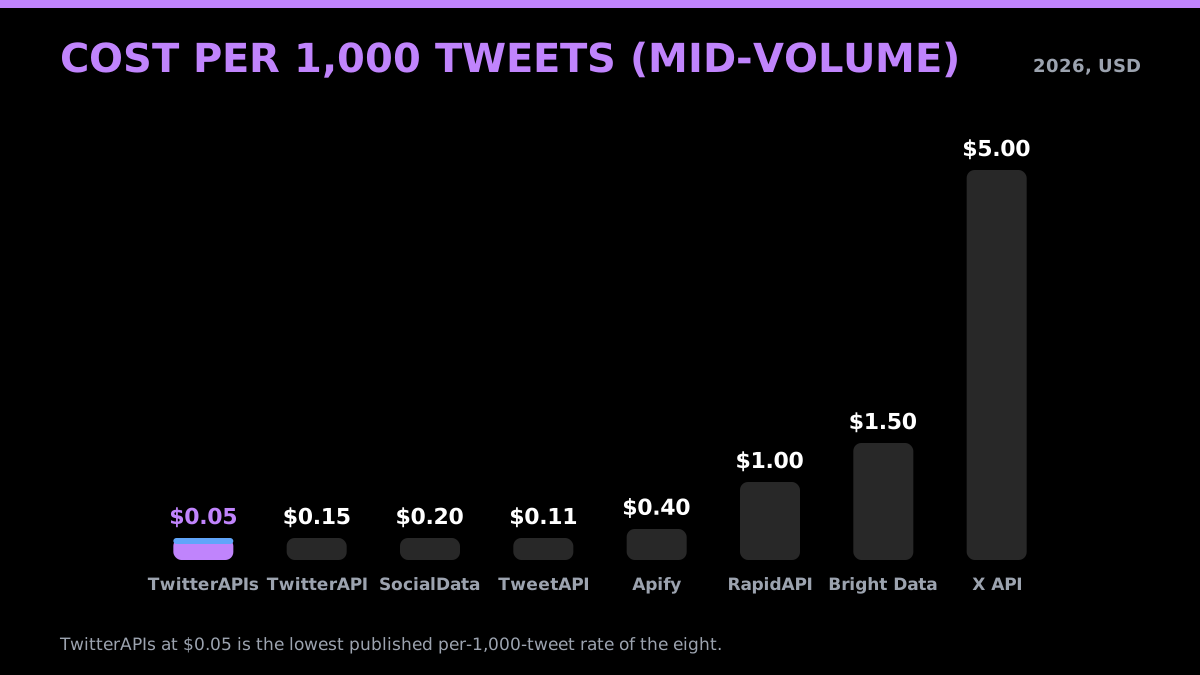
The full reasoning for every row is below, but the answer does not need to be buried. This ranking covers read pricing across providers; for the official tiers, write pricing and the break-even against a subscription, see the X API cost price sheet. Here is the whole ranking on one screen, at a mid-volume workload of 100,000 tweets a month.
| # | Provider | Per 1,000 tweets | Monthly at 100K | Billing model |
|---|---|---|---|---|
| 1 | TwitterAPIs | 0.04 dollars | 4 dollars | Per call, up to 20 tweets a call |
| 2 | TwitterAPI.io | 0.15 dollars | 15 dollars | Per read, pay as you go |
| 3 | SocialData.tools | 0.20 dollars | 20 dollars | Per item, misses not billed |
| 4 | TweetAPI.com | 0.11 dollars at full quota | 57 dollars | Monthly subscription |
| 5 | Apify | 0.25 to 0.40 dollars plus overhead | 35 to 50 dollars | Per event plus compute and proxy |
| 6 | RapidAPI listings | 0.50 to 5.50 dollars | 50 to 550 dollars | Varies by seller |
| 7 | Bright Data | 1.50 dollars plus proxy | 150 to 300 dollars | Per record plus bandwidth |
| 8 | Official X API | 5.00 dollars | 500 dollars | Per post read, 3M monthly cap |
The numbers match the per-provider sections below, and the # column is that section number rather than a strict cost ordering, because two rows do not sort cleanly on price. TweetAPI.com's 0.11 dollars looks cheaper than SocialData.tools' 0.20 dollars and is not, in practice, because it is a subscription rate that only holds if you consume your whole quota.
Read that table with two cautions. The TweetAPI.com rate assumes you consume your full subscription quota, which most teams do not, so its real per-1,000 figure is usually worse than 0.11 dollars. And the Apify and Bright Data rows exclude add-ons that are not optional in practice, proxy bandwidth in both cases. Every one of those caveats is unpacked in the per-provider sections below.
What does Twitter/X data actually cost in 2026?
The honest one-sentence answer is that it depends almost entirely on who you buy it from, and the spread is wider than in most software categories. Reading 100,000 tweets in a month costs an estimated 4 dollars through the cheapest option in this ranking and 500 dollars through the official X API. That is a 125x range for what is, in the fields that matter to most applications, the same data.
Three forces produce that spread.
Who absorbs the infrastructure. The official API is the source of record and prices accordingly. Third-party providers run their own collection layer and compete on price because price is the axis they can win on. What you are really choosing between is a first-party contract and someone else's operational risk.
What unit the meter counts. A per-call API that returns 20 tweets a call and a per-read API that meters each tweet individually can quote similar-looking numbers and bill 20x apart. This is the single most common way a budget goes wrong, and it is why every figure in this post is normalized to the same unit before it is compared.
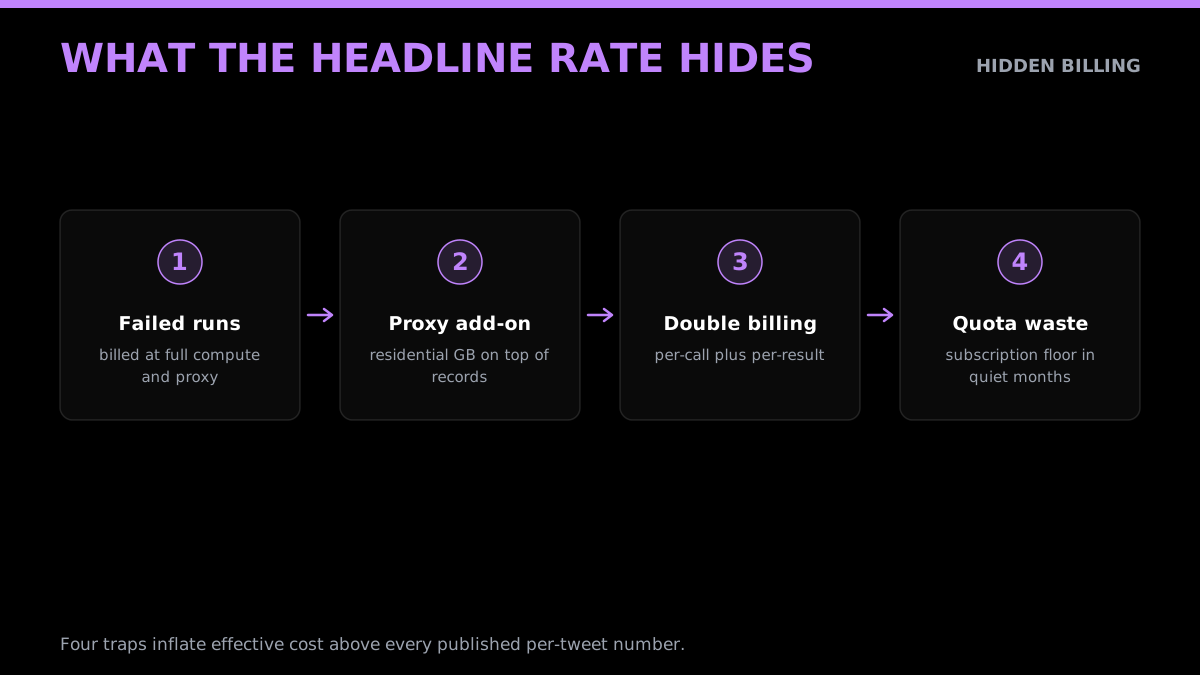
What is excluded from the sticker. Residential proxy bandwidth, failed requests you are still billed for, unused subscription quota, and per-post link surcharges are all real money that no pricing page puts in the headline number.
So the useful question is not what Twitter data costs. It is what your specific workload costs, which is your monthly tweet volume multiplied by an effective rate that includes the exclusions above. The rest of this post is that calculation, run eight times.
Did X kill the Twitter API? What changed since 2023
No, but it killed the version most developers had built on, and understanding that sequence explains why a third-party market exists at all.
The turn came in February 2023, when Twitter ended free API access for developers. The following month it announced a Free, Basic, and Enterprise tier structure that left a large gap between a nearly unusable free tier and enterprise pricing, and a wave of independent projects that had run on the old free quota simply stopped.
The second turn came in 2026, when X moved to pay-per-usage as the default for new developers, which Social Media Today covered as a usage-based access charge. That change is genuinely better than the tier structure it replaced for small and bursty workloads, because there is no monthly floor to buy past. It is still expensive per unit: the published standard read rate is 0.005 dollars per post read, which is the 5.00 dollars per 1,000 figure in the table above.
So the accurate framing is that the official API did not disappear, it repriced twice in roughly three years and settled at a rate that makes sense for write access and compliance-sensitive work, and rarely makes sense for bulk reading. The third-party providers ranked below exist in the space that repricing opened. Whether that gap stays open is not something anyone can promise, which is a good argument for putting a thin internal interface in front of whichever one you pick.
What are the main alternatives to the Twitter/X API?
Every option in this ranking falls into one of four categories, and the category tells you more about how the tool will behave in production than the price does.
Direct third-party REST APIs. You send an HTTP request and get tweets back synchronously. TwitterAPIs, TwitterAPI.io, SocialData.tools, and TweetAPI.com sit here. The provider owns the collection problem, you own nothing but your query. This is the category with the lowest unit cost and the lowest operational burden, and the tradeoff is that you are trusting a third party's uptime rather than X's.
Managed scraping platforms. Apify and Bright Data sit here. You configure a job, it runs on their infrastructure, results land in a dataset you fetch afterward. These cost more per record and add latency because the unit of work is a run rather than a request, and they earn that premium when your pipeline spans many sites or when completion rate matters more than unit cost.
API marketplaces. RapidAPI is the main one. You are buying a reseller's listing, which means the price, the schema, and the uptime are all set by a third party you did not choose and cannot escalate to. The genuine benefit is one bill and one auth pattern across many unrelated APIs.
The official X API. First-party, most expensive per read, and the only option for posting, direct messages, webhooks, and anything requiring authenticated action on behalf of a user. If your workload writes, this is not an alternative you compare against, it is a requirement you budget for alongside whatever you use for reads.
A fifth option exists and is deliberately not ranked here: running your own scraper on an account pool or a headless browser fleet. Its per-call price is near zero and its real cost is engineering time and account attrition, which no per-1,000 figure captures. Our Twitter scraping in Python guide prices that route honestly.
Normalizing eight different billing models to one number
No two vendors here charge in the same unit, which is exactly why headline rates mislead. The official X API meters per post read. TwitterAPIs meters per API call, and one call can carry up to 20 tweet objects. Apify charges compute units and bills proxy bandwidth on a separate line. Bright Data prices per record, then adds residential proxy cost as its own item. Some RapidAPI listings run a per-call counter and a per-result counter at once.
To compare them honestly, we collapsed every model into one figure: what it costs to land 1,000 tweet objects in your own store. Then we measured that figure at three workloads.
The three workloads in this post:
- Low: 10,000 tweets a month
- Mid: 100,000 tweets a month
- High: 1,000,000 tweets a month
How a tweet is counted: we count tweet objects delivered, not HTTP requests fired. When one request returns 20 tweets, which is common across paginated search, that request earns 20 tweets in the math. The conversion fits on two lines:
def cost_per_thousand(call_price, tweets_per_call):
    """Dollar cost to land 1,000 tweet objects, whatever the metering unit."""
    return (1_000 / tweets_per_call) * call_price

print(cost_per_thousand(0.0008, 20))  # TwitterAPIs, 20 tweets a call -> 0.04
print(cost_per_thousand(0.005, 1))    # Official X API, one read a tweet -> 5.00
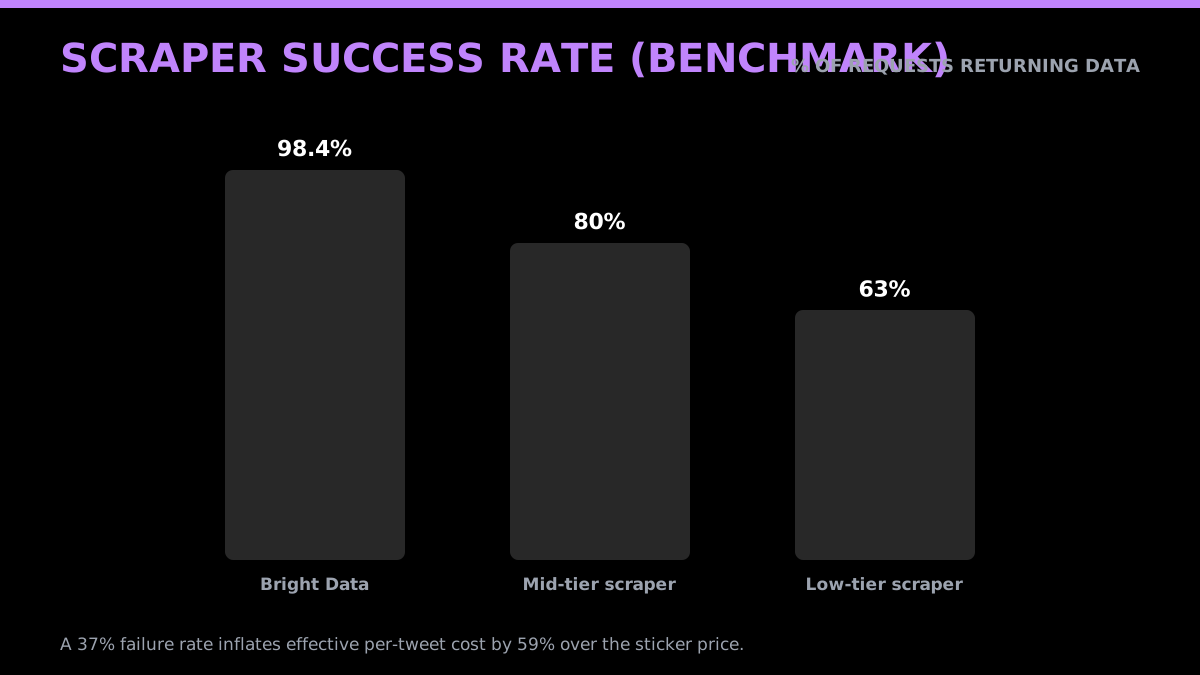
Adjusting for failures: when a provider discloses a failure rate, or a benchmark exposes one, we add a worst-case column. Misses you still pay for raise your true rate. An estimated 10% miss rate lifts effective cost by about 11%; a 37% miss rate (the bottom end seen on some scraping actors) lifts it by 59%. The correction is one division by the success rate:
def inflate_for_failures(clean_per_1k, fail_share):
    """When you are billed for misses too, your real rate climbs."""
    return clean_per_1k / (1 - fail_share)

print(inflate_for_failures(0.40, 0.10))  # 10% misses -> 0.444 (+11%)
print(inflate_for_failures(0.40, 0.37))  # 37% misses -> 0.635 (+59%)
What we left out of the ranked table: write (posting) cost sits outside the ranking, though the official X API entry covers it because its link surcharge bites publishing tools hard. We also set aside one-time setup, SDK licensing, and engineering hours. For one running per-provider number, our Twitter API cost guide keeps a live table.
One more modeling choice worth stating: every figure here is a steady-state monthly run rate, not a one-time backfill. If your first month also pulls a year of history on a topic before the pipeline settles into its normal cadence, that opening month spikes well above the tier numbers, then drops back. Treat the three workloads as the recurring bill you live with after the initial load, and size your free credits and trial balances against the backfill separately. The numbers below are estimates built from published rates and disclosed benchmarks, not quotes; your own bill will shift with query shape, failure rate, and how often you re-pull the same data.
Every figure links to its source inline. Official rates are checked against the X developer platform documentation where X publishes them, and wherever we lean on a third-party benchmark or an operator's own disclosure, we flag it.
Start building with TwitterAPIs
$0.0008 a call, about $0.04 per 1,000 tweets at 20 tweets a page. $0.50 free credits. No credit card required.
1. TwitterAPIs: the floor at $0.04 per 1,000 tweets
How it bills: a flat $0.0008 per API call. Hit the search or timeline endpoints and a single call returns up to 20 tweet objects, which works out to about $0.04 for 1,000 tweets. A search read is one line:
curl "https://api.twitterapis.com/twitter/tweet/advanced_search?query=web3&limit=20" \
  -H "x-api-key: $TWITTERAPIS_KEY"   # one call, $0.0008, up to 20 tweets
Across the three workloads (estimated):
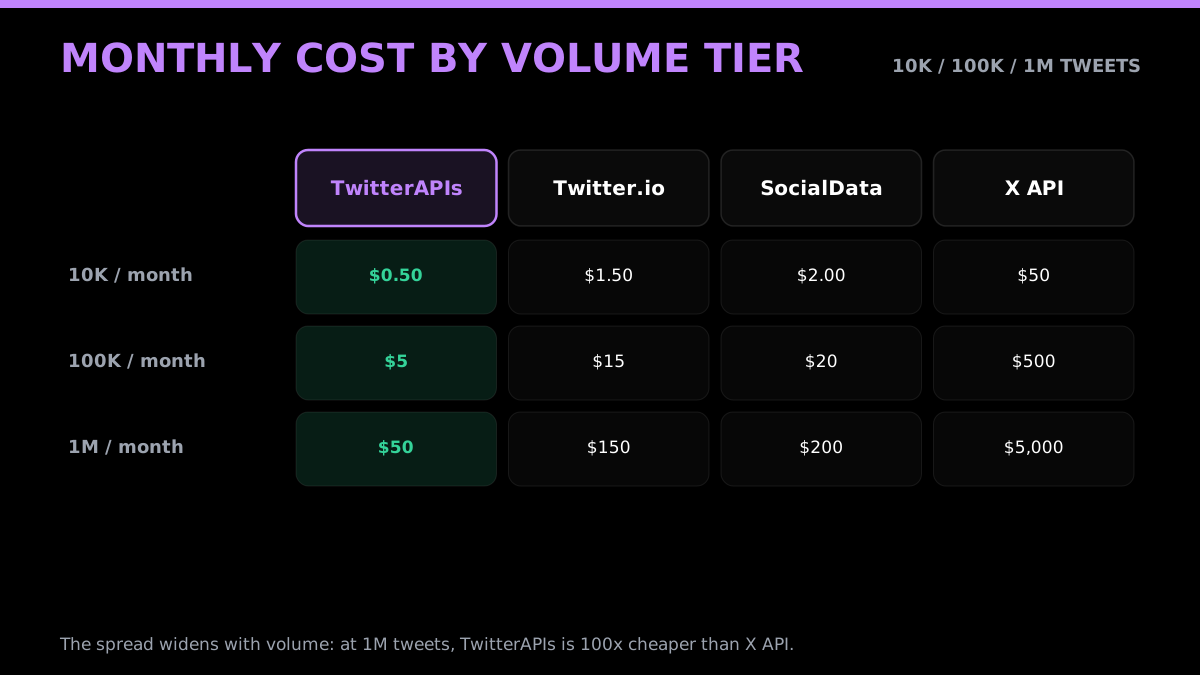
- 10K tweets/month: $0.40
- 100K tweets/month: $4.00
- 1M tweets/month: $40.00
Nothing to subscribe to, nothing to commit. Billing follows the calls you make, so a slow month is a cheap month. Sign-up grants $0.50 in free credits, roughly 625 calls or about 12,500 tweets, with no card required, per the published pricing page.
Reads are not the whole catalog. Alongside the 65 read endpoints (tweet, thread, search, timeline, user lookups, and the rest) TwitterAPIs ships 44 write endpoints: favorite and unfavorite, retweet and unretweet, bookmark and unbookmark, follow and unfollow, delete, tweet creation, media upload, and DM send, the simple actions at $0.0008 per call, with tweet creation and DM send at $0.0016. Writes run on credentials you hand over per request, your own auth_token and ct0, which the service never stores. That puts the full surface at 109 endpoints. Direct messaging is covered here too: the dm/send endpoint bills at $0.0016 per call and runs on the same bring-your-own auth_token and ct0 model as the other writes.
Why 20 tweets a call matters at scale. Providers that bill per tweet object look identical on a per-item basis, but once your pipeline is firing thousands of requests a day, whether through a library like requests or a higher-level SDK, the fixed cost of each request starts to dominate under request-per-tweet pricing. TwitterAPIs holds the call overhead constant no matter how many tweets ride back in one response.
No X developer account in the loop. You skip the X access application, the approval queue, and managing OAuth 2.0 tokens for the data source, because TwitterAPIs owns authentication. If you are still deciding whether you even need official credentials, our look at whether the Twitter API is still free walks the 2026 tiers, and the TwitterAPIs best practices guide shows how to shape calls for the lowest effective rate. For teams shut out of X access, or unwilling to hold official keys for a scraping job, that removes a real setup tax.
A write call looks much like a read call. Because writes carry your own session credentials, a favorite or a follow is just another keyed request, and at $0.0008 it costs the same as a read. The practical effect is that a bot which reads a timeline, then bookmarks or retweets a handful of matching posts, pays cents for the whole loop rather than dollars. Keep the credentials out of source and inject them per request, since the service holds nothing on its side; you rotate or revoke an auth_token on your account and the next call simply uses the new one.
The infrastructure is in the price. Proxy rotation, rate-limit handling, and bot-detection mitigation are absorbed by the service, not billed as extras, unlike Bright Data where proxy bandwidth is its own line item.
You can forecast a month from a single volume number:
rates_per_1k = {"twitterapis": 0.04, "twitterapi_io": 0.15, "socialdata": 0.20, "x_api": 5.00}
tweets_this_month = 100_000
for vendor, rate in rates_per_1k.items():
    bill = tweets_this_month / 1_000 * rate
    print(f"{vendor:14} ${bill:,.2f}")   # twitterapis -> $4.00, x_api -> $500.00
The mid-volume picture: at 100,000 tweets a month TwitterAPIs runs about $4, against Apify pay-per-result actors at $18 to $40 before platform overhead, and the official X API at $500. An independent side-by-side published on the TwitterAPIs blog puts TwitterAPIs far under Apify's effective rate at this tier.
Where it fits: research pipelines, sentiment trackers, competitive-intel scripts, anything where tweets are the raw input and the budget is the constraint. Building one in Python? The Python Twitter API tutorial walks the call pattern end to end, and if you come from a library-first habit, Tweepy is the open-source client most people start on. It also suits early projects testing demand before they sign up for any subscription.
The frustration that sends most teams hunting for these rates is easy to find on X:

Zev
@zevML
Karpathy tried the X API for a project. 30 minutes cost him $200. He called the pricing "really excessive." When the guy who built the tech stack says your API is too expensive, you might want to check the rate card.
2. TwitterAPI.io: pay-as-you-go at $0.15 per 1,000, no floor and no ceiling
How it bills: $0.00015 per read on a pure pay-per-use model, with no monthly minimum and no mandatory subscription tier. New accounts pick up a $1 trial credit, good for roughly 6,667 reads, per the TwitterAPI.io cost breakdown.
Across the three workloads:
- 10K tweets/month: $1.50
- 100K tweets/month: $15.00
- 1M tweets/month: $150.00
Breadth: the service lists around 75 endpoints spanning search, user lookups, timelines, trends, and more. That range pays off when your work touches several endpoint types rather than one search query. Teams already on it who want cheaper pay-per-call billing usually open with our migrate from TwitterAPI.io to TwitterAPIs walkthrough.
No read ceiling. The official X API stops you at 3M reads a billing cycle before forcing an Enterprise talk; TwitterAPI.io publishes no such wall. Push to 2M reads and you would pay $300, against roughly $10,000 on the official API at the same volume, a 33x gap, per the TwitterAPI.io pricing analysis. If your worry is throttling rather than a monthly cap, our Twitter API rate limit guide maps the per-window limits and X's own rate-limit documentation lists the official per-endpoint ceilings.
Failure billing: the pricing docs say nothing explicit about charges for failed requests. When a provider stays quiet on this, treat it as an open risk at high volume.
Where it fits: projects that need more than tweet search, developers who burned trial credits elsewhere and want a flat-rate home, and teams leaving the official API who want predictable bills without committing to a plan.
3. SocialData.tools: a flat $0.20 per item with one expensive exception
How it bills: $0.0002 per tweet or user profile returned, and failed requests are explicitly free, per the SocialData.tools pricing documentation. A standing allowance of 3 requests a minute runs before any charge, which gives small projects a genuine zero-cost on-ramp.
Across the three workloads (estimated):
- 10K tweets/month: $2.00
- 100K tweets/month: $20.00
- 1M tweets/month: $200.00
The exception to watch: extended bio lookups cost $0.001 each, 5x the standard $0.0002 item rate. Any app pulling full profiles, complete bios and follower counts, will trip that higher rate more often than the headline suggests. A tool fetching the author profile behind every tweet at 100K tweets a month can see its true rate drift toward $0.50 to $1.00 per 1,000 items once those lookups stack up. Query shape is the lever here: our how to scrape tweets guide and the Twitter advanced search operators reference both show how tighter queries cut the profile round-trips you pay for.
Misses are not billed. The docs are explicit that failed requests never touch your balance. That carries real weight at scale, where scraping-style competitors charge compute and proxy even when nothing comes back.
The 3-requests-a-minute free tier covers ad hoc exploration, integration testing, or a low-volume personal project without a card. The meter starts only once you cross that line.
Where it fits: pipelines that blend tweet data with profile data, teams that want clean per-item billing and no subscription, and anyone who values the no-failure-billing guarantee as a budget guardrail.
4. TweetAPI.com: subscription tiers from $0.10 to $0.17, and a rate that moves
How it bills: monthly subscription across three tiers, per the TweetAPI.com pricing guide:
| Tier | Monthly cost | Included requests | Effective rate |
|---|---|---|---|
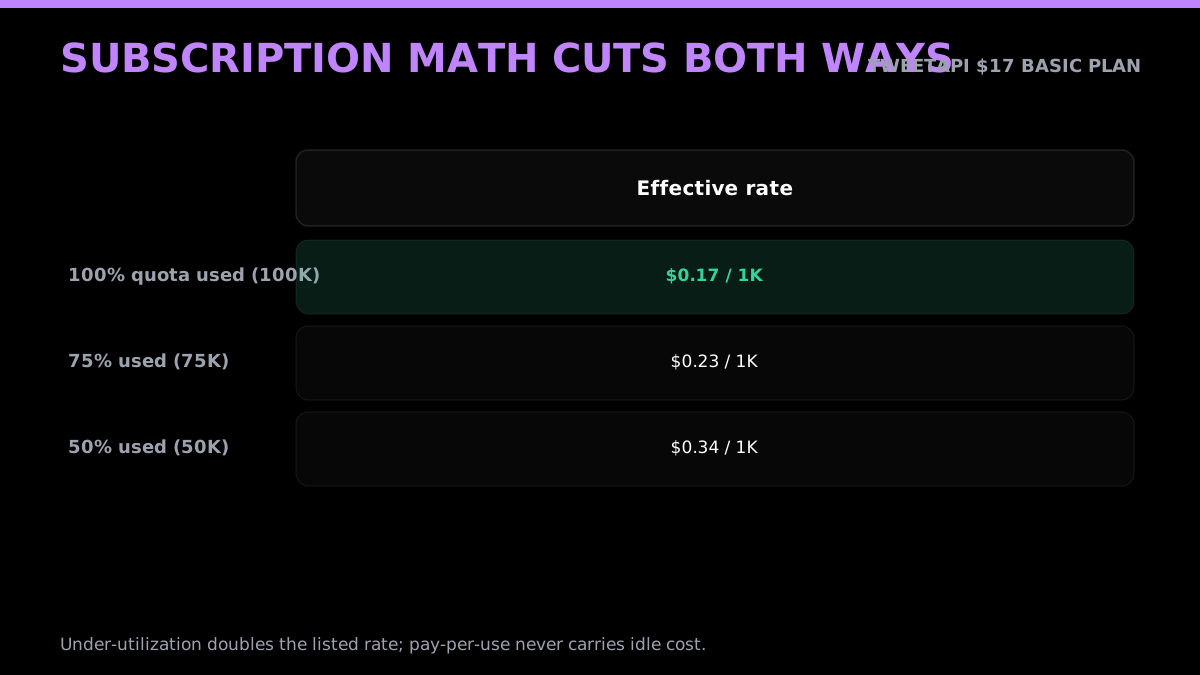
| Basic | $17/month | 100K requests | $0.17 per 1K |
| Standard | $57/month | 500K requests | $0.11 per 1K |
| Pro | $197/month | 2M requests | $0.10 per 1K |
The real rate is the plan price over what you actually consume, not over the quota you bought:
def real_rate(monthly_fee, calls_actually_used):
    return monthly_fee / (calls_actually_used / 1_000)

print(real_rate(17, 100_000))  # whole quota burned -> 0.17
print(real_rate(17, 50_000))   # half burned -> 0.34, the rate doubles
Why the rate moves: burn the full quota and the rate is competitive. Use 50K requests on the $17 Basic plan and your true rate becomes $0.34 per 1,000, double the sticker. That is not a quirk of TweetAPI; it is the nature of any subscription, where the published rate only holds at full utilization.
Who wins on fixed caps: teams with steady, predictable monthly volume and no spikes. Pull exactly 400K tweets every month and the $57 Standard tier gives a clean $0.14 per 1K with no surprises.
Who loses on it: seasonal jobs, research with variable query loads, anything where demand swings month to month. There, pay-per-use almost always wins in the quiet months where you fall short of plan capacity.
No public word on failure billing. Subscriptions usually count every request fired, returned data or not, because the quota is spent at request time. Verify this before committing if any of your sources fail often.
Where it fits: teams with consistent monthly volume that prefer a predictable bill and accept the cost-of-carry. Still wiring your first integration? The Twitter API tutorial for 2026 covers auth and pagination whichever provider you land on. Not a fit for variable or seasonal work.
This subscription trap shows up in the wild often enough to surface on Reddit:
I tried the new X API - it's nice, but doesn't look so cheap long term
5. Apify: a listed rate that rarely survives production
How it bills: pay-per-result on the two main Twitter actors, per Apify actor listings and the Apify pricing guide:
- kaitoeasyapi actor: $0.25 per 1,000 results
- apidojo V2 actor: $0.40 per 1,000 results
Those are per-result rates before platform overhead, and the listed number is seldom your bill.
The failed-run problem. Hit a proxy timeout, a bot-detection block, or a rate-limit wall, and Apify still charges the full compute unit and proxy cost for that run, even when it returns zero tweets, as documented in Apify's platform pricing documentation. At normal Twitter-scraping failure rates, which swing from 10% to 37% depending on proxy setup and actor choice, that quietly inflates your effective cost. Proxy configuration is the biggest single lever on that rate, which is why our guide to the best residential proxies for Twitter scraping is worth a read before you commit to an actor pipeline.
Add-ons that stack on top of the per-result fee:
- Concurrent run fees ($5 per concurrent run on the default plan)
- Dataset storage (per GB, per month)
- Data transfer charges
- Separate proxy cost when you move from shared to residential
Independent analysis puts that platform overhead at an estimated 30% to 50% above the quoted per-tweet actor rate under typical use. A six-month total-cost projection against flat-fee alternatives had Apify landing at an estimated $120 to $200 a month for 200K tweets, where a flat-fee provider sat near $10 at the same volume.
When the batch model earns its premium. Apify gives you something the others do not: managed scraping infrastructure where you swap actors, chain tasks, schedule runs, and wire into hundreds of downstream services through its API. If Twitter is one stop in a larger multi-source pipeline that also touches LinkedIn, Amazon, or elsewhere, the unified billing and orchestration can justify the per-tweet markup. You are buying the platform, not just the rows.
The realistic floor: at 100K tweets on kaitoeasyapi the base is an estimated $25, but factor in average failure rates and overhead and the true total lands in the $35 to $50 range, against about $4 on TwitterAPIs for the same job. For the exact tweet-scraping head-to-head, see our Apify Twitter scraper vs TwitterAPIs breakdown, and if you are still choosing, the best Twitter API for scraping comparison ranks the field on reliability as well as price.
Where it fits: teams already running multi-source Apify pipelines who want to fold Twitter into existing infrastructure, not greenfield builds where cost leads the decision.
6. RapidAPI marketplace: rates swing widely depending on who you buy from
How it bills: as a marketplace, every listing sets its own rate and model. RapidAPI keeps roughly 20% of publisher revenue as a marketplace cut, folded into the price you see, so effective per-tweet cost ranges widely inside a single platform.
From the RapidAPI marketplace analysis, the rough bands are:
- RapidAPI popular scraping wrappers: $0.50 to $1.50 per 1,000 tweets
- RapidAPI unofficial API wrappers: $1.50 to $3.00 per 1,000 tweets
- RapidAPI data aggregators: an estimated $2.00 to $5.50 per 1,000 tweets
Across the three workloads (an estimated mid-tier listing at $1.00/1K):
- 10K tweets/month: $10.00
- 100K tweets/month: $100.00
- 1M tweets/month: $1,000.00
The double-billing trap. Some listings run a per-call counter and a per-result counter together: you pay once when the request fires and again for each tweet it returns. At volume that compounds fast, and it usually hides in the listing's detailed pricing tab rather than the headline. The per-result counter only makes sense once you understand how the underlying read works, which X documents in its post lookup reference.
Failure billing: most listings charge your plan whether the call succeeded or not, and because RapidAPI sits between you and the real provider, refund policies vary and can drag.
The marketplace-fee math. That estimated ~20% cut shows up in the displayed price. A provider selling direct at $0.80/1K often appears at $1.00/1K on RapidAPI, so buying straight from the source, where that option exists, almost always costs less.
Where it fits: developers testing several providers behind one key and one bill, without juggling separate vendor accounts. The convenience premium is real and can pay off for early prototyping. It rarely earns its keep in production where cost matters.
The cheapest pay-as-you-go Twitter API. Try it free.
$0.0008 a call, about $0.04 per 1,000 tweets at 20 tweets a page. $0.50 free credits. No credit card required.
7. Bright Data: $0.75 to $2.50 per record, and the benchmark win on reliability
How it bills: pay-as-you-go at $1.50 per 1,000 records, or a Scale plan at $499/month for 384K records ($1.30 per 1K). A promo code (APIS25) drops the PAYG rate to $0.75/1K for the first three months, per Bright Data's pricing and benchmark blog.
Across the three workloads (PAYG, no promo):
- 10K tweets/month: $15.00
- 100K tweets/month: $150.00
- 1M tweets/month: $1,500.00
The proxy add-on. The per-record rate excludes the residential proxy network that actually fetches the data, billed separately:
- Pay-as-you-go: $8.40 per GB
- Committed: $3.00 per GB
A Twitter page payload runs roughly 0.5 to 2 MB per request depending on thread depth, so a proxy-heavy crawl (common when X tightens bot detection) can add an estimated $1 to $4 per 1,000 records on top of the base. The $0.75 to $2.50 effective range captures that spread, but your number turns on crawl strategy and proxy tier.
The reliability case. Per an independent benchmark of 11 Twitter data providers run in 2026, Bright Data posted a 98.44% average success rate, the highest of any provider tested, where most scraping competitors landed between 63% and 95%. At an estimated 37% miss rate you are paying for data you never receive, which lifts effective per-tweet cost by 59% over the sticker. Those misses are mostly bot-detection blocks, and our Twitter bot detection guide explains why managed providers eat that risk where DIY scrapers swallow it.
Volume discounts on the proxy network start to matter above roughly $200 a month in spend. There is no hard minimum, but the unit economics improve at committed volume.
When the reliability premium pays off: research where completeness beats unit cost, compliance-sensitive work where an estimated 37% data hole would void the analysis, and enterprise cases where auditable data lineage and SLAs outrank raw price.
Where it fits: data teams with budget room that need the highest completion rate going. Not the call for cost-led or high-volume work, where a 20x premium over TwitterAPIs would swamp the budget.
8. The official X API: pay-per-read pricing, plus a link tax nobody budgets for
How it bills: pay-per-use, made the default for every new X API developer in February 2026. That same month X closed the Basic ($200/month for 10K reads) and Pro ($5,000/month for 1M reads) plans to new sign-ups. We track that shift in our 2026 X API pricing change explainer, and X lists current access tiers on its X API pricing page. Per the PostProxy X API pricing breakdown and the TwitterAPI.io cost analysis:
| Operation | Rate |
|---|---|
| Post read (pay-per-use) | $0.005 per read |
| Post creation (plain text) | $0.015 per post |
| Post creation with URL | $0.20 per post |
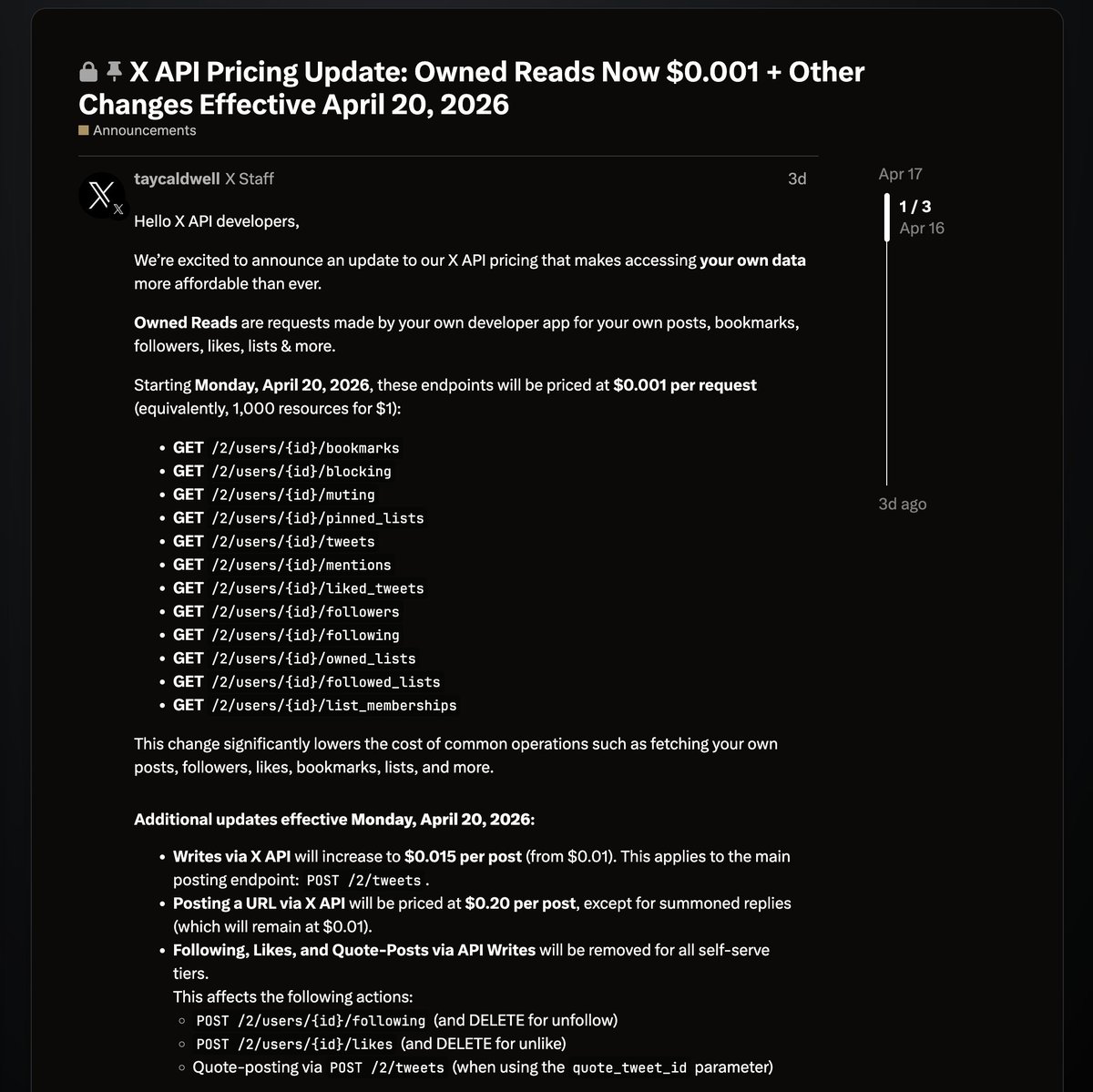
| Owned-account read (as of April 20, 2026) | $0.001 per resource |
Across the three workloads (read-only, estimated):
- 10K tweets/month: $50.00
- 100K tweets/month: $500.00
- 1M tweets/month: $5,000.00
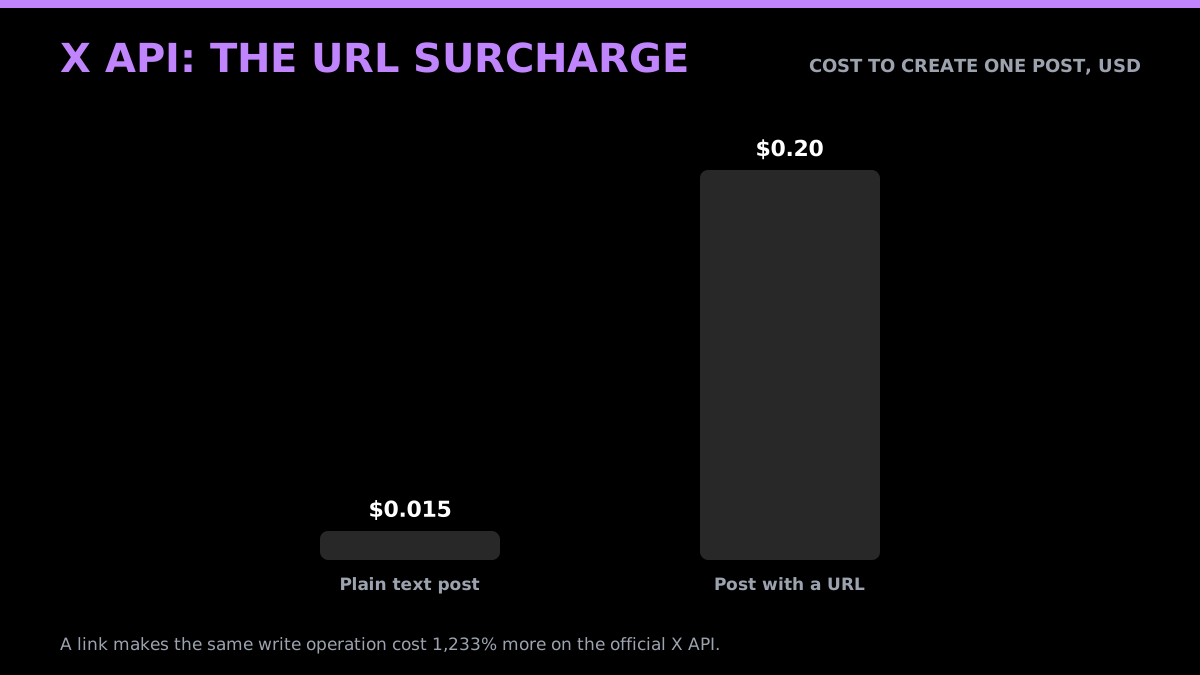
The link surcharge is the trap for publishing tools. A plain post is $0.015 to create. Add a URL and it is $0.20, a 1,233% premium for the same write with a link in it. Per Blotato's Twitter API pricing analysis, a scheduling tool sending 3,000 posts a month with half carrying links pays about $325 a month on pay-per-use. All plain text, the same volume runs about an estimated $45. The links alone add $280.
Developers who watch their per-read bill have already run this arithmetic in public:

Mike on X
@Mike_onX
x API pricing: 1000 reads for $1. writes up 50%. URL posts 20x. follow/like/quote removed from self-serve. cheap workflows now: search, monitoring, alerts, mentions digests. expensive workflows: posting and engagement automation. read is a commodity. write is premium. https://t…
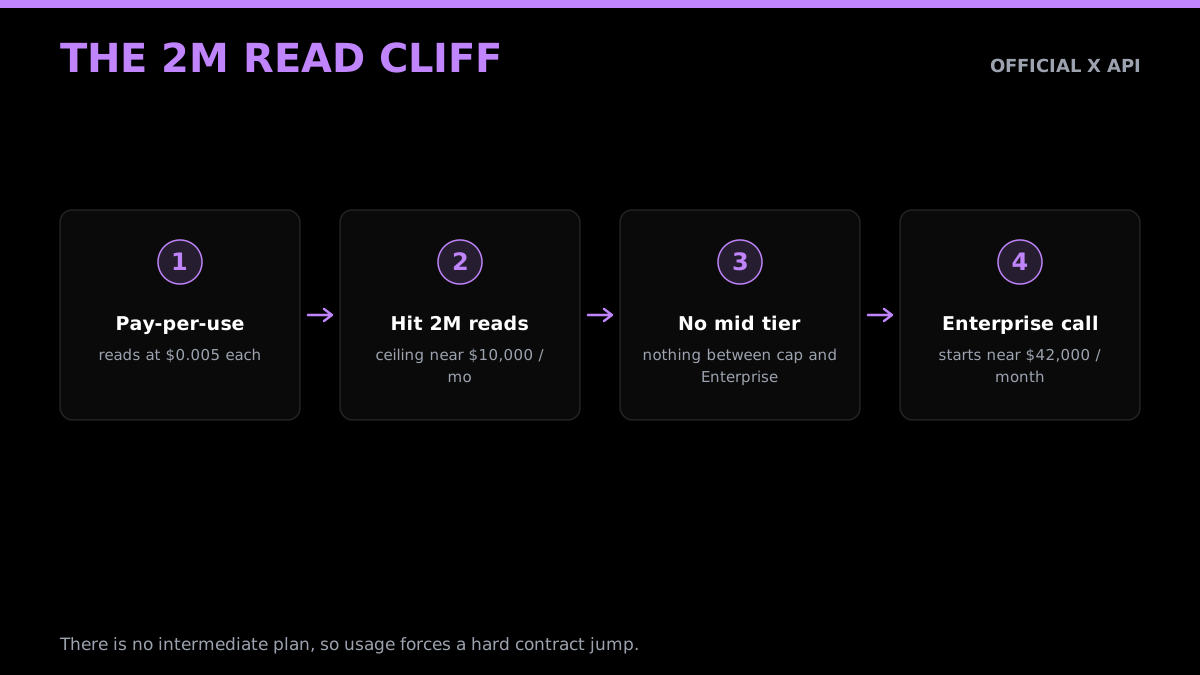
The 3M-read cliff. Pay-per-use stops at 3M reads a billing cycle with no automatic step up. Hit it and X pushes you into an Enterprise negotiation it does not publish a price for, since crossing the cap opens a contact form rather than a rate card, a shape the TwitterAPI.io pricing analysis also traces. Between the pay-per-use ceiling ($15,000 at 3M reads) and Enterprise there is no middle plan. Pull large historical windows and that wall arrives sooner than you expect, which our guide to scraping tweet history via API plans around.
The owned-account read discount (April 2026). On April 20, 2026, X cut the rate for reading posts from accounts you own to $0.001 per resource, a 5x reduction. That helps analytics dashboards reading back their own history, but does nothing for the cost of reading anyone else's tweets.
Free tier gone. Old free-tier developers got a one-time $10 credit when it closed in early 2026. The open access that defined the platform's API history for over a decade is finished, with no free path for new builders. If you still want the official route, our how to get a Twitter API key walkthrough covers the current flow.
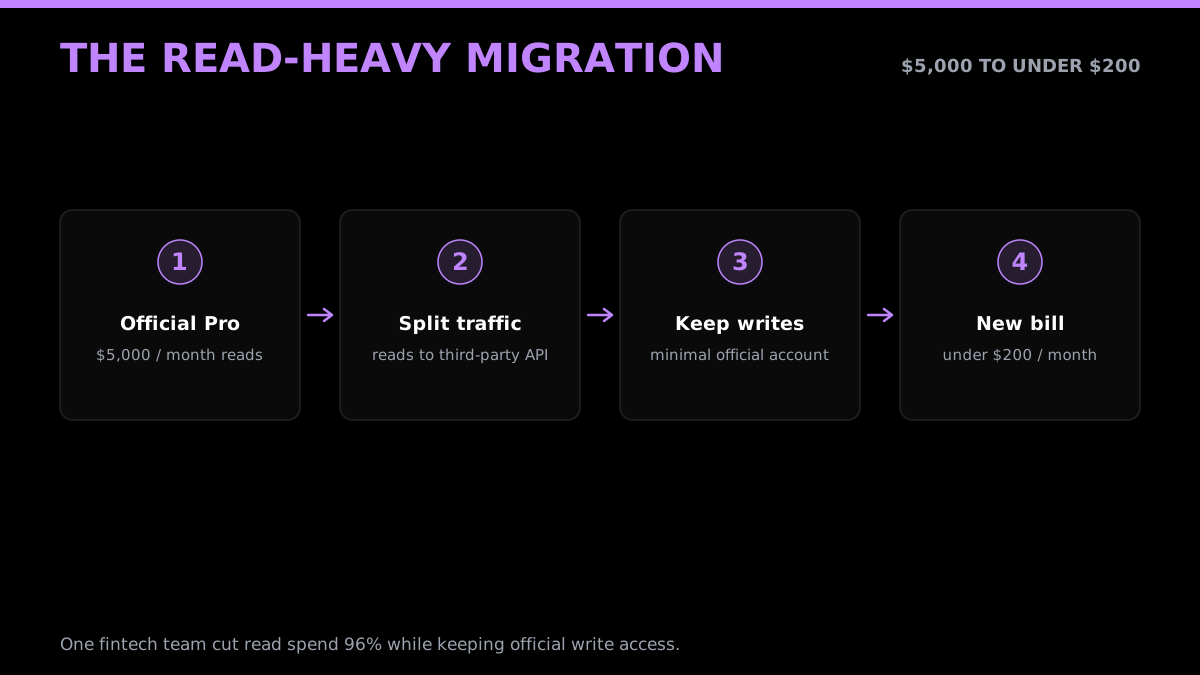
A practitioner's read: a data engineer on a fintech sentiment pipeline told the Sorsa API blog that their team fell from thousands of dollars a month to under $200 after moving reads off the official Pro plan to a third party, around 50x cheaper on post reads, while keeping a thin official connection only for direct posting. The logic is plain: official rates make sense when you need compliance guarantees or are writing to X on behalf of verified accounts, and rarely make sense for read-heavy research.
The same complaint runs constantly through developer communities:
What is going on with Twitter (X) API pricing ???
On Hacker News in 2026, the xAPIs.dev creator posted a Show HN that named the exact decision point behind most migrations: "The X API pricing killed my side project," followed by a sub-$10/month alternative aimed at indie devs, researchers, and startups who need Twitter data without enterprise budgets. One commenter added: "X API pricing definitely pushed many indie devs toward client-side solutions instead."
Who should actually run the official X API in 2026: teams under compliance rules that mandate official access (regulated industries, verified business accounts posting at scale), anyone posting to X at volume and needing official write endpoints, and cases where a contractual SLA from X itself is a business requirement. For read-only research and data work, the cost case almost never holds against a third party.
Matching a provider to your scale and workload
There is no universal winner. The right pick turns on what you are building, how much data you need, and whether you are optimizing for unit cost, success rate, endpoint breadth, or operational simplicity.
Sizing by monthly volume
Under 50K tweets a month: Down here the dollar gaps are small. At 25,000 tweets a month TwitterAPIs bills an estimated $1 and a typical mid-tier RapidAPI listing bills $25, a real difference for a side project and a rounding error for a funded team. Optimize for integration ease and endpoint coverage over price. TwitterAPI.io's $1 trial credit and SocialData.tools' 3-requests-a-minute free tier both let you ship before spending a cent.
50K to 500K tweets a month: This is where the choice moves your P&L. At 100K the spread runs from about an estimated $4 (TwitterAPIs) to $500 (official API). Pay-per-use providers (TwitterAPIs, TwitterAPI.io, SocialData.tools) beat subscriptions unless you can predict and hit your quota every month. Apify gets hard to defend against flat-fee options at this tier once overhead is counted.
Above 500K tweets a month: TwitterAPIs at an estimated $40 per 1M against the official API at $5,000 is roughly a 125x gap that recurs every month, which makes the provider call the single biggest budget lever in your stack. Uncapped pay-per-use providers (TwitterAPIs, TwitterAPI.io) scale linearly; subscriptions need custom Enterprise talks; the official API forces a hard upgrade at 3M reads.
Sizing by what you are building
Mixed read-write pipelines: The standard 2026 pattern is a hybrid: the official X API for write endpoints, where you need official access anyway, plus a third party for reads, search, and monitoring at a fraction of the cost. The split bill is easy to model:
def split_bill(reads, writes, read_rate_per_1k=0.04, write_price=0.015):
    read_cost = reads / 1_000 * read_rate_per_1k    # third-party reads
    write_cost = writes * write_price               # official writes
    return read_cost + write_cost

print(split_bill(100_000, 3_000))  # 4.00 reads + 45.00 writes -> 49.0
A fintech team on the official Pro plan for read-only sentiment plus an estimated $45 for posting can restructure to a fraction of that on a third party for reads and a thin official account for writes.
Read-heavy research (sentiment, academic datasets, competitor monitoring): Here unit cost rules. Evaluate TwitterAPIs at about $0.04 per 1K and TwitterAPI.io at $0.15 per 1K first. Bright Data earns a look only when completeness guarantees outweigh per-tweet cost. If sentiment is the job, our Twitter sentiment analysis in Python guide pairs the cheap-read path with a working classifier, and academic teams sizing a dataset can lean on Pew Research's work on how Americans use X as a representativeness benchmark against the platform's global user base.
Write-heavy publishing (scheduling, cross-posting tools): The official X API is the only legitimate write path. Bake the link surcharge into your per-post cost from day one, because a tool posting mostly links pays roughly 13x more per post than one posting plain text. Build the model around $0.20 a post, not $0.015.
Bulk historical data: For deep archives (months or years on a topic or account), check whether your provider caps historical search depth. The official API limits free historical access; third parties vary. Query depth drives how many calls you pay for, and X documents the operator set in its build-a-query reference. Batch actor models like Apify can suit a one-time pull where per-run failure overhead is acceptable for a non-recurring job. Exporting a specific account's audience follows the same shape, covered in how to export Twitter followers via API.
Picking the wrong tier is one of the most common early mistakes, and watching one walkthrough end to end saves a lot of trial and error:
https://www.youtube.com/watch?v=qSIONwzLfFY
The quick-reference matrix
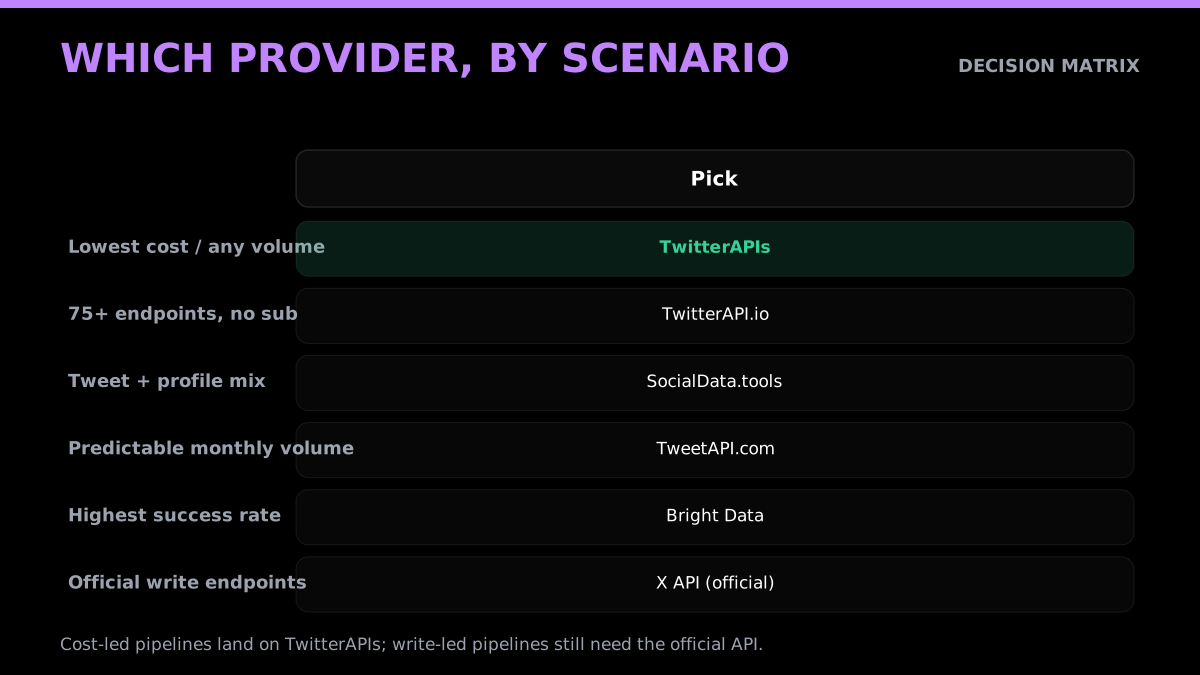
| Scenario | Recommended provider | Why |
|---|---|---|
| Official write endpoints required | X API (official) | The only compliant path for writes |
| Highest success rate matters most | Bright Data | 98.44% benchmark, residential proxy reliability |
| Lowest cost per tweet, any volume | TwitterAPIs | $0.04/1K, no minimum, no proxy add-on |
| Need a provider that lists 75+ endpoints, no subscription | TwitterAPI.io | $0.15/1K, broadest coverage per cost |
| Steady, predictable monthly volume | TweetAPI.com | Subscription efficiency once you hit quota |
| Mixed tweet + profile data | SocialData.tools | $0.20/1K tweets, $0.001/profile (plan for it) |
| Already on Apify for multi-source work | Apify | Platform consolidation offsets the premium |
| Prototyping across several providers | RapidAPI | Unified billing for exploration, not production |
One workload the matrix skips is trends and topic monitoring, which most providers expose through a dedicated endpoint covered in our Twitter trends API guide. And if you are specifically weighing a third party against staying on the official v2 endpoints, the Twitter API v2 vs TwitterAPIs comparison runs that one in isolation.
What the headline rate hides
Search any pricing table and you get the sticker. Here is what the sticker leaves off, provider by provider.
Official X API: the $0.20 link surcharge is the biggest shock for teams off legacy plans. At 3,000 posts a month with half carrying links, it adds $280 over what plain-text posting would cost. Second comes the 3M-read hard cap with no middle upgrade, which forces Enterprise talks far earlier than usage alone would warrant.
Apify: failed runs bill full compute and proxy. A run that returns zero tweets to bot detection still spends your quota and charges bandwidth, which at typical failure rates lifts effective per-tweet cost an estimated 10% to 50% above the per-result sticker. Concurrent-run fees, storage, and transfer pile on another 30% to 50%.
RapidAPI: the estimated ~20% marketplace cut is baked into displayed prices, so buying direct from the source removes that layer where the option exists. Per-call and per-result double billing lives on specific listings, so check the detailed tab before committing, and refund handling varies by listing.
Bright Data: residential proxy cost ($3.00 to $8.40 per GB) is its own line item apart from the per-record fee, and on proxy-heavy crawls it can double the effective rate. The APIS25 promo trims PAYG to $0.75/1K for three months, then reverts to $1.50/1K.
SocialData.tools: the extended-bio endpoint at $0.001 a request is 5x the standard $0.0002 rate, and pipelines pulling a full profile per author will see it dominate the bill at scale.
TweetAPI.com: under-utilization is the trap. The $17 Basic plan works out to $0.34 per 1K if you use only 50K of your 100K quota, and variable projects keep paying the floor in quiet months.
The cost every provider shares and none of them prices
Two line items sit outside all eight rate cards, and they are the ones that turn a modelled bill into a real one.
The first is retry volume. On any usage-billed API a request that fails and is retried is two billed requests, so the effective rate is the sticker multiplied by your failure rate, not the sticker. That is straightforward to plan for when a provider documents its rate limit and much harder when it does not, because the only way to find an undocumented ceiling is to reach it in production. Note this is a different mechanism from Apify's failed-run billing above: there you are charged for a run that returned nothing, here you are charged twice for a request that eventually succeeded.
The second is schema churn, and it does not appear on a bill at all. Twitter's response shapes change without announcement, and a pipeline parsing raw JSON does not break loudly when they do. A field stops arriving, the parser writes a null, and the pipeline keeps running while the data quietly degrades. Nobody gets paged, because nothing errored. The cost lands weeks later as a backfill, or as a decision made on a column that had been empty since a change nobody noticed.
The mitigation is cheap and almost nobody does it: assert the schema at ingest rather than wrapping the request in a try/except. Fail on an unexpected shape, count the fields you require, and alert on a field whose null rate moves. A provider that versions its responses is worth a premium over one that does not, and none of the eight rate cards above prices that difference.
There is a third line item this ranking deliberately leaves out, because it is not a provider cost at all: the engineering hours the integration itself consumes. OAuth setup, token refresh, and backoff handling are free on a rate card and expensive on a calendar, and at low volume they can outweigh the per-call gap entirely. Our true cost of official versus third-party X API access guide runs that math, adding setup and monthly maintenance hours to the raw per-call price across light, medium, and heavy workloads, and it is the piece to read before a per-1,000 figure decides anything.
A decision rule for the busy engineering lead
If you have twenty minutes rather than an afternoon, the eight sections above collapse into four questions. Answer them in order and stop at the first one that decides.
1. Does your workload write? If you need to post, reply, send direct messages, or take any authenticated action for a user, the official X API is a requirement, not a choice. Budget it for the write path and use a cheaper provider for reads. Splitting the two is normal and is usually the largest single saving available.
2. Does a person or a live system wait on the response? If yes, you need a synchronous REST provider, which rules out the managed scraping platforms regardless of price. A batch job that finishes in thirty seconds is not a latency you can put behind a user-facing request.
3. Would a data hole invalidate the result? If you are doing research, compliance work, or anything where missing 5 percent of the corpus changes the conclusion, completion rate outranks unit cost and Bright Data's measured 98.44 percent success rate is worth its premium. For most product work the answer is no, and paying 37x for it is a poor trade.
4. What is your monthly tweet volume? Below roughly 10,000 tweets a month every option in the top half of this table costs less than a team lunch, so pick on convenience and free-tier terms rather than rate. Above 100,000 a month the per-1,000 figure is the dominant term in the bill and the ranking above is the answer in order.
One rule sits underneath all four. Whatever you pick, put a thin internal wrapper in front of it so the provider is a configuration value rather than a dependency threaded through fifty call sites. The official API has repriced twice in three years and third-party rates move too. The teams that handled those changes in an afternoon are the ones that could swap a module instead of auditing a codebase.
The ranking at a glance
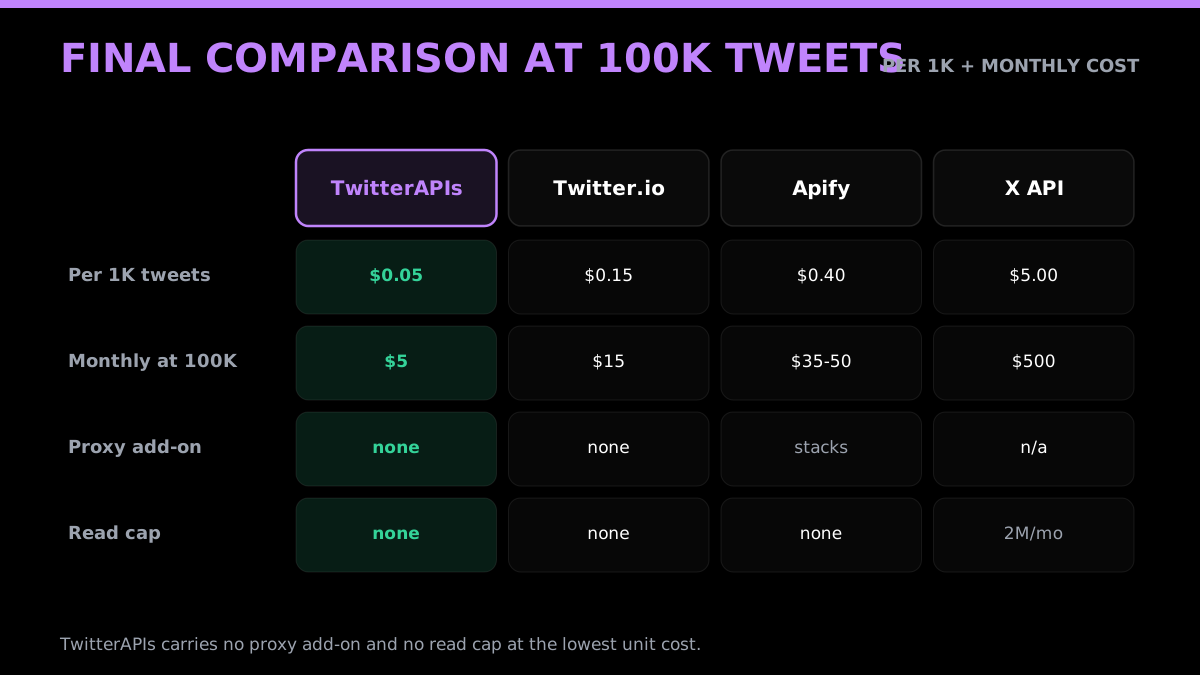
| Provider | Per 1K tweets (mid-vol) | Monthly at 100K | Notes |
|---|---|---|---|
| Official X API | $5.00 | $500 | $0.20/post with URL, 3M read cap |
| Bright Data | $1.50 (+ proxy) | $150-300 | Highest success rate (98.44%) |
| RapidAPI | $0.50-5.50 | $50-550 | Rate varies by listing |
| Apify | $0.25-0.40 (+ overhead) | $35-50 est. | Platform overhead adds 30-50% |
| SocialData.tools | $0.20 | $20 | Profile endpoint jumps to $0.001 |
| TweetAPI.com | $0.11 | $57 (subscription) | Rate assumes full quota use |
| TwitterAPI.io | $0.15 | $15 | Lists 75 endpoints, pay-per-use |
| TwitterAPIs | $0.04 | $4 | No minimum, no proxy add-on |
All figures at 100,000 tweets a month. Bright Data includes estimated proxy overhead. Apify includes an estimated 30% platform overhead. The official X API figure is read-only; writes bill separately.
Starting fresh and want one tutorial that ties the cheapest path together? The complete Twitter API tutorial for 2026 is the place to begin.
The same cost calculus keeps surfacing in scraping threads, where developers ask for a workable path over and over:
Is there a current solution to scrap tweets
The 100x-plus spread between TwitterAPIs and the official X API at 100K tweets a month is not a glitch in someone's pricing. It reflects who absorbs the infrastructure cost. Third-party providers compete on price because they must, while the official API prices against what it can extract from teams that need official write access or compliance cover.
If you want a single rule of thumb, work the bill backwards from your monthly tweet count before you read a single feature list. Multiply your expected volume by each provider's effective per-1K rate, add a failure cushion for any scraping-based option, and only then weigh endpoint coverage and reliability on top. Most teams that skip that step over-buy: they pick a subscription sized for a peak they hit twice a year, or an enterprise plan to cover a write workload they could have run through a thin official account for the price of lunch. The cheap path and the reliable path are not always the same path, but the gap between them is something you can put a number on, and that number is usually smaller than the headline pricing pages imply.
For most read-heavy work in 2026 the migration math is simple. The open question is which third party matches your endpoint coverage, your volume curve, and your tolerance for failure-rate risk. That answer depends on your specific pipeline, which is why the matrix above is the output of this post, not a single winner.
// sources
Where these numbers come from
Each row is a figure in this post and the artefact it was read from. Prices and limits on this platform move, so check the date on the source before you plan against it.
- TwitterAPI.io X API cost breakdown 2026
- Source of the $0.00015 per read figure, the $1 trial credit worth roughly 6,667 reads, and the 2M-read comparison where $300 sits against roughly $10,000 on the official API.
- SocialData.tools pricing documentation
- Backs the $0.0002 per tweet or user profile returned, the rule that failed requests are not charged, and the standing 3-requests-a-minute free allowance.
- Apify platform pricing documentation
- Backs the failed-run billing trap, that a run hitting a proxy timeout or a bot-detection block still incurs the full compute unit and proxy cost even when it returns zero tweets.
- Bright Data Twitter data provider pricing post
- Source of the Bright Data row in the ranking, pay-as-you-go at $1.50 per 1,000 records, the $499 per month Scale plan for 384K records at $1.30 per 1K, and the promo rate of $0.75 per 1K for three months.
- PostProxy X API pricing breakdown 2026
- Backs the February 2026 shift making pay-per-use the default for new X API developers and the closure of the Basic plan at $200 per month for 10K reads and the Pro plan at $5,000 per month for 1M reads.
- Blotato Twitter API pricing analysis
- Source of the link surcharge figures, $0.015 for a plain post against $0.20 for a post carrying a URL, and the worked example of a scheduling tool paying about $325 a month for 3,000 posts with half of them linked.
Frequently Asked Questions
TwitterAPIs has the lowest published pay-as-you-go read rate in the market: $0.0008 per API call, and because each call returns up to 20 tweets, that lands near $0.04 per 1,000 tweets. There is no subscription, no monthly floor, and new accounts get $0.50 in free credits, enough for roughly 12,500 tweets.
No. The free tier closed in early 2026 and every new developer now lands on the pay-per-use plan. Developers who had been on the old free tier received a one-time $10 credit when it shut down.
Yes. TwitterAPIs, TwitterAPI.io, SocialData.tools, TweetAPI.com, the Apify actors, RapidAPI listings, and Bright Data all return Twitter data without you ever holding an X developer account. Each one owns the authentication layer so you do not have to.
TwitterAPIs, by a wide margin. At 100,000 tweets a month TwitterAPIs runs about $4, while Apify pay-per-result actors list at $18 to $40 before you add failed-run billing, compute units, proxy variance, and storage. Independent side-by-sides put TwitterAPIs far below Apify's effective rate at that volume.
The pay-per-use X API meters reads at $0.005 each, so 1,000 tweet reads cost $5.00. Writing is separate: a plain post is $0.015 to create, but a post that contains a link jumps to $0.20, a 1,233% premium for the same action.
Watch for five: Apify charging full compute and proxy for runs that return nothing, the official X API's $0.20 link surcharge versus $0.015 for a plain post, RapidAPI listings that meter per-call and per-result at the same time, Bright Data's residential proxy bandwidth billed on top of per-record fees ($3 to $8.40 per GB), and TweetAPI quota you pay for but never use.
Nothing upgrades automatically. The pay-per-use plan stops at 3M reads a billing cycle, and crossing it means negotiating an Enterprise contract whose price X does not publish. There is no step between the $15,000 pay-per-use ceiling at that cap and whatever Enterprise turns out to cost.
Check out similar blogs
More guides on the Twitter/X API, scraping, and pricing.
How to Choose a Twitter/X API in 2026: The Complete Buyer's Guide
A decision framework for choosing a Twitter/X API in 2026: the seven criteria that actually matter (pricing model, data coverage, rate limits, auth, reliability, compliance, migration cost), a use-case decision tree, and where each path wins.

X API Pricing in 2026: The Full Timeline, the Real Rate Card, and a Survival Playbook by Workload
The 2026 X API pricing story in full: the February pay-per-use switch, the April link-tweet jump to $0.20, the frozen legacy tiers, and a workload-by-workload plan for what to pay, cut, or move.
Build vs Buy: Should You Build Your Own Twitter/X Monitoring Tool? (2026)
Buying a listening seat costs $29 to $2,000 a month depending on the vendor. Building costs real engineering hours plus a data bill. Here is the real math behind the twitter monitoring tool build vs buy decision, priced both ways.
Twitter/X API Access Without a Developer Account: What Actually Works in 2026
The official X API still gates every call behind a reviewed developer account and OAuth 2.0. Here is what real developers use instead, and what each route actually costs.
The Twitter API Developer Reference (2026): Endpoints, Rate Limits, Error Codes and Pagination
A single indexed reference for the Twitter/X API in 2026: the endpoint catalog, how authentication and bearer tokens work, the rate limits behind every 429, what error codes 401, 403, and 429 mean, cursor pagination, response shapes, and the real per-call cost of each call.

Is the Twitter API Free in 2026? What the Free Tier Actually Gives You
The X API free tier is write only: 1,500 posts a month, zero read access. Here is the full 2026 cost ladder and where pay-per-call APIs fit for read-heavy work.

RapidAPI Twitter Alternative: Direct API vs Marketplace
Weighing a RapidAPI Twitter alternative? See how marketplace listings stack up against the official X API and TwitterAPIs on cost, uptime, billing, and switching effort.

Apify Twitter Scraper vs TwitterAPIs: The Real 2026 Numbers
The honest 2026 breakdown of Apify Twitter Scraper against the TwitterAPIs REST API: what each billing model really costs per 1,000 tweets, latency, failure modes, and a 60-minute bake-off you can run before you commit.