GUIDE
TwitterAPIs Is Live on Uneed: A $0.0008 Twitter API With No Developer Account
TwitterAPIs launched on Uneed today. What the pay-per-call Twitter API costs next to the official X API, how a Uneed launch day actually works, and what founders say one delivers.
Per our own spec, 62 of 109 endpoints bill $0.0008, 24 are free, and 23 sit between $0.0016 and $0.01. Every price ships inside our published OpenAPI document as an x-cost-usd field, so any figure in this post can be checked against the contract that bills it rather than taken on trust.
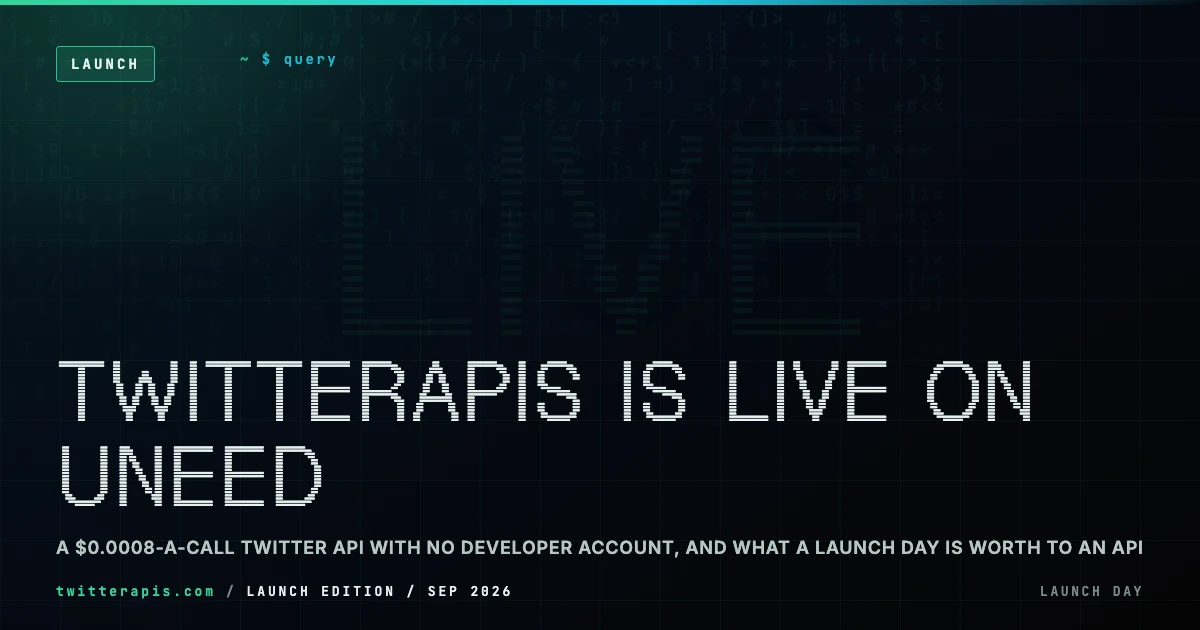
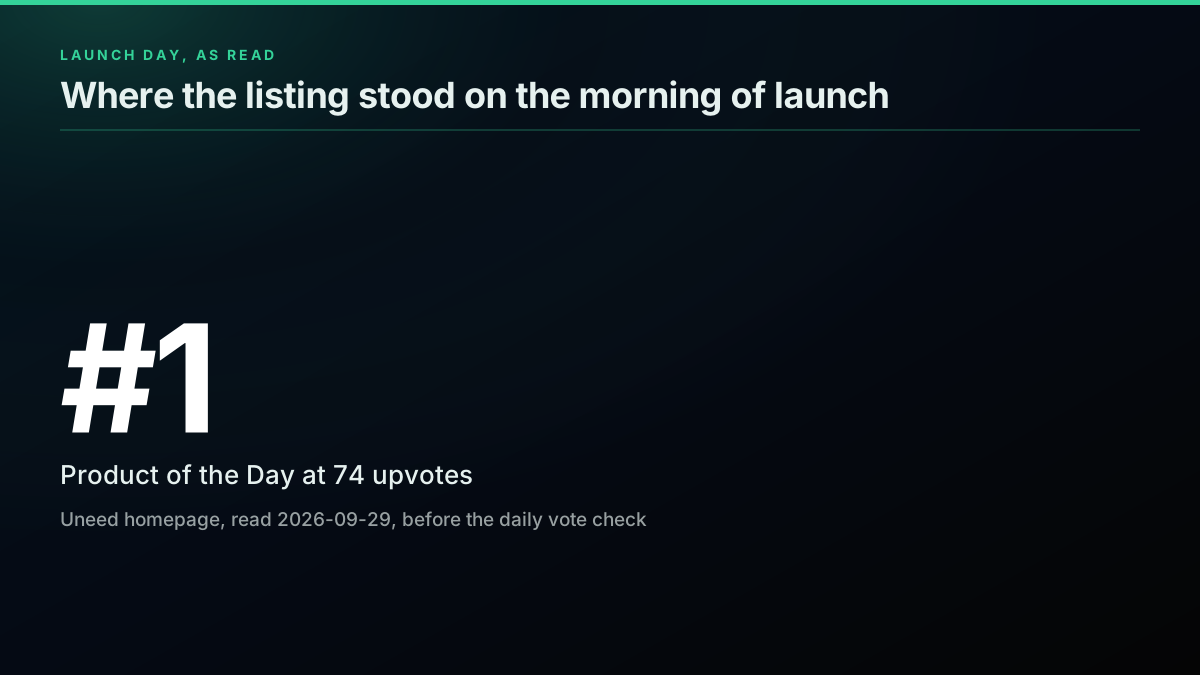
TL;DR: TwitterAPIs went live on Uneed on 2026-09-29 and held #1 Product of the Day with 74 upvotes when we read the homepage that morning. It is a pay-per-call Twitter API: $0.0008 for a standard call that returns about 20 tweets, roughly $0.04 per 1,000 tweets, where the official X API bills $5.00 for 1,000 post reads. No developer account, no plan, $0.50 in free credits. Uneed launches at least 30 free products a day and emails its weekly top 3 to 26,000 plus subscribers. Founders report outcomes from 20 plus signups to zero, so we will publish ours.
We launched on Uneed today. This post covers three things a visitor coming from the listing will want: what the product is and what it costs, how that compares with getting the same data from X directly, and how a Uneed launch actually works, including the parts founders complain about. If you only want to try it, the fastest route is the signup page and one curl command, shown further down.
The short answer
TwitterAPIs launched on Uneed on 2026-09-29 and sat at #1 Product of the Day with 74 upvotes when we read the homepage that morning. It is a pay-per-call Twitter API: $0.0008 for a standard call that returns about 20 tweets, roughly $0.04 per 1,000 tweets, against $5.00 for 1,000 post reads on the official X API. No developer account, no monthly plan, $0.50 in free credits at signup. Uneed launches at least 30 free products a day, keeps four leaderboards and emails its weekly top 3 to 26,000 plus subscribers. Founders report results from 20 plus signups to zero, so we will publish ours.
What is TwitterAPIs, the product on today's Uneed listing?
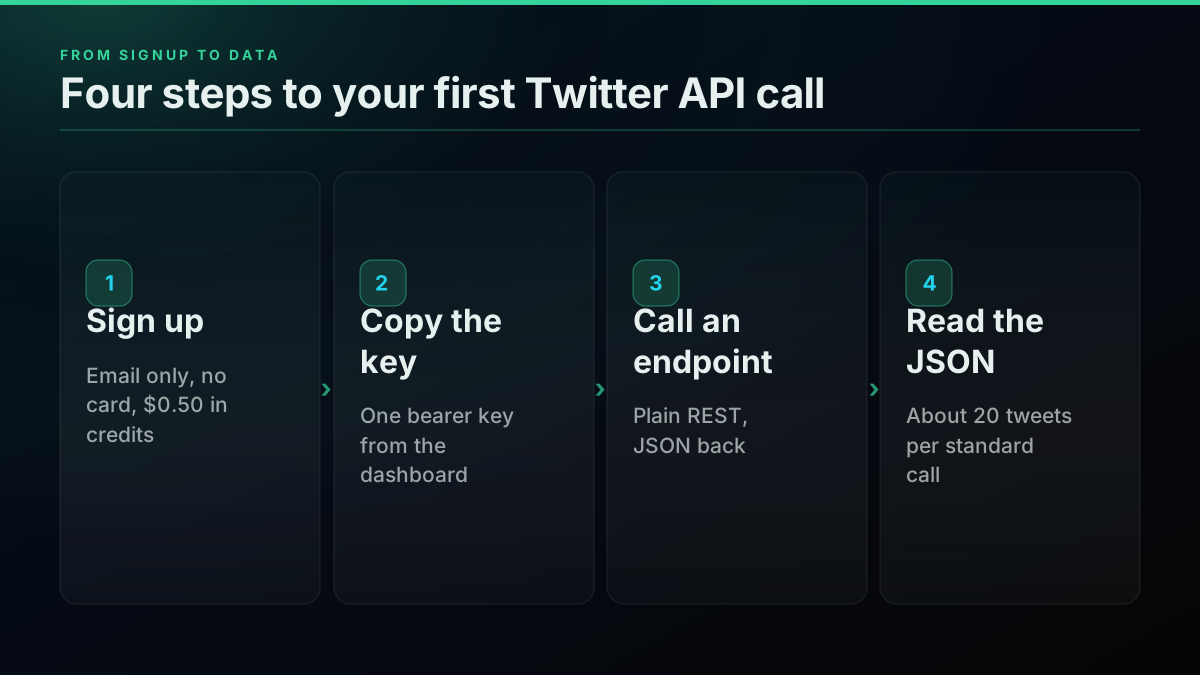
TwitterAPIs is a pay-per-call Twitter API for developers who need X data as clean JSON without applying for an X developer account. You sign up with an email, the dashboard issues one bearer key, and every endpoint is plain REST: search, user timelines, followers, replies, lists, communities, trends, Spaces, and write actions such as posting, replying and sending DMs.
The listing on Uneed sums it up in one line: a Twitter API at $0.0008 per call, no X developer account, no subscription. That line is accurate, and the rest of this post puts numbers behind it.
The product exists because the two common ways to get X data both have a cost that surprises people, a point our explainer on whether the Twitter API is free covers from the other side. The official API bills every post you read, and the resulting bill for a research script or a monitoring tool is often ten to a hundred times what the builder expected. Scraping avoids the bill but hands you a maintenance job, because every change to X's front end breaks the scraper, which our comparison of Tweepy, Twikit and snscrape shows in practice. A per-call API sits between the two: you pay for calls, somebody else keeps the extraction working. Our guide to X API access without a developer account walks through every route in more depth.
I want to slowly reduce the importance of the launch platform on Uneed. Ideally, I'd like to have 10 new super interesting products launching everyday, not more.
What does a Twitter API call cost on TwitterAPIs?
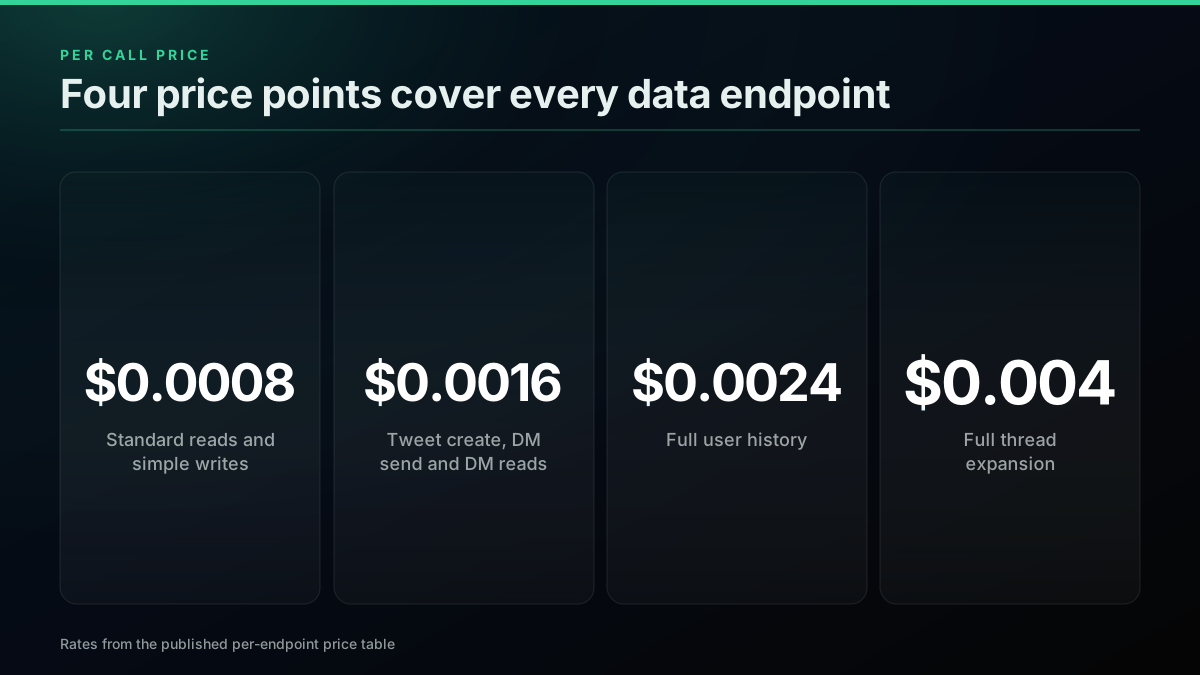
A standard call costs $0.0008 and returns about 20 tweets, which is roughly $0.04 per 1,000 tweets. Four price points cover every data endpoint, and the one account login call costs $0.01: standard reads and simple writes at $0.0008, tweet creation and DMs at $0.0016, a complete user history at $0.0024 and a full thread expansion at $0.004. There is no subscription, and top-ups start at $10.
TwitterAPIs per-call prices by endpoint tier
| Tier | Example endpoints | Price per call | Per 1,000 calls | Source |
|---|---|---|---|---|
| Standard | Search, user tweets, followers, replies, likes, follow | $0.0008 | $0.80 | measured |
| Premium write | Tweet create, DM send, DM reads | $0.0016 | $1.60 | measured |
| Full history | Complete user tweet history | $0.0024 | $2.40 | measured |
| Full thread | Thread expansion | $0.004 | $4.00 | measured |
Three details matter more than the headline rate. New accounts get $0.50 in free credits with no card, which is 625 standard calls. Credits do not expire, so a month where your script sleeps costs nothing. And paying in crypto adds 2 percent bonus credits on top of the amount you top up. The full pricing page lists every endpoint individually, and the cost calculator turns a workload into a monthly figure before you write any code.
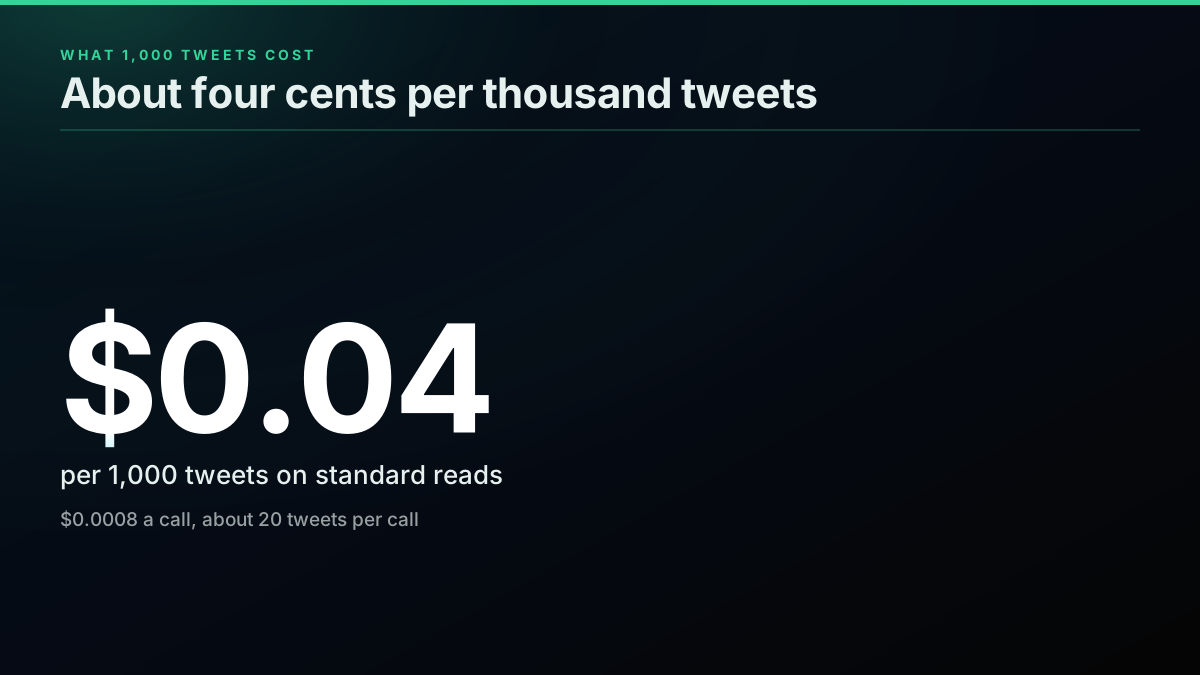
The per-tweet figure depends on how full each page is. A search on a quiet keyword can return fewer than 20 tweets, and then the cost per tweet rises proportionally even though the cost per call does not. Our breakdown of what the Twitter API costs by workload shows the numbers for monitoring, research and export jobs separately.
See every endpoint's price before you build
The full per-endpoint price table, from $0.0008 standard reads to the premium write and thread calls.
How does that compare with the official X API?
The official X API moved to pay per use and bills each resource you read: $0.005 per post and $0.010 per user, according to X's own pricing page. Reading 1,000 posts therefore costs $5.00 there, against about $0.04 through standard calls here. That is a gap of more than 100 times on reads.
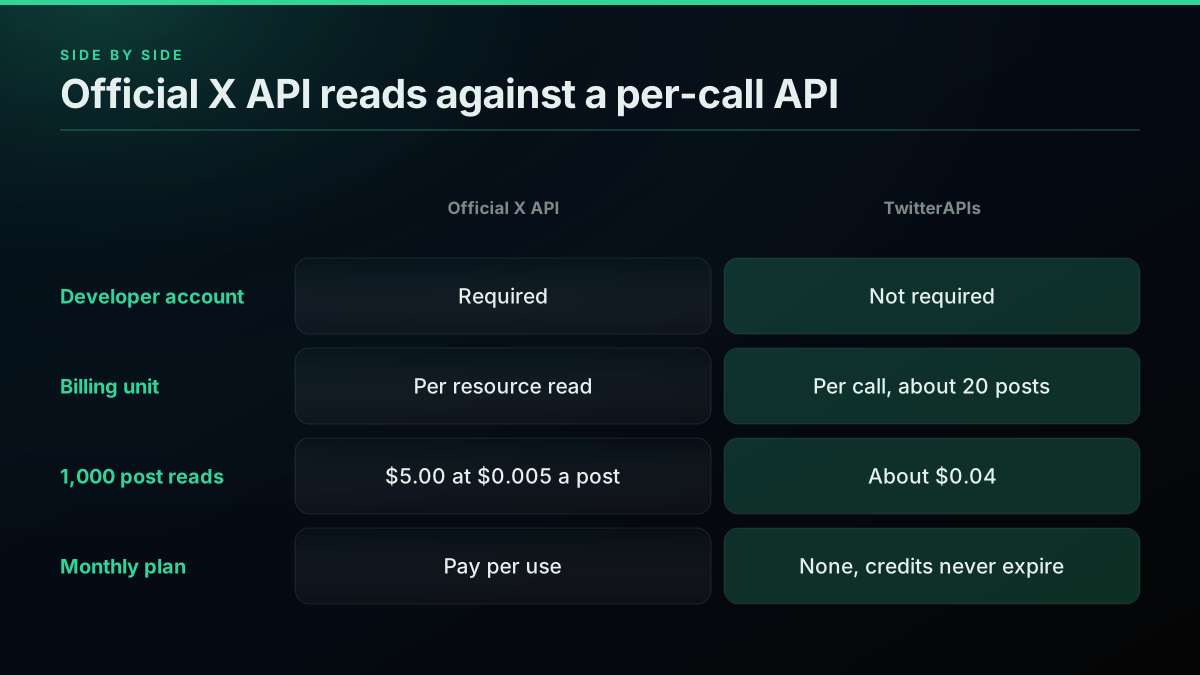
Reading 1,000 posts: official X API against TwitterAPIs
| Route | Billing unit | Cost for 1,000 posts | Developer account | Plan | Source |
|---|---|---|---|---|---|
| Official X API | Per post read at $0.005 | $5.00 per 1,000 posts | Required | Pay per use | measured |
| TwitterAPIs | Per call, about 20 posts | About $0.04 per 1,000 posts | Not required | None, credits do not expire | derived |
The comparison is not all one way, and we would rather say so here than have a reader discover it later. The official API is X's own contract, which matters to procurement teams and to anyone who needs enterprise terms. Its webhooks deliver account activity without polling. It also carries no third-party dependency. Our X API pricing change explainer covers what moved in 2026 and who it hurt most, and the price sheet across every tier and alternative puts every option on one page.
The read bill is where third-party APIs win
The official X API bills each post read as a resource at $0.005, so a research script that reads 200,000 posts in a month spends $1,000 on reads alone. The same 200,000 tweets through standard calls at about 20 per call is 10,000 calls, or $8.00. The gap narrows for writes, where premium calls cost $0.0016, and it closes entirely when you need X's own contract or delivery guarantees.
docs.x.com pricing and the TwitterAPIs per-endpoint price table, read 2026-09-29
Route selection
Three ways to get X data in 2026
| Official X API | TwitterAPIs | Self-hosted scraper | |
|---|---|---|---|
| Account or approval | X developer account | Email signup | X accounts to log in with |
| Cost for 1,000 posts | $5.00 per 1,000 posts | About $0.04 per 1,000 posts | Proxies and account upkeep |
| Maintenance | Handled by X | Handled for you | Yours, every time X changes |
| Best for | Enterprise contracts | Reads at low cost, fast start | Teams with scraping staff |
What can you build with it on the first afternoon?
Most people who sign up start with one of five jobs: keyword and brand monitoring through advanced search, follower and audience pulls, account watchers that post new tweets to a webhook, posting automation, and tools for AI agents. Each is a handful of calls, and each has a worked guide on this blog.
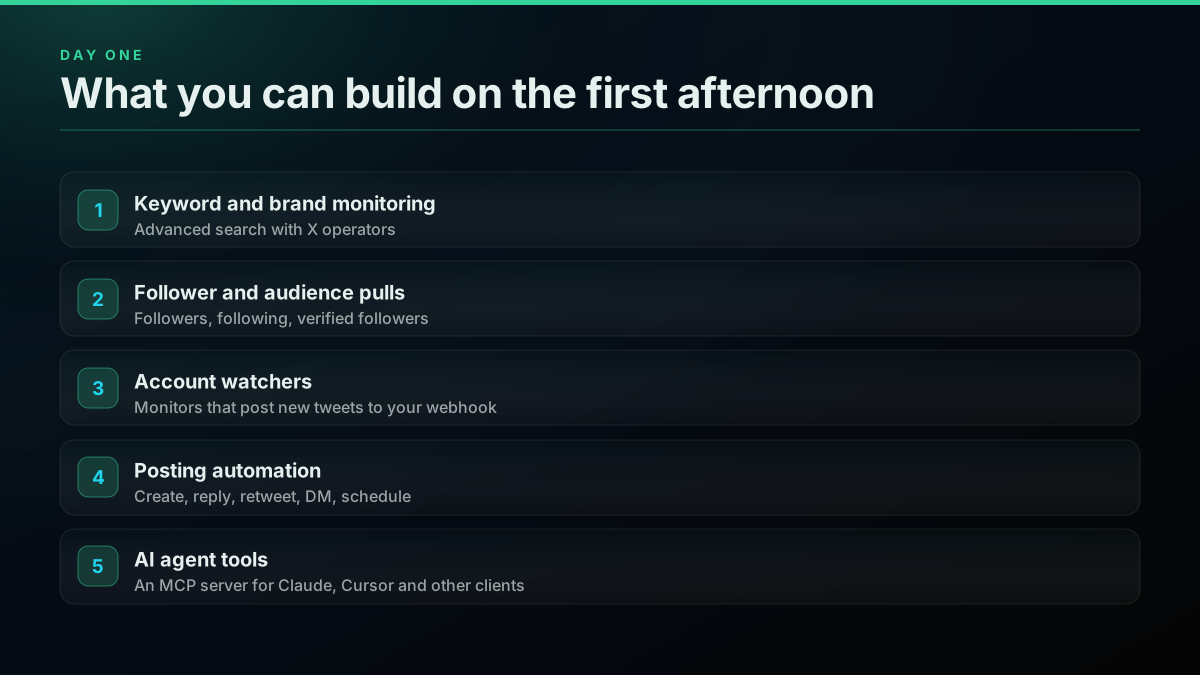
For monitoring, the real-time mentions guide covers search operators and polling cadence. For audiences, the follower export guide pages through a full follower list. For a complete working example, the crypto Twitter tracker in Python watches a list of accounts and alerts on contract addresses, with the monthly bill priced for 25 and 100 accounts. For agents, the Twitter MCP server lets Claude, Cursor and other clients of the Model Context Protocol query X directly. For analysis work, the sentiment analysis in Python guide scores a search result set end to end. If you are starting from zero, the Python Twitter API tutorial is the shortest path to a first script.
The fastest proof is a single request. This pulls the latest posts from one public account:
curl -s "https://api.twitterapis.com/twitter/user/tweets?username=XDevelopers" \
  -H "Authorization: Bearer $TWITTERAPIS_KEY"
The response is JSON with about 20 tweets, each carrying its text, timestamps, engagement counts and expanded links, plus a cursor for the next page. That one call costs $0.0008 from the signup credit. Here is the first item of a real page we pulled on launch morning, trimmed to five fields:
{
  "count": 20,
  "has_more": true,
  "next_cursor": "DAAHCgABHTY4keV__-sLAAIAAAATMjA5...",
  "tweets": [
    {
      "id": "2102535041532186709",
      "text": "X Livestream API has been rebuilt from the ground up. ...",
      "created_at": "Tue Sep 22 23:06:31 +0000 2026",
      "favorite_count": 550,
      "is_retweet": false,
      "is_reply": false
    }
  ]
}
One real call
The timeline read behind the JSON sample above
Calls: 1 · Cost: $0.0008 · Items returned: 20
☑ 20 items and a cursor for the next page · ☑ 1 original post, 1 reply, 18 retweets · ☑ No developer account, no OAuth setup
Notice the is_retweet and is_reply flags. The timeline endpoint returns what X shows on the profile, so on that page 18 of the 20 items were retweets. The same request in Python, keeping original posts only:
import os
import requests

API = "https://api.twitterapis.com/twitter/user/tweets"
HEADERS = {"Authorization": f"Bearer {os.environ['TWITTERAPIS_KEY']}"}

page = requests.get(API, params={"username": "XDevelopers"}, headers=HEADERS, timeout=30).json()
originals = [t for t in page["tweets"] if not t["is_retweet"] and not t["is_reply"]]
for t in originals:
    print(t["created_at"], t["favorite_count"], t["text"][:80])
To go further back, pass next_cursor into the next request and stop when has_more is false. Every page is one billed call:
def all_pages(username, max_pages=5):
    cursor, calls = None, 0
    while calls < max_pages:
        params = {"username": username}
        if cursor:
            params["cursor"] = cursor
        page = requests.get(API, params=params, headers=HEADERS, timeout=30).json()
        calls += 1
        yield from page["tweets"]
        if not page.get("has_more"):
            break
        cursor = page["next_cursor"]
Search works the same way with X's own operators. The same idea in Node, using the built-in fetch API:
const url = new URL("https://api.twitterapis.com/twitter/tweet/advanced_search");
url.searchParams.set("query", "uneed.best -filter:replies min_faves:10");
url.searchParams.set("product", "Latest");

const res = await fetch(url, {
  headers: { Authorization: `Bearer ${process.env.TWITTERAPIS_KEY}` },
});
const { tweets, next_cursor } = await res.json();
console.log(tweets.length, "tweets", next_cursor ? "more available" : "end");
Before a job runs, the bill is one line of arithmetic, because every call has a fixed price:
PRICE = {"standard": 0.0008, "premium_write": 0.0016, "full_history": 0.0024, "thread": 0.004}

def monthly_cost(calls_per_day, tier="standard", days=30):
    return round(calls_per_day * days * PRICE[tier], 2)

print(monthly_cost(500))           # 500 searches a day: 12.0
print(monthly_cost(100, "thread")) # 100 thread expansions a day: 12.0
The Python samples use the requests library, and the shell one uses plain curl, so nothing here needs an SDK. The Node.js tutorial and the guide to scraping full tweet history take both further.
Make your first call from the free credit
Sign up with an email, copy your key and pull 20 tweets for $0.0008. The $0.50 signup credit covers 625 standard calls.
Start building with TwitterAPIs
$0.0008 a call, about $0.04 per 1,000 tweets at 20 tweets a page. $0.50 free credits. No credit card required.
Why launch a developer API on Uneed at all?
Because the people who browse and vote on Uneed are mostly makers, and makers are the people who need cheap X data: indie hackers building monitors, social tools, lead finders and AI agents. A launch puts the product in front of that audience for one day, and a good day can keep it in front of them for a week through the newsletter.
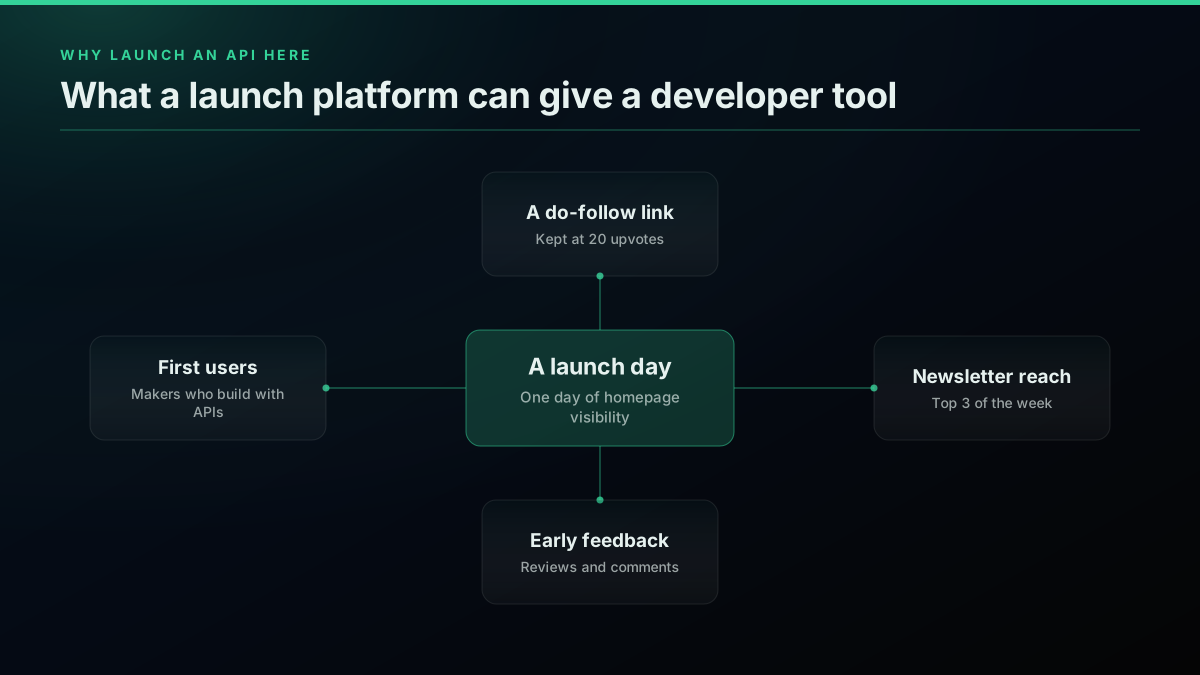
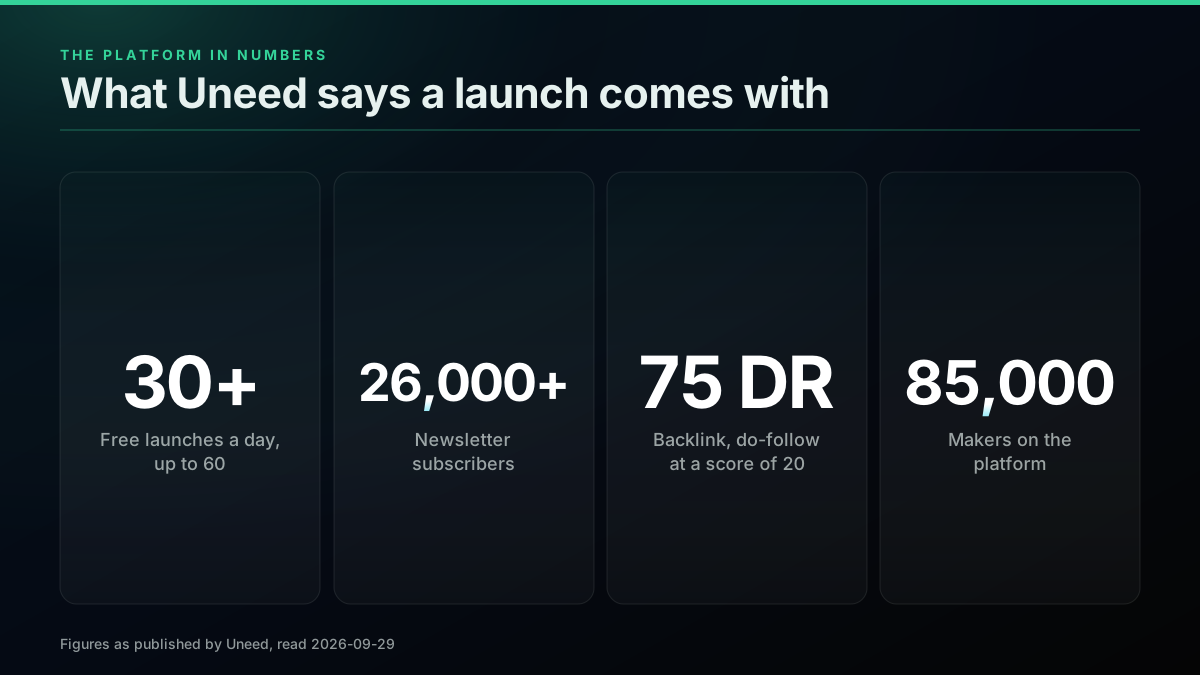
There are three concrete returns beyond the day itself. Uneed gives a do-follow backlink from a site it describes as 75 DR, kept as long as a free launch reaches an upvote score of 20 on launch day, and its pricing page sets out what the paid launch options add. The weekly top 3, plus two picks by the team, go out in a newsletter to more than 26,000 subscribers. And the listing collects reviews and comments from people who have actually tried the product, which is feedback a developer tool rarely gets this early.
We do not expect revenue from the launch, and we would be suspicious of anyone who promised it. The value we are after is the right fifty people trying the API and telling us what broke.
How does a Uneed launch day actually work?
Every day at 12
AM PST a new batch goes live on the Uneed homepage: at least 30 free launches pulled from a waiting line, up to 60 when the line is long, plus every paid launch. Launch day is the one day a product competes for Product of the Day, but votes keep counting afterwards on three rolling leaderboards.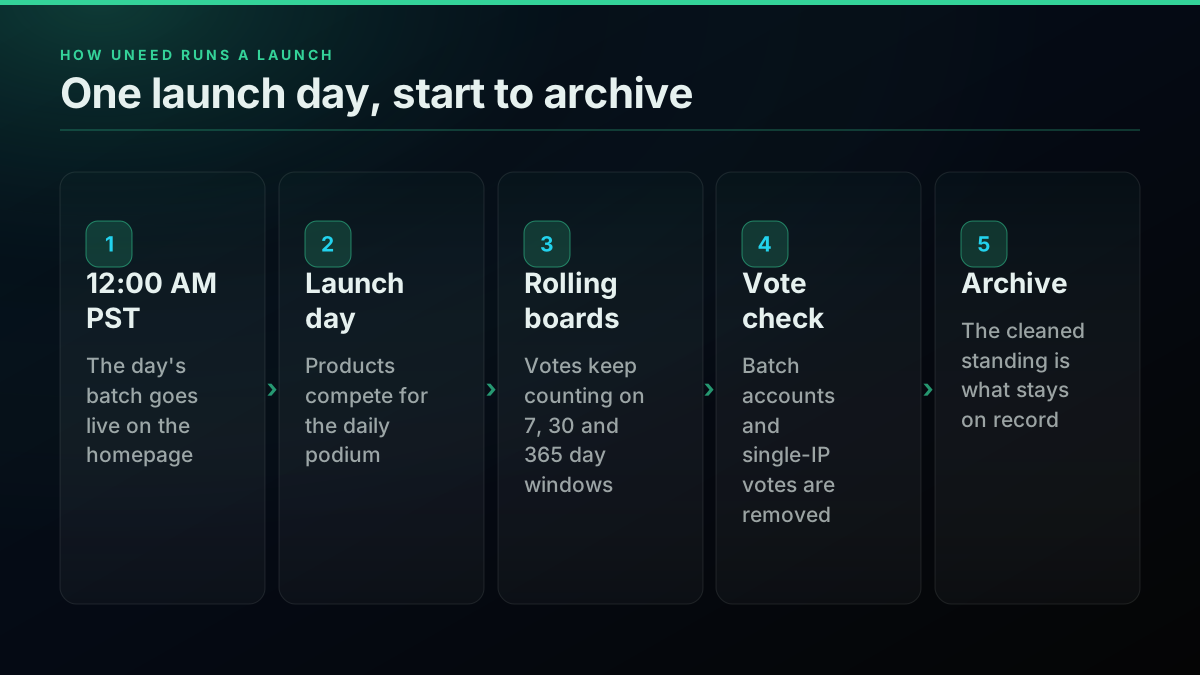
How a Uneed launch works, from its own pages
| Item | What Uneed says | Source |
|---|---|---|
| Launch time | 12:00 AM PST every day | measured |
| Free launches a day | At least 30, up to 60 when the line is long | measured |
| Longest free wait | Up to 5 months | measured |
| Leaderboards | Day, plus rolling 7, 30 and 365 days | measured |
| Newsletter | Weekly top 3 plus 2 picks, 26,000 plus subscribers | measured |
| Stays published (free) | Upvote score of 10 on launch day | measured |
| Do-follow backlink (free) | Upvote score of 20 on launch day | measured |
| Vote integrity | Batch-created and single-IP votes removed | measured |
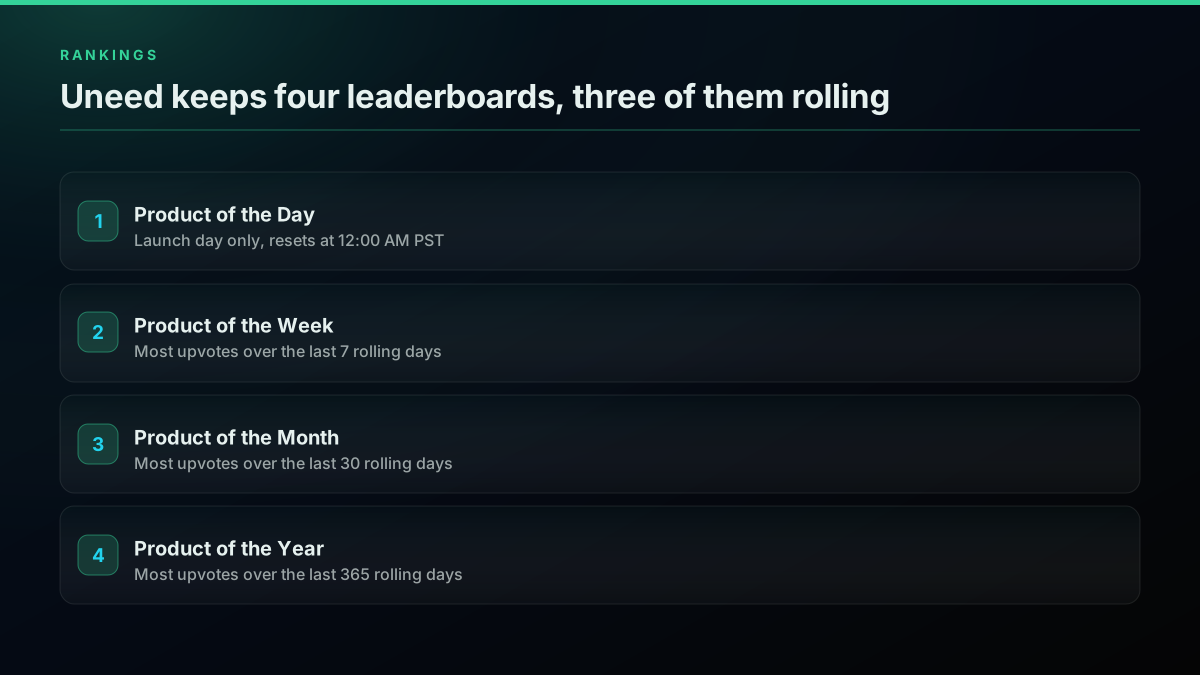
The rolling part is the detail most people miss. The weekly board is the last 7 days, the monthly board the last 30 and the yearly board the last 365, so a product can climb after its launch day as users keep voting. The how it works page explains the windows, and the launch guide covers preparation.
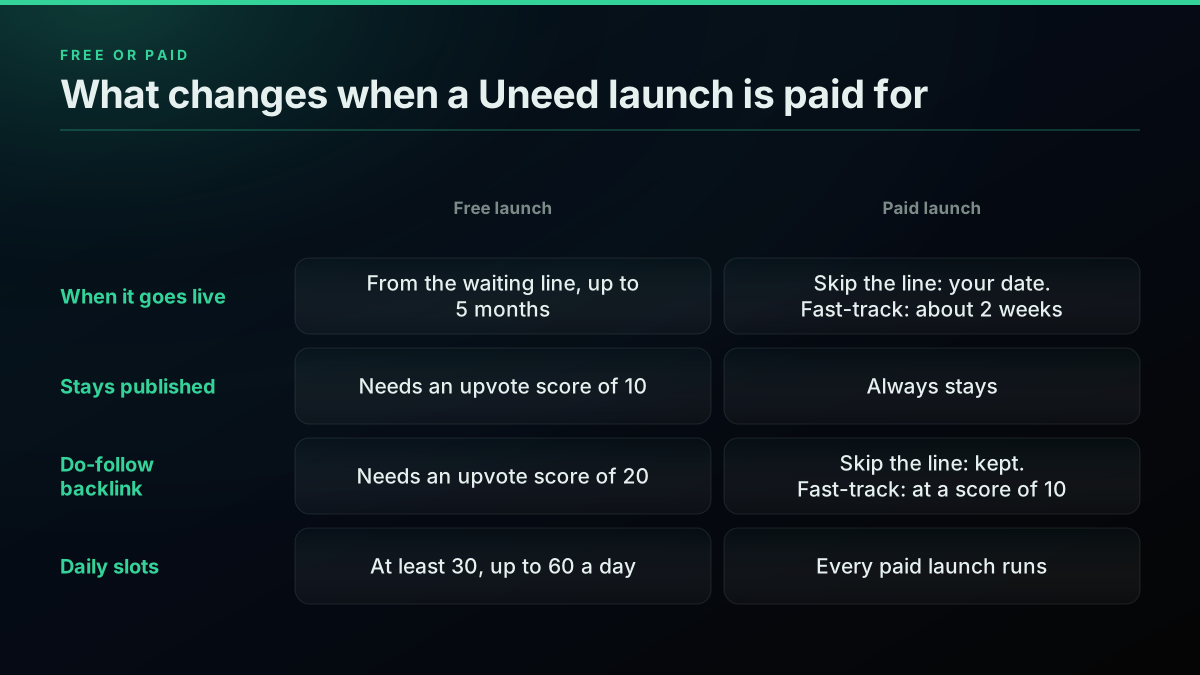
Two rules shape the numbers you see. A free launch needs an upvote score of 10 on launch day to stay published and 20 to keep its do-follow link, while paid launches always stay. The score is weighted, because streaks and Pro memberships multiply a voter's upvote. And Uneed removes votes from accounts created in a batch or from a single IP address, so the standing at the end of the day can differ from the live count. The FAQ states the free queue never goes past 5 months.
A live Uneed rank is not the final rank
Uneed removes votes that come from accounts created in a batch or from a single IP address, so the standing at the end of the day can differ from what the homepage showed in the morning. Our 74 upvote read was taken before that check. The daily archive is the number that counts, and it is the one we will report.
uneed.best/how-it-works, read 2026-09-29
What do founders say a Uneed launch delivers?
Results vary more than any launch platform's homepage suggests. At the good end, one maker reported #1 on Uneed with 69 upvotes on the same day as #4 on Product Hunt, with hundreds of page views and more than 20 signups. At the other end, founders report paid slots that drew nothing.
https://x.com/JarekAvi/status/2020504544350765429
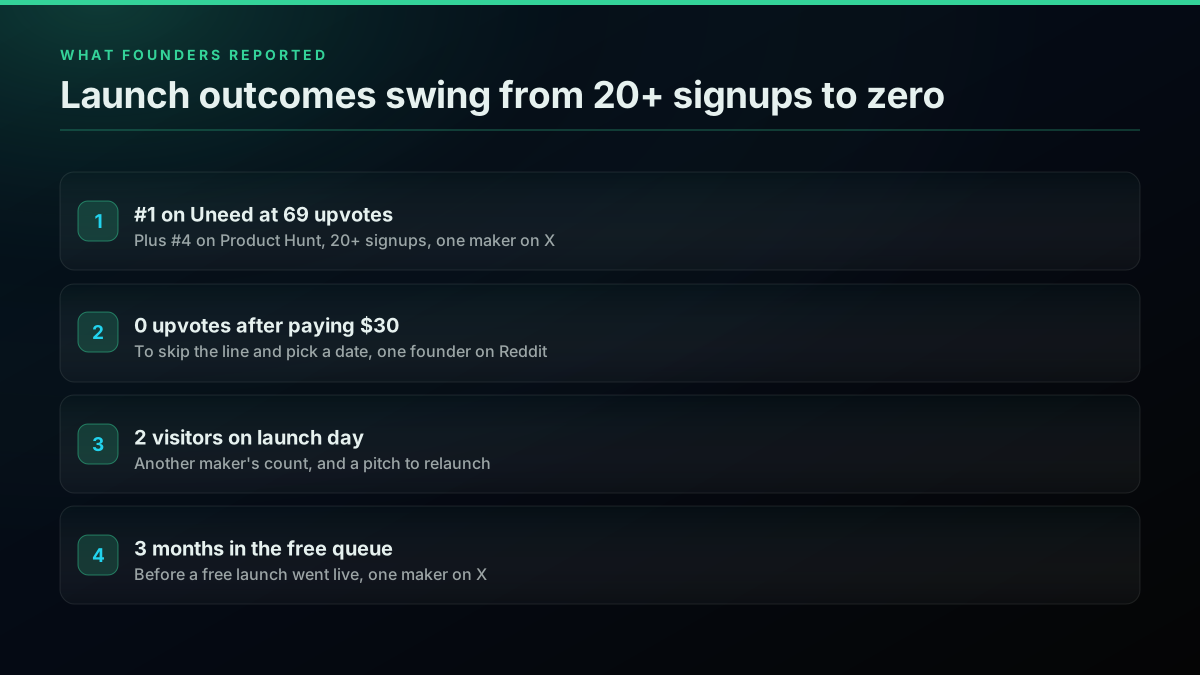
The most useful discussion we found is a thread in r/SaaS that asked founders for real numbers rather than success stories. Across 70 comments, the pattern is consistent: platforms deliver when the founder brings an audience, and deliver little when they do not.
https://www.reddit.com/r/SaaS/comments/1viwlmo/founders_who_launched_on_product_hunt_microlaunch/
Not looking for success stories specifically. If you paid $50, got 12 visitors and zero signups, that's honestly just as useful to know.
In that thread, one founder wrote that their app got 110 upvotes on Product Hunt, then paid $30 on Uneed to skip the waiting line and choose a date, and got 0 upvotes. Another counted 2 visitors from their launch date. The free route has its own cost in time: one maker waited 3 months in the queue before going live.
https://x.com/vaaselene/status/2084248261804580957
The founder of Uneed has also said publicly that he wants fewer launches a day, closer to 10 strong products than the current 30 or more, to leave more room for the community. That fits the complaint in the r/SaaS thread that launch lists fill up with other launch tools.
A first-time maker in r/micro_saas described a more typical good day: listed on a few directories first, bought a skip-the-line slot to launch on a Monday rather than a Friday, shipped a demo video the week before, and reached #4 within a couple of hours.
https://www.reddit.com/r/micro_saas/comments/1wsgl2l/first_launch_ever_4_on_uneed_with_a_solobuilt/
For a wider view of the same question across many platforms, this walkthrough of launching one SaaS everywhere compares what each site actually sent.
https://www.youtube.com/watch?v=0sUxbZmZK60
Where did TwitterAPIs stand on launch morning?
When we read the Uneed homepage on the morning of 2026-09-29, TwitterAPIs was #1 in the day's launches with 74 upvotes, ahead of the #2 product at 47 and the #3 product at 39. That is a live count taken before Uneed's end-of-day vote check, so treat it as a snapshot, not a result.
Launch day
TwitterAPIs on the Uneed homepage, launch morning
Daily rank: #1 · Upvotes: 74 · Next product: 47
☑ Listed as a Twitter API at $0.0008 per call · ☑ No X developer account, no subscription · ☐ Rank read before the end-of-day vote check
We are reporting it because the next section commits us to reporting the rest. A launch post that shows only the good morning number is the kind of post the r/SaaS thread was complaining about.
The cheapest pay-as-you-go Twitter API. Try it free.
$0.0008 a call, about $0.04 per 1,000 tweets at 20 tweets a page. $0.50 free credits. No credit card required.
What will we report back after launch week?
Four numbers, published on this blog once the week settles: referral visits from Uneed in our own analytics, signups whose source names Uneed, paid top-ups from those signups within 7 days, and the final daily and weekly standing from the Uneed archive after the vote check.
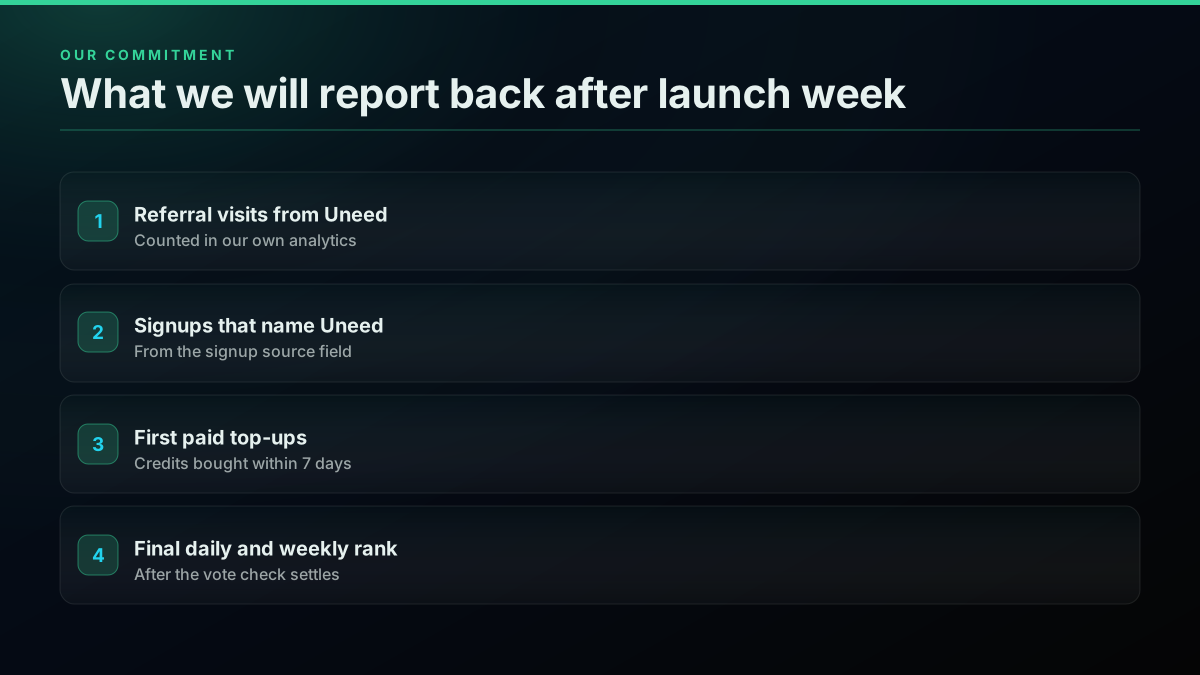
If the answer is 40 visits and 3 signups, we will say that. It is the number other API builders deciding whether to launch here actually need, and it is cheap for us to publish because we already measure all four.
How do you try TwitterAPIs in five minutes?
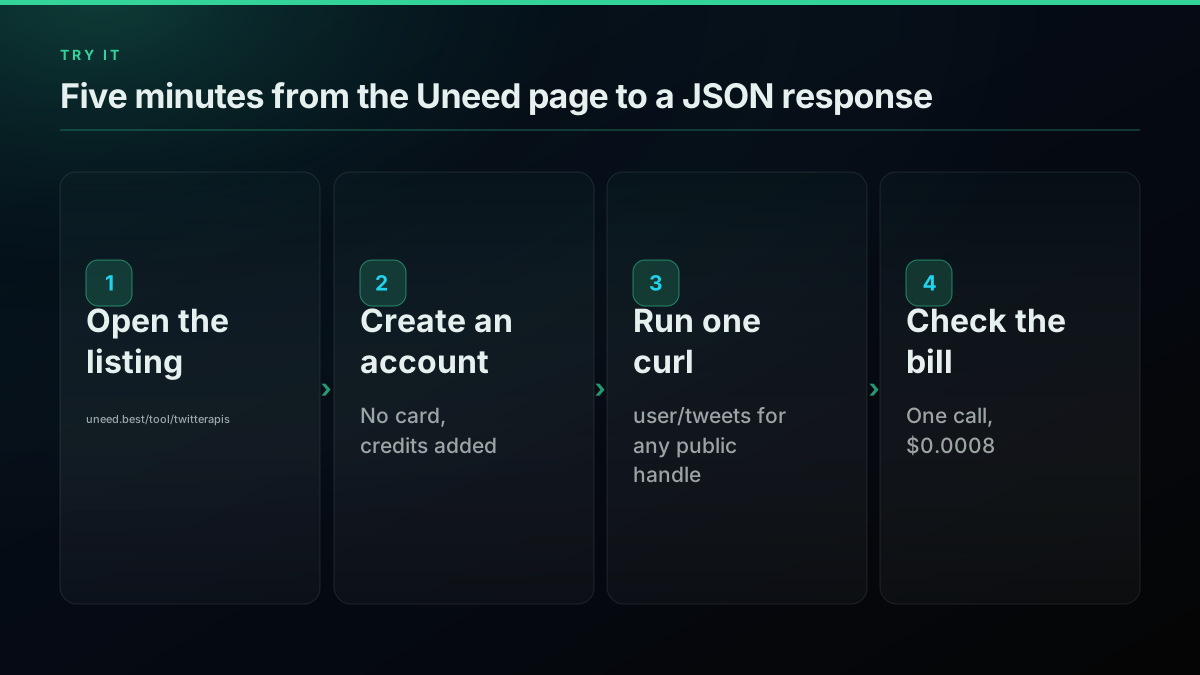
Open the Uneed listing or go straight to the signup page, create an account with an email and copy your key. Run the curl command above against any public handle and you will get about 20 posts as JSON for $0.0008, paid from the $0.50 credit.
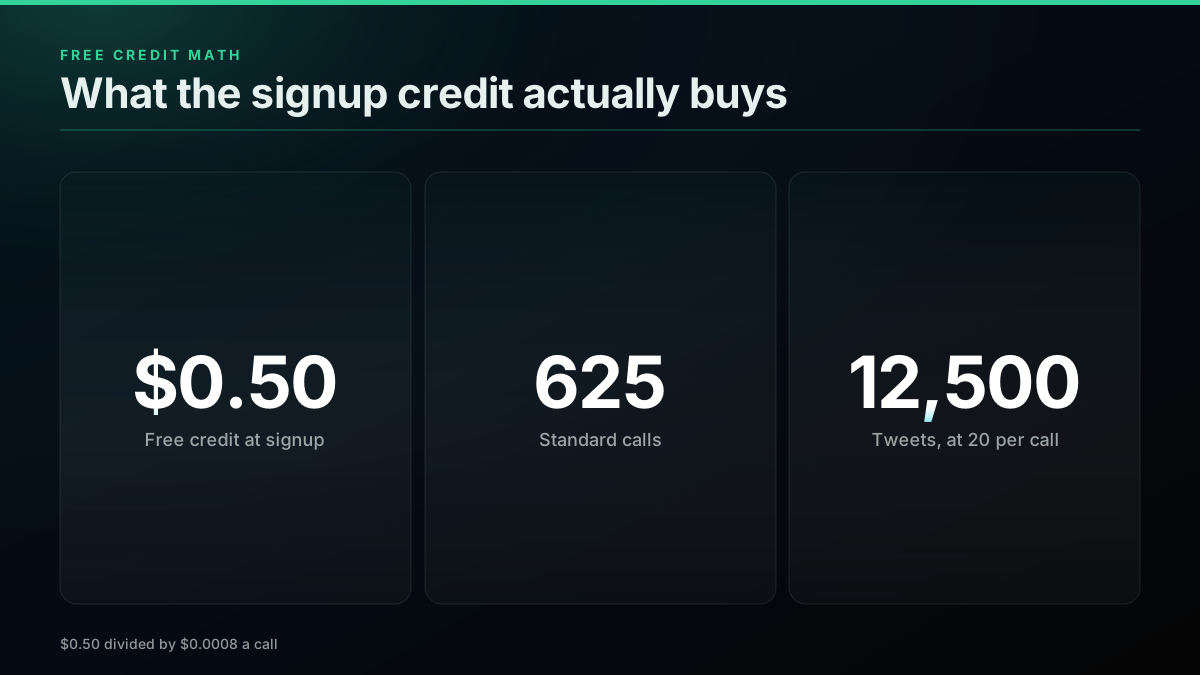
That credit is 625 standard calls, roughly 12,500 tweets at 20 per call. It is enough to build and test a small monitor or research script end to end before you top up. The developer docs list every endpoint with its parameters and response fields, and the complete Twitter API tutorial goes from first call to pagination and error handling.
When is TwitterAPIs the wrong choice?
When you need something only X can sell you. A per-call third-party API is the wrong tool if your company requires X's own contract and enterprise terms, if you need an official partner badge for procurement, or if your volume is large enough that a negotiated plan beats metered pricing.
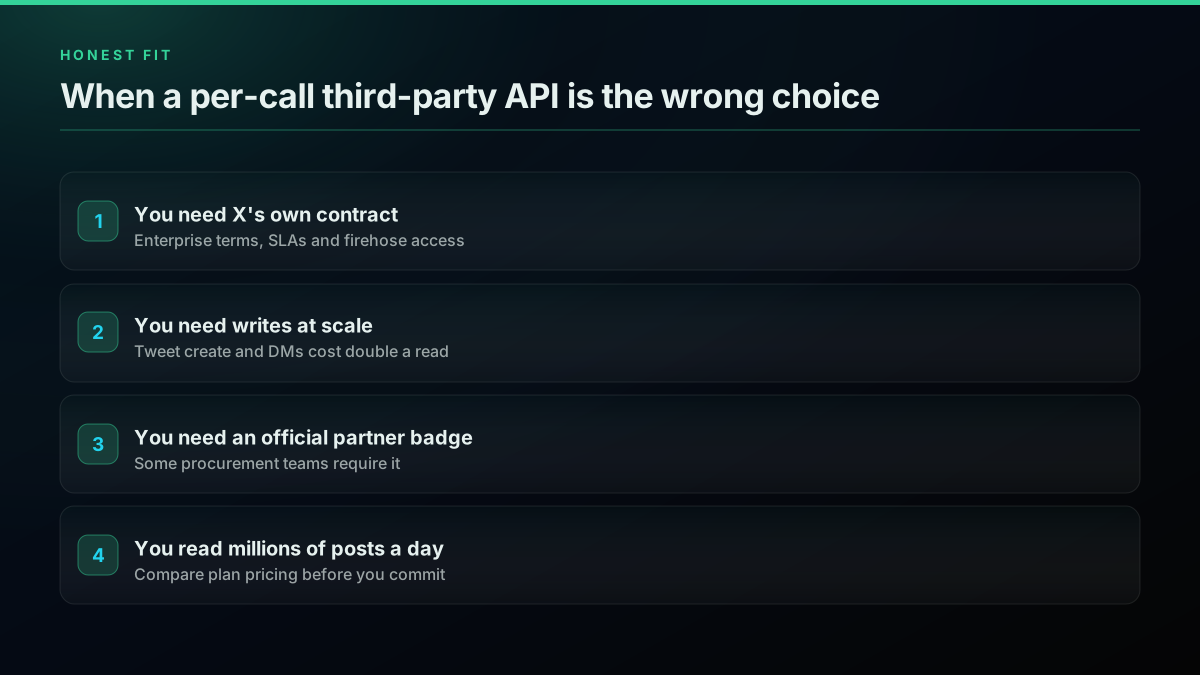
Write-heavy work also changes the math. Tweet creation and DMs cost $0.0016 a call, double a read, and posting at scale through any unofficial route carries account risk that reads do not. If your use case is mostly writes, price it carefully and compare it with the official plans on the X API pricing page before you commit. For read-heavy research, monitoring and agent tools, which is most of what people build, the per-call route is usually the cheaper and faster one, and our ranking of the cheapest Twitter APIs by real cost per 1,000 tweets shows where it sits against other providers.
Where can you vote or leave a review?
The listing is at uneed.best/tool/twitterapis. If you have used the API, a review there helps other builders more than an upvote does, because it tells them what the product is actually like to integrate. If you have not tried it yet, the fastest route is still one curl command and the free credit.
Frequently Asked Questions
TwitterAPIs is a pay-per-call Twitter API, also called an X API, for developers who need tweets, user profiles, followers, search results and write actions as clean JSON. You sign up with an email, copy one bearer key and call plain REST endpoints. There is no X developer account to apply for and no monthly plan; top-ups start at $10. Standard calls cost $0.0008 and return about 20 tweets, new accounts get $0.50 in free credits, and an MCP server lets AI agents such as Claude and Cursor query X data directly.
For reading posts, yes by a wide margin. The official X API now bills pay per use by resource, $0.005 for each post read and $0.010 for each user read, so 1,000 post reads cost $5.00. On TwitterAPIs the same 1,000 tweets cost about $0.04 through standard calls. The official route still wins on some things: it is X's own contract, it offers enterprise terms, and its webhooks can deliver events without polling. Pick the official API when you need those, and a per-call API when read cost is the constraint.
Uneed is a social launchpad for tech products, run from the EU and described by its founder as a Product Hunt alternative. Every day at 12:00 AM PST a new batch of products goes live on its homepage: at least 30 free launches from a waiting line, up to 60 when the line is long, plus every paid launch. Products compete on four leaderboards, a daily board and rolling weekly, monthly and yearly boards, and the top three each week are featured in a newsletter sent to more than 26,000 subscribers.
The evidence is mixed, and we are keeping it that way on purpose. One maker reported reaching #1 on Uneed with 69 upvotes alongside #4 on Product Hunt, with 20 plus signups. Another founder paid $30 to skip the line and pick a date and got zero upvotes, and a third counted 2 visitors from launch day. The honest read is that a launch amplifies an audience you already have. It rarely creates one. Treat it as one channel in a week of outreach, not the plan.
A standard read costs $0.0008 and returns about 20 tweets, which works out to roughly $0.04 per 1,000 tweets. Premium endpoints are priced separately and published per endpoint: tweet creation, DM sending and the two DM reads are $0.0016, a full user history is $0.0024 and a full thread expansion is $0.004. There is no subscription. You top up credits by card or crypto, crypto top-ups add a 2 percent bonus, and credits do not expire, so a quiet month costs nothing.
No. TwitterAPIs is a third-party API, so you never apply to X, describe your use case, wait for approval or manage OAuth apps. You create an account on twitterapis.com with an email, the dashboard issues a bearer key, and your first request can run within a few minutes. That is the main reason people pick it for prototypes, research scripts and AI agents that need X data today rather than after an approval queue. Our guide to X API access without a developer account covers every route in detail.
Because the people who vote on Uneed are largely makers, and makers are exactly who needs cheap X data: indie hackers building monitors, social tools, lead finders and AI agents. A launch also brings a do-follow backlink kept at a launch-day upvote score of 20, a chance at the weekly newsletter, and public feedback from people who will actually try the API. We are not treating it as a revenue event. We will publish what it delivered, visits, signups and first top-ups, once launch week settles.
Open the listing at uneed.best/tool/twitterapis or go straight to twitterapis.com, create an account with an email and copy your key from the dashboard. Run one request against the user tweets endpoint for any public handle and you will get about 20 recent posts as JSON for $0.0008, paid from the $0.50 signup credit. That credit covers 625 standard calls, roughly 12,500 tweets, which is enough to build and test a small monitor or research script before you top up anything.
Check out similar blogs
More guides on the Twitter/X API, scraping, and pricing.
What a 1 Million Tweet Dataset Actually Costs in 2026: Every Route Priced
Ten results rank for the cost of a tweet dataset and one states a price. We fix the quantity at a million tweets and cost every route, with each number's source named.
Build a Crypto Twitter Tracker in Python: Watch a KOL List and Catch Contract Addresses
A runnable Python watcher that polls a named list of crypto accounts, pulls every new post, finds EVM and Solana addresses, and alerts you, with the monthly bill for 25 and 100 accounts.
Watching 50 X Accounts: What Every Poll Cadence Actually Bills
Every monitoring page sells you an interval and calls it real time. None of them prices it. Here is what a one minute, fifteen minute and daily poll across a fixed fifty account roster costs per month, and the route where the watch itself bills nothing.
Why X Advanced Search Misses Posts You Know Exist (2026)
A query that returns nothing is not proof that nothing exists. We searched for 17 posts confirmed to exist, published between 2015 and 2026, and measured which query forms found them and which did not.

X/Twitter Statistics in 2026: What an API Can Actually Measure, and What Nobody Can
Most X statistics roundups re-cite the same handful of numbers. We measured what a public API can and cannot see across 34 accounts, printed the query behind every figure, and traced the rest to their real sources.
X API Cost in 2026: Every Tier and Alternative on One Sheet
X bills per resource in 2026. Here is every official rate and every vendor converted to one unit, dollars per 1,000 tweets, with a worked bill.
Sprout Social Alternative 2026: What Twitter Data Really Costs
Sprout is $199 a seat. Brandwatch publishes no price. Here is what Twitter data costs per 1,000 mentions across all three, read live on 2026-09-09.
Twitter API Reliability, Measured: What Actually Fails Across 5.16 Million Calls
Every vendor publishes an uptime promise. Nobody publishes the failure distribution. Here is what broke across 5,155,699 production calls, by status code, by endpoint and by week.