GUIDE
Sprout Social Alternative 2026: What Twitter Data Really Costs
Sprout is $199 a seat. Brandwatch publishes no price. Here is what Twitter data costs per 1,000 mentions across all three, read live on 2026-09-09.
Per our own spec, 70 of 121 endpoints bill $0.0008, 24 are free, and 27 sit between $0.0016 and $0.01. Every price ships inside our published OpenAPI document as an x-cost-usd field, so any figure in this post can be checked against the contract that bills it rather than taken on trust.
Sprout Social lists at $199 per seat per month on its own pricing page, Brandwatch publishes no price at all on its pricing page, and the Twitter data underneath both is sold separately at $0.005 per post on X's published rate card or $0.0008 per call through a metered API. Every comparison ranking for this query puts suites against suites. None of them prices the option of not buying a suite, which is the only comparison that answers what the data itself costs.
TL;DR
A five-seat contract at Sprout's published Standard rate is $11,940 a year for 1.2 million mentions, which is $9.95 per 1,000. The same volume through a metered Twitter API on our published per-call rate is $48 to $120 a year, or $0.04 to $0.10 per 1,000, and through the official X API rate card is $6,000, or $5.00 per 1,000. Brandwatch cannot be placed on that scale because it publishes nothing. These are not the same product: the suite includes an inbox, publishing, approvals and reports, and the API includes none of them. The decision is whether you are buying a workflow or buying data.
Why every Sprout Social alternative list misses the same option
The six comparison articles currently ranking for this query recommend Buffer, Later, Hootsuite, Agorapulse, Metricool and Publer. Every one of those is another per-seat suite. The frame is fixed before the first recommendation lands: you have a suite, you are unhappy with its price, here is a cheaper suite. Nobody asks what you were using the suite for.
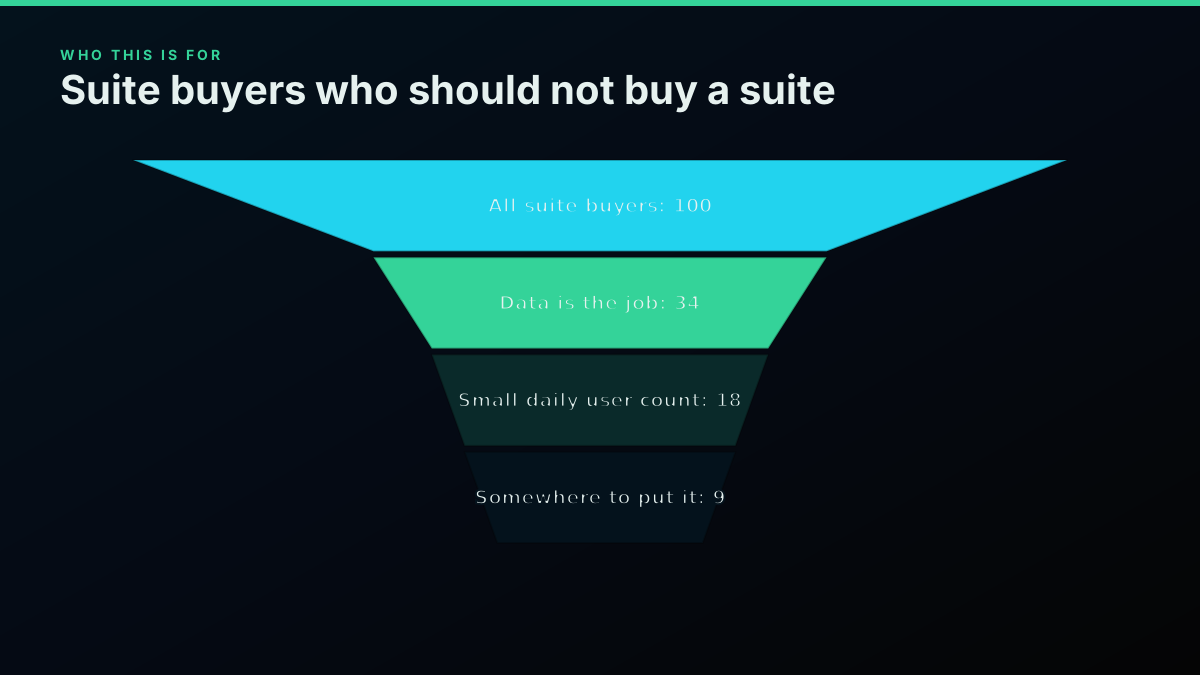
That matters because the answer splits the audience cleanly. If you open the tool daily to publish, reply and route messages to colleagues, a suite is the correct purchase and the only real question is which one. If you open it to find out what people said about a topic, and then export or screenshot the result into something else, you are paying a per-person subscription for a data pull.
We checked whether the ranking pages address that second case. Across the nine scrapeable results for this query, none states a cost per 1,000 mentions retrieved, none states what platform data costs the vendor, and exactly one mentions X API pricing at all, once, in passing. The structural gap is not an oversight in one article. It is the shape of the whole result page.
This post fills it with numbers rather than argument. Every published price below was read from the vendor's own live page on 2026-09-09, and every number that is arithmetic on top of a published price is labelled as arithmetic. Where a vendor publishes nothing, the cell says so rather than carrying an estimate borrowed from somebody else's roundup.
How much does Sprout Social cost per month in 2026?
Sprout Social publishes four seat prices and hides the fifth. On annual billing, Essentials is $79 per seat per month, Standard is $199, Professional is $299 and Advanced is $399, with Enterprise available only through a demo. Essentials is $99 per seat when billed monthly. Every figure below was read from Sprout's own pricing page on 2026-09-09.
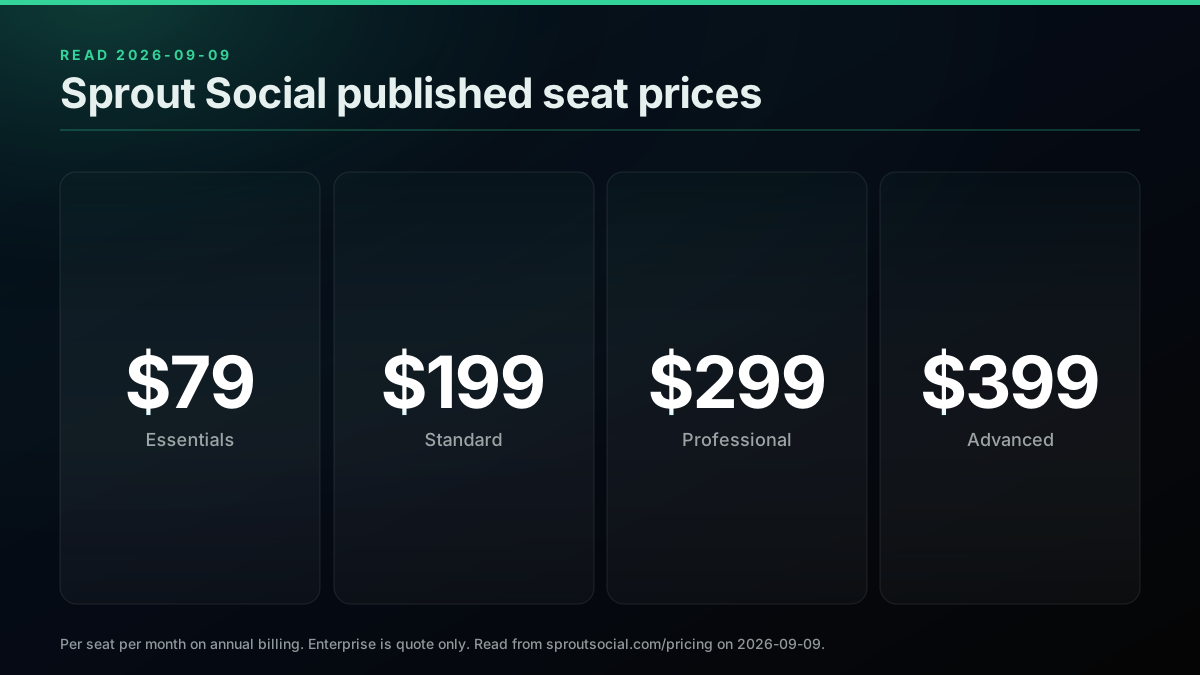
The seat multiplier is the part that surprises teams. Standard at $199 sounds close to a mid-tier SaaS subscription until you multiply by headcount: five people at Sprout's published Standard rate is $995 a month and $11,940 a year, and the number tracks hiring rather than usage.
The arithmetic is worth writing down once, because it is the number a renewal conversation turns on and almost nobody has it to hand when the call starts:
# Sprout Social seat math. Per-seat rates read from sproutsocial.com/pricing on 2026-09-09.
SEATS = 5
STANDARD_PER_SEAT_MONTH = 199
PROFESSIONAL_PER_SEAT_MONTH = 299

standard_year = SEATS * STANDARD_PER_SEAT_MONTH * 12          # 11940
professional_year = SEATS * PROFESSIONAL_PER_SEAT_MONTH * 12  # 17940
Nothing in that block is a projection. Both totals are a published per-seat rate multiplied by a headcount you choose and by twelve months, which is why a suite quote moves when you hire and does not move at all when your mention volume changes.
What each tier buys is also narrower than the price suggests at the bottom. Standard covers 5 social profiles, a consolidated inbox, keyword and location monitoring, review management and Sprout's Trellis AI agent. Unlimited social profiles do not arrive until Professional at $299, which is where message tagging and competitor insight also sit. The Sprout API itself is an Advanced-tier item at $399.
The trial terms are genuinely good and worth stating plainly: 30 days, no credit card. That is more evaluation runway than several competitors in this category offer, and it is the right way to test whether the workflow fits before anyone signs an annual commitment.
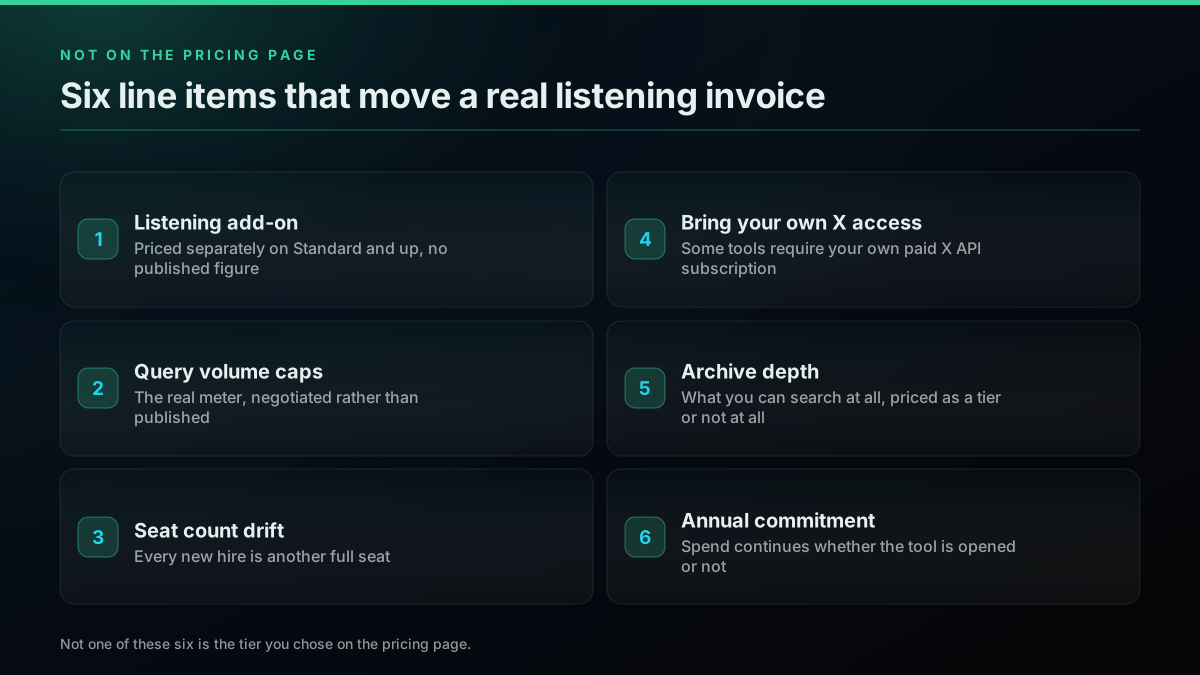
Two things the sticker price does not include are covered in the next section, and together they matter more than the gap between any two tiers.
Is listening included in the Sprout Social price, or is it an add-on?
It is an add-on, and Sprout says so on its own pricing page in one sentence: Premium Analytics and Listening are each available as individual add-ons to the Standard plan and up. Neither carries a published figure anywhere on the page. The capability most buyers arrive for is not in the price they were quoted.
We ran a control on that claim rather than asserting it. Fetching sproutsocial.com/pricing on 2026-09-09 and counting dollar figures in the rendered text returns five distinct values. Fetching Sprout's listening feature page with the identical extractor in the same pass returns zero. The extractor works, so the absence is a property of the page rather than of our tooling.
Practitioners describe the consequence before they can see the mechanism. A buyer comparing tools in r/sociallistening put it as a downside of pricing when monitoring is mainly what you are after: listening is an add-on, so it can get expensive pretty quickly. That is the same sentence as Sprout's, arrived at from the invoice side.
The practical effect is that a Sprout quote has two numbers in it, one of which is public and one of which is not. Any comparison built on the public one is comparing a partial figure against a competitor's full figure, which is how a tier-by-tier table can be arithmetically perfect and still mislead.
How much does Brandwatch cost?
Brandwatch does not publish a price. We fetched brandwatch.com/pricing on 2026-09-09, stripped script and style blocks, removed the remaining markup and counted dollar figures in what a reader would actually see: zero, across 1,037,749 bytes of page. No tier table, no starting-from figure, no per-seat rate.
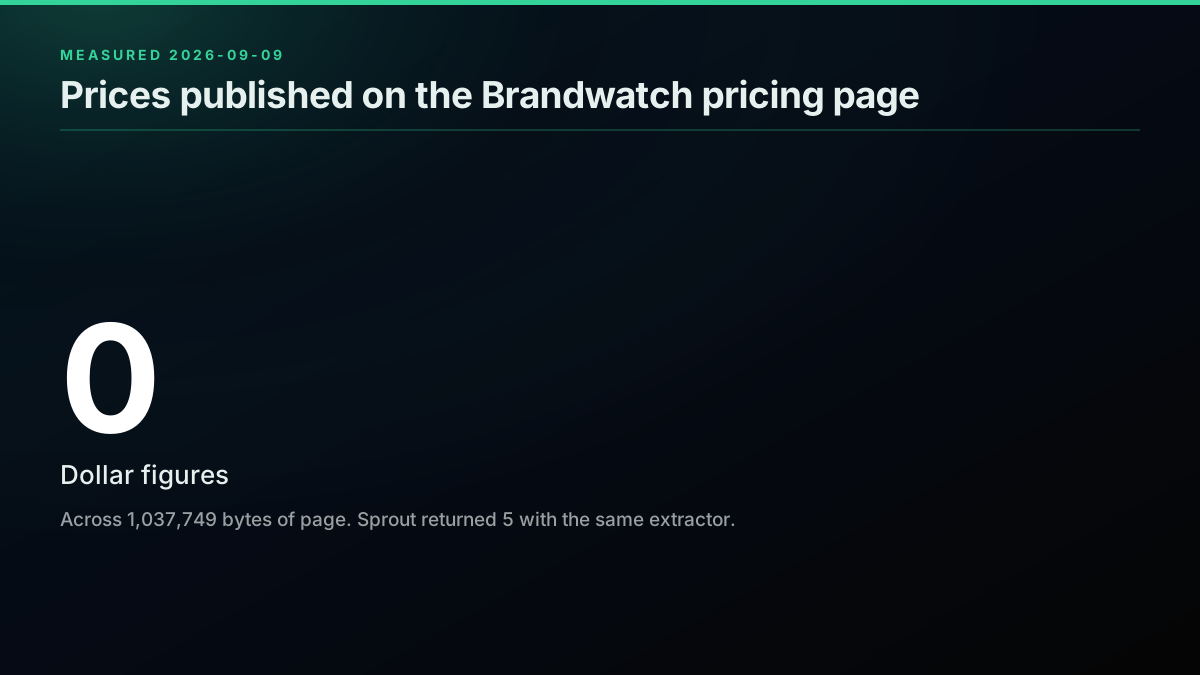
The same extractor found five figures on Sprout's pricing page in the same pass. That pairing is what makes the zero meaningful rather than a tooling artefact, and it is the check most comparison pages skip when they write that a vendor is enterprise-priced.
This is a planning cost, not a presentation choice. A buyer building a shortlist can price Sprout, Hootsuite and Brand24 in ten minutes from public pages, and cannot place Brandwatch on the same axis at any effort short of a sales call. The middle column of this comparison is a blank that only a calendar invitation fills.
The only public figures come from third parties and should be read as such. A disclosed site-owner audit posted to r/marketinteltools cites aggregated contract data putting the median Brandwatch purchase near $50,000 a year across 40 recorded contracts, in a range from roughly $19,500 to $81,200. We are citing that as a third-party aggregate, not as a Brandwatch rate, because Brandwatch has published nothing to check it against.
What Brandwatch does publish is capability, and it is real. Its Consumer Research product page states 1.4 trillion plus posts, coverage from today back to 2008, and 496 million new posts a day. That is the argument for its price, and it is the strongest one in this category.
Every published price in one table
Putting the published rates side by side is the first thing none of the ranking pages does, because it requires admitting that one column is empty. The table below carries only figures read from the vendor's own live page on the same day, with the source named per row so any cell can be re-checked in one fetch.
Every published price in this comparison, read from the vendor's own live page on 2026-09-09
| Vendor | Published entry price | Billing unit | Listening included | Source read | Source |
|---|---|---|---|---|---|
| Sprout Social | $79 per seat per month, annual | Seat | No, separate add-on, unpriced | sproutsocial.com/pricing | published |
| Sprout Social Standard | $199 per seat per month, annual | Seat, 5 social profiles | No, separate add-on, unpriced | sproutsocial.com/pricing | published |
| Brandwatch | Not published, zero figures on page | Not published | Not published | brandwatch.com/pricing | published |
| Hootsuite | $99 per month, Standard | Plan | Not at the Standard tier | hootsuite.com/plans | published |
| Brand24 | $199 per month, annual | Plan | Yes, it is the product | brand24.com/pricing | published |
| Official X API | $0.005 per post resource | Resource returned | Raw data only | docs.x.com pricing | published |
| TwitterAPIs | $0.0008 per standard call | Call, up to 20 tweets | Raw data only | twitterapis.com/pricing | published |
| Vendor | Published entry price | Billing unit | Listening in the base price | Source read 2026-09-09 |
|---|---|---|---|---|
| Sprout Social Essentials | $79 per seat per month, annual | Seat | No, separate add-on, unpriced | sproutsocial.com/pricing |
| Sprout Social Standard | $199 per seat per month, annual | Seat, 5 social profiles | No, separate add-on, unpriced | sproutsocial.com/pricing |
| Sprout Social Professional | $299 per seat per month, annual | Seat, unlimited profiles | No, separate add-on, unpriced | sproutsocial.com/pricing |
| Brandwatch | Not published, zero figures on page | Not published | Not published | brandwatch.com/pricing |
| Hootsuite Standard | $99 per month | Plan | Not at this tier | hootsuite.com/plans |
| Brand24 Individual | $199 per month, annual | Plan | Yes, it is the product | brand24.com/pricing |
| Official X API | $0.005 per post resource | Resource returned | Raw data only | docs.x.com pricing |
| TwitterAPIs | $0.0008 per standard call | Call, up to 20 tweets | Raw data only | our pricing page |
Two patterns fall out of it immediately. Vendors who publish get quoted accurately, and vendors who do not get quoted from whatever a competitor's blog guessed. The r/marketinteltools audit reached the same conclusion independently after re-checking eight tools between 30 July and 1 August 2026, and found roughly half the widely repeated figures wrong, including Sprout being listed at $249 across the web when Standard is $199.
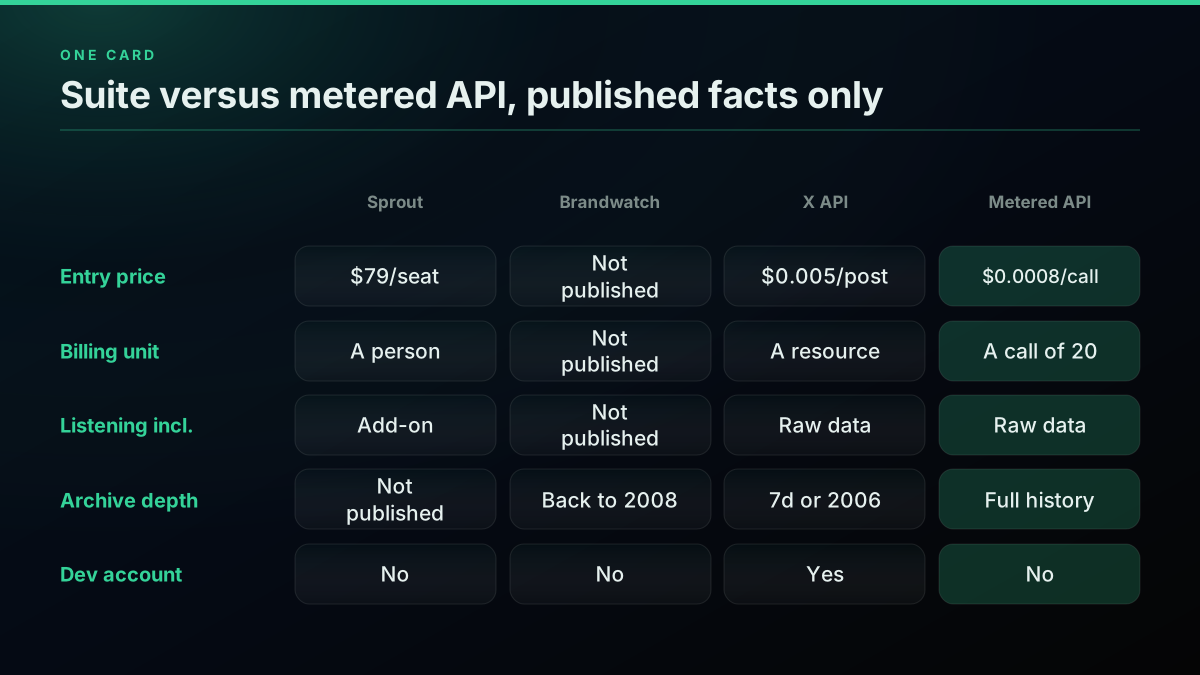
The second pattern is the unit. Four of the seven rows bill a person, and three bill a piece of data. Those are not comparable numbers, and no amount of care in a seat-by-seat table makes them comparable. That conversion is the next section.
Like for like
What each option actually sells, once the seat price and the call price are put in the same frame
| Sprout Social | Brandwatch | Official X API | Metered API | |
|---|---|---|---|---|
| Published entry price | $79 per seat, annual | None published | $0.005 per post read | $0.0008 per call |
| What one unit is | A person | Not published | A resource returned | A call of up to 20 |
| Listening in the base price | No, separate add-on | Not published | Raw data only | Raw data only |
| Archive depth | Not published | Back to 2008 | 7 days, or 2006 on full archive | Full history, priced per call |
| Developer account needed | No | No | Yes, reviewed | No |
| Can you budget it without a call | Partly | No | Yes | Yes |
How stale is the pricing you have already read?
Most of the figures circulating for this category are one to two years old, and the people buying these tools know it. A disclosed site-owner audit posted to r/marketinteltools re-checked eight platforms against current sources between 30 July and 1 August 2026 and found roughly half the widely repeated numbers wrong, with dates attached so the audit itself can be dated.
The specific misses are instructive. Sprout is listed across the web at $249 per seat when Standard is $199, and Essentials at $79 gets left out of most comparisons entirely. Hootsuite is quoted almost everywhere at $199 when its own plans page currently opens at $99. Both errors point the same way: the repeated figure is the tier above the entry one, which makes a category look more expensive than it is.
We checked those two claims independently rather than relaying them, because a Reddit audit is a practitioner report and not a rate card. Sprout's live pricing page returned $79, $99, $199, $299 and $399 on 2026-09-09, and Hootsuite's plans page returned $99, $199 and $399 the same day. Both confirmed the audit's direction and neither was taken on trust.
The mechanism behind the staleness is worth naming because it predicts where the next wrong number will be. Vendors who publish get quoted accurately, because a writer can check in one fetch. Vendors who publish nothing get quoted from whatever a competitor's blog guessed, and that guess then propagates through every roundup that copies the roundup above it. Brandwatch is the extreme case: it publishes nothing, so every figure attached to it in public is somebody else's inference.
Video reviews inherit the same problem with a longer half life, since a walkthrough recorded in 2025 keeps ranking with its prices baked into the audio. Treat any undated figure in this category as a hypothesis, including the ones in this post once its own date has aged.
What is the difference between a social listening suite and a Twitter data API?
A suite sells a workflow and an API sells a payload. The suite gives you publishing, a shared inbox, approvals, sentiment scoring, dashboards and reports, priced per seat because seats are what consume a workflow. The API returns JSON, priced per call because calls are what consume data. Neither one is a cheaper version of the other.
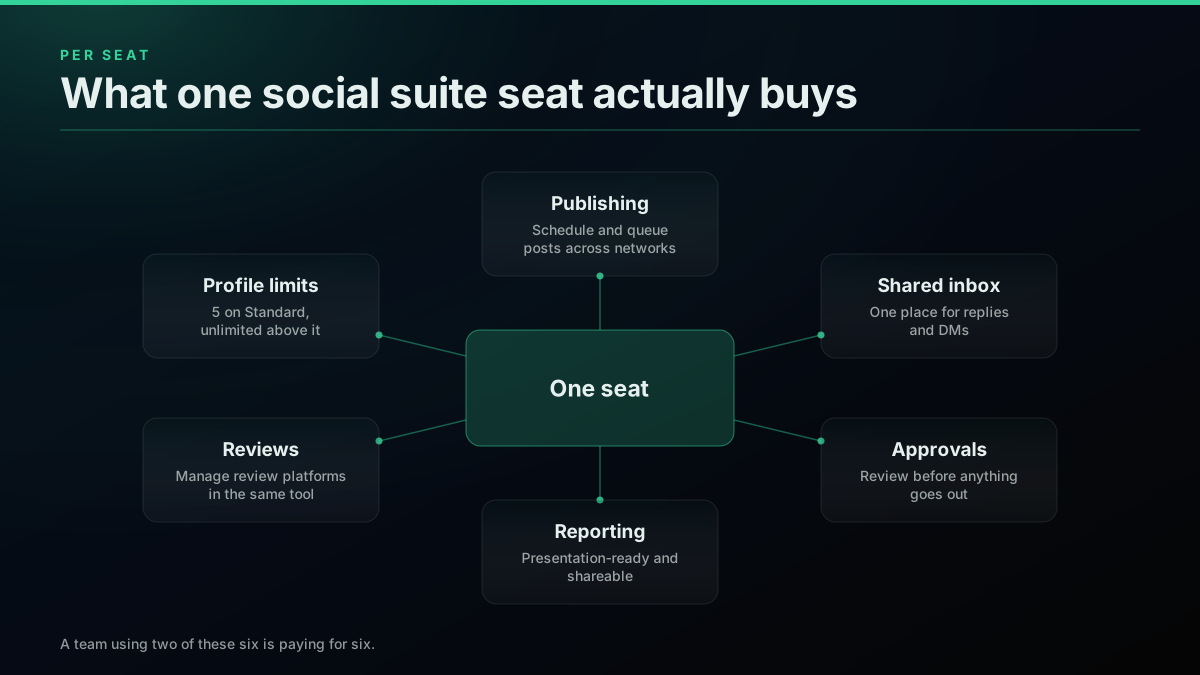
The clearest way to see it is to ask what each becomes worthless without. A suite with no daily users is a stack of unused licences, however good the data underneath. An API with nowhere to put the results is a bill for a file nobody opens. The failure mode of each purchase is the other one's prerequisite.
The tell in a buying conversation is which noun the buyer uses. Someone who describes a dashboard, an approval queue or a report their manager reads is describing a suite. Someone who describes a pipeline, a table, an alert or a credit system for their own end users is describing an API. A developer in r/webdev asking for a social listening API said it in one line: the API would be tied into a platform where paying users would access it, perhaps on a credit system. That buyer had already left the suite market.
Our own build versus buy comparison for monitoring tools works the same decision through from the engineering side, and the choosing a Twitter API guide is the hub that sits above both.
What does Twitter data cost per 1,000 tweets?
Two published answers exist and they differ by more than 100x. The official X API rate card charges $0.005 per post resource returned, which is $5.00 per 1,000 tweets, and $0.010 per user resource, which is $10.00 per 1,000 profiles. A metered third-party API prices per call instead, at $0.0008 a standard call, returning up to 20 tweets, so $0.04 per 1,000 tweets on a full page. Our official X API versus third-party providers comparison runs those same two rate cards against each other endpoint by endpoint.
The per-resource model is what makes the official number behave unexpectedly. A search request returning 100 posts bills 100 times, and one returning 3 posts bills 3 times, so the invoice tracks the shape of the data rather than the shape of the code. X also caps pay-per-usage plans at 3 million post reads per monthly billing cycle, which is $15,000 at the published read rate, after which the conversation moves to Enterprise access.
The metered figure needs its own honesty. The $0.04 per 1,000 assumes a full 20-tweet page, and real pages are not always full. On a sparser page returning 8 to 13 items the delivered rate lands between $0.10 and $0.0615 per 1,000, which is the range we use in every worked example below rather than the flattering list rate. Our pay-per-use pricing page publishes both.
One call against your own query settles which end of that band you sit at, and it is a single authenticated GET. Save the response, because the next section counts what came back in it:
# Base URL and key both come from your twitterapis.com dashboard.
curl -sG "$TWITTERAPIS_BASE/twitter/tweet/advanced_search" \
  -H "Authorization: Bearer $TWITTERAPIS_KEY" \
  --data-urlencode "query=sprout social" \
  -o page.json
That one request is billed at the standard call rate whether it hands back twenty items or three. The rate card cannot tell you which happened, which is the entire reason list price and delivered price are two different numbers rather than one.
The full breakdown of official tiers, per-endpoint rates and every third-party vendor in one unit sits in the Twitter API cost hub and the X API price sheet. This post uses those rates rather than restating them.
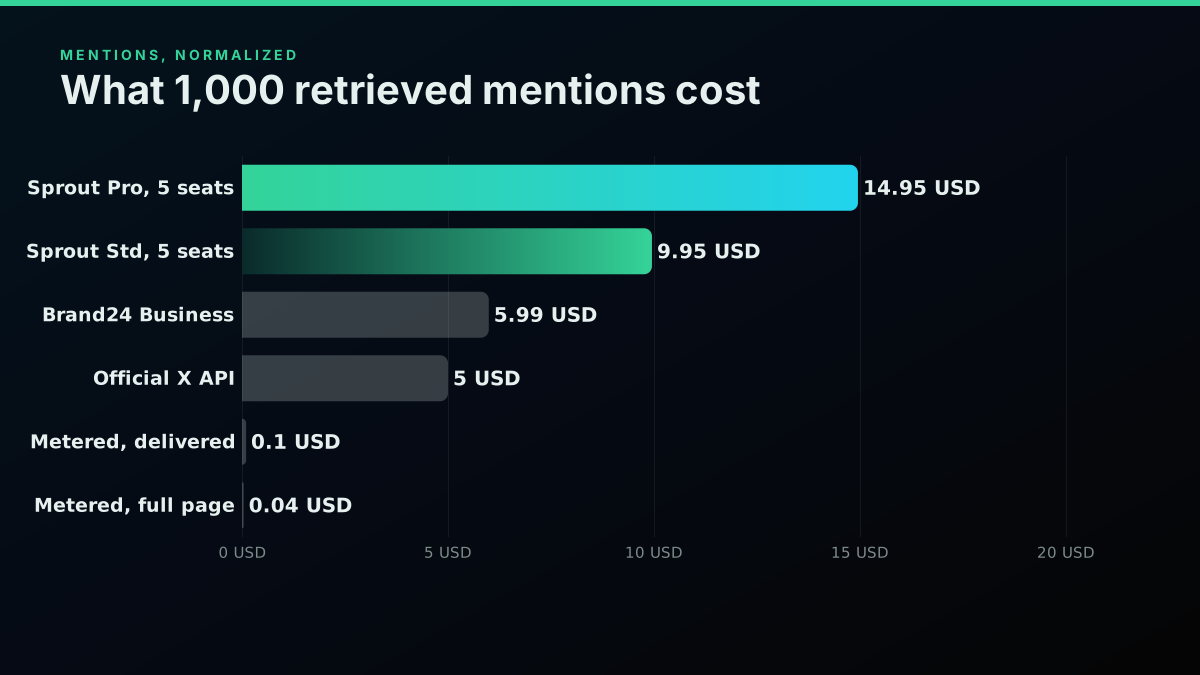
Mentions, normalized
What 1,000 retrieved mentions cost, once seats and calls are put in the same unit
| Point | Value (USD per 1,000) |
|---|---|
| Sprout Professional, 5 seats | 14.95 USD per 1,000 |
| Sprout Standard, 5 seats | 9.95 USD per 1,000 |
| Brand24 Business | 5.99 USD per 1,000 |
| Official X API | 5 USD per 1,000 |
| Metered API, delivered | 0.1 USD per 1,000 |
| Metered API, full page | 0.04 USD per 1,000 |
Measure your own page density on free credit
New accounts start with $0.50 in credit and no card, which is roughly 625 standard calls. Enough to count what one page of your own query actually returns.
Start building with TwitterAPIs
$0.0008 a call, about $0.04 per 1,000 tweets at 20 tweets a page. $0.50 free credits. No credit card required.
The TwitterAPIs Mention Unit Cost, and how to compute yours
The Mention Unit Cost is the annual cost of an option divided by the mentions it retrieves in a year, expressed per 1,000. It is the only unit in which a seat quote and a call rate can be compared honestly, because it prices the thing both options actually deliver rather than the thing each vendor happens to bill for.
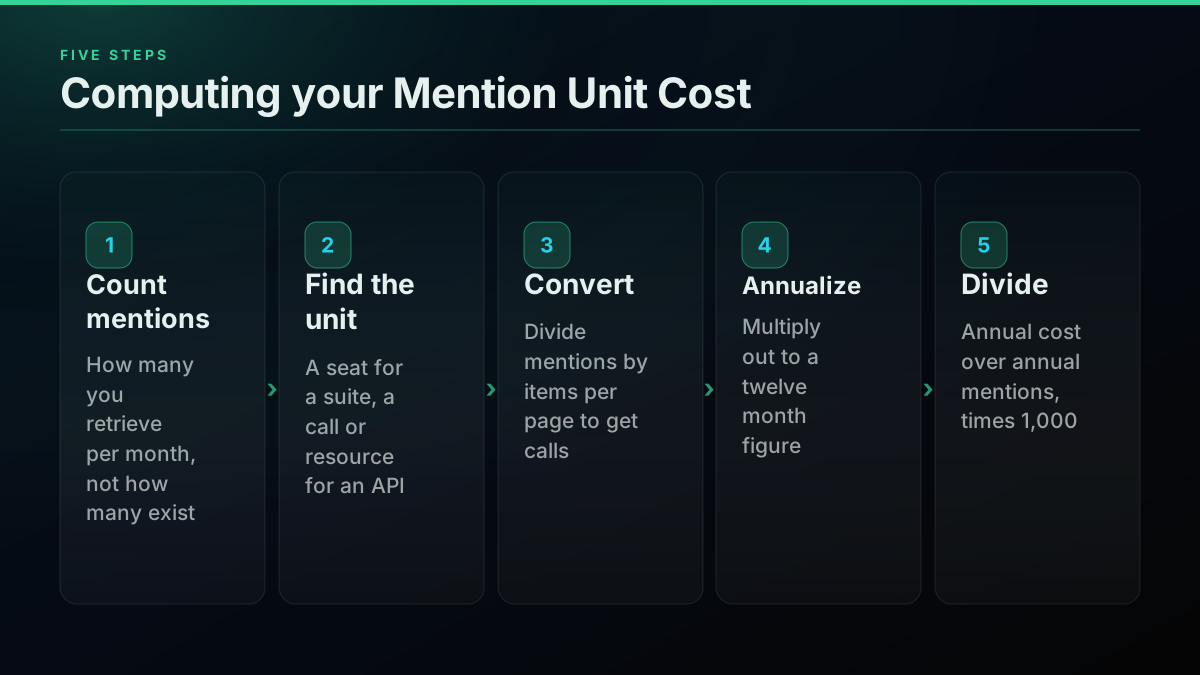
It is five steps. Count the mentions you need per month. Find each option's billing unit, which is a seat for a suite and a call or a resource for an API. Convert to that unit, dividing your mention count by the items one call actually delivers, or multiplying seats by headcount. Multiply out to an annual figure. Divide by annual mentions and multiply by 1,000.
In code, across the options in this comparison, that is a dictionary and one division:
ANNUAL_MENTIONS = 100_000 * 12

options = {
    "Sprout Standard, 5 seats": 5 * 199 * 12,
    "Sprout Professional, 5 seats": 5 * 299 * 12,
    "Official X API post reads": ANNUAL_MENTIONS * 0.005,
    "Metered API, full 20-tweet page": (ANNUAL_MENTIONS / 20) * 0.0008,
}

for name, annual in options.items():
    print(name, round(annual / ANNUAL_MENTIONS * 1000, 2))
The only input there you cannot read off a pricing page is the divisor on the metered line, because how many items one call returns is a property of your query rather than of the rate card. Our Twitter API cost by workload breakdown runs the same model across several workload shapes if yours is not a flat monthly volume.
The step people skip is the third. A metered API's rate card states a price per call, and a call is not a mention, so the conversion depends entirely on how many items your specific query returns per page. One request against your own real query tells you more about your unit cost than any comparison table, this one included.
Counting it is two lines against the response the earlier call saved:
# items delivered by one billed call, then the delivered cost per 1,000
jq '.tweets | length' page.json
jq '0.0008 / (.tweets | length) * 1000' page.json
Run that against the query you actually monitor rather than a broad one. A narrow brand query returns short pages and lands near the top of the delivered band, and a wide topic query fills pages and lands near the bottom, which is how one rate card produces two different unit costs for two teams on the same plan.
The step people get wrong is the first. Mentions retrieved is not mentions that exist, and it is not mentions you read. Use the number your monitoring actually pulls, because that is the number both billing models scale on.
We name the metric because an unnamed one gets restated differently in every conversation and stops being comparable. The same definition is used across this cluster, including in the cost of a 1 million tweet dataset breakdown.
Price your own mention volume before the next renewal call
Put your real monthly mention count into the calculator and get a dollars-per-1,000 figure you can hold beside a seat quote.
Is Sprout Social or Brandwatch cheaper for Twitter data?
The question cannot be answered from published information, and that asymmetry is the finding rather than a gap in our research. Sprout's rates are public, so a seat count produces a figure in one multiplication. Brandwatch publishes nothing, so any figure for it is either a third-party aggregate or a number somebody was quoted under an agreement they cannot share.
On the public evidence available, a small team is almost certainly cheaper on Sprout and a large research programme is a genuinely open question. Five seats of Sprout Standard is $11,940 a year against a third-party median Brandwatch contract near $50,000. But those buy different things: Sprout at Standard does not include listening at all, and Brandwatch Consumer Research is a listening archive first and a management suite second.
The comparison also inverts on archive depth, which nobody prices. Brandwatch states coverage from today back to 2008 across 1.4 trillion plus posts. If the question in front of you is what people said about a topic last quarter, or in 2019, that capability is not expensive relative to alternatives, because most alternatives cannot answer at any price.
So the useful reframe is not which is cheaper. It is whether the thing you need is a workflow, an archive, or a feed, because those three have different vendors and only the first two are suites.
Why is Sprout Social so expensive?
Because you are buying seats, and seats scale with headcount while data scales with volume. Five people on Standard is $11,940 a year for mentions that one API key retrieves. The pricing also unbundles the capability most buyers came for, since listening is a separate add-on on Standard and up with no published figure.
The third reason is underneath all of it and is newer than most comparison pages acknowledge. Platform data now costs the vendor money. X's published price sheet charges $0.005 per post read and $0.015 per plain post created, and those charges land on every tool that touches the platform on your behalf. A suite is reselling access it now pays for per item.
Practitioners see the pass-through even without seeing the rate card. In the highest-engagement first-hand thread on this topic, an agency owner testing every major suite in turn wrote that Sprout's functionality for posting seems decent and has the best cross-commenting tested so far, and then that the pricing is not in any way competitive.
That thread carried 39 upvotes and 125 comments when we re-read it live on 2026-09-09, which is the shape genuine procurement demand takes: heavily answered rather than heavily upvoted. The value judgement in it is consistent across a decade of these threads, which suggests a structural cause rather than a reaction to one price rise.
The honest counterweight is that the suite is doing more than retrieving data, and the parts it adds are real work that somebody has to do either way. The next sections price that work rather than dismissing it.
What is the cheapest alternative to Sprout Social?
It depends entirely on which half of Sprout you are replacing, and the two answers are different products. If you need the suite workflow, Hootsuite currently lists Standard at $99, Professional at $199 and Advanced at $399 on its own plans page, which puts its entry tier below Sprout's Standard. If you only need Twitter and X data, a metered API removes the seat entirely.
Note the Hootsuite figures against what is repeated online. The widely quoted entry price is $199, which is the Professional tier, not the entry one. That is the same staleness pattern the r/marketinteltools audit documented across eight tools, and it is a good reason to read a live pricing page rather than a roundup, including this one, in six months.
Brand24 is the other honest comparison for a listening-first buyer, publishing Individual at $199, Team at $299, Pro at $399, Business at $599 and Enterprise from $1,499 on annual billing. It is a monitoring product rather than a management suite, so it is cheaper than Sprout plus a listening add-on and does not replace publishing or the inbox.
The metered API answer is $0.0008 a call, or $0.04 per 1,000 tweets on a full page, with no seats and no subscription. We are not going to make that claim in the abstract, because it is not the same product and a bare superlative would be doing exactly what the stale roundups do. It is the cheapest pay-as-you-go way to obtain the data, with no monthly commitment, which is a narrower and checkable claim.
Our Twitter API alternatives comparison covers the metered vendors against each other, which is a different question from this one, and the eight providers ranked by real per-1,000 tweet cost rundown puts every one of them in the same unit this post uses.
Unit economics: what 1,000 mentions costs across every option
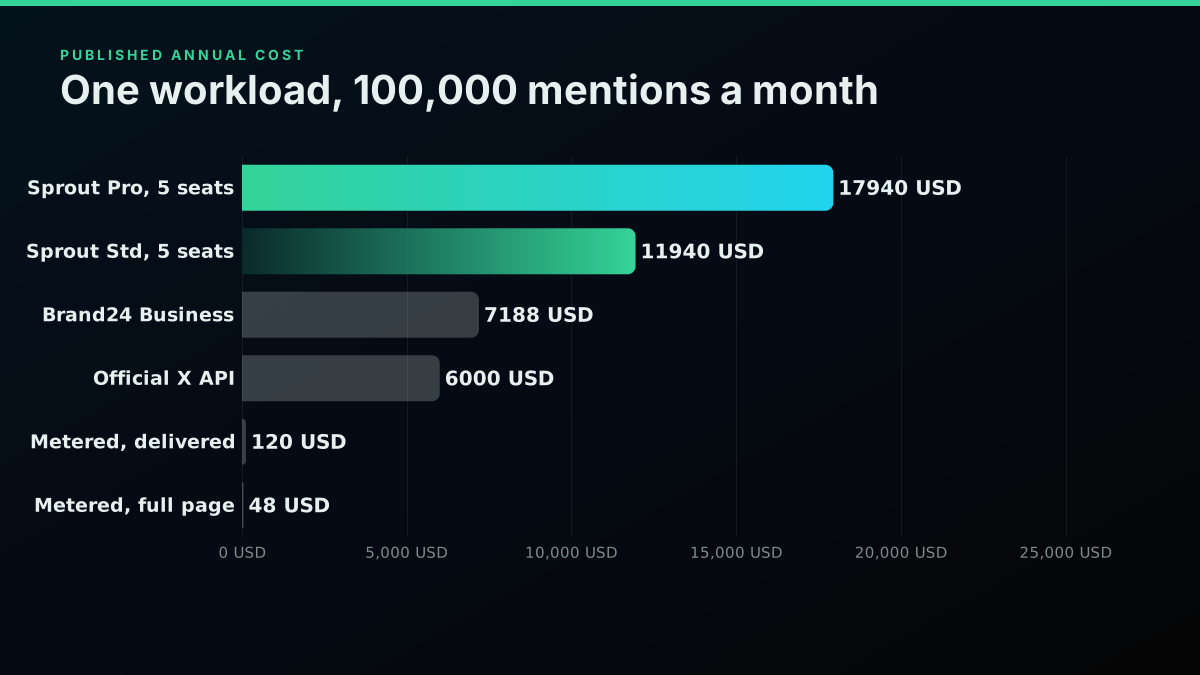
Normalizing to dollars per 1,000 mentions retrieved is the comparison none of the ranking pages runs, and it is the one a finance team asks for. The table below holds the workload fixed at 100,000 mentions a month and divides each option's published rate into it, so the only variable is the pricing model itself.
The TwitterAPIs Mention Unit Cost at one fixed workload, 100,000 mentions a month
| Option | Annual cost | Mentions per year | Per 1,000 mentions | What the number excludes | Source |
|---|---|---|---|---|---|
| Sprout Standard, 5 seats | $11,940 | 1,200,000 | $9.95 | The listening add-on, which is unpriced | derived |
| Sprout Professional, 5 seats | $17,940 | 1,200,000 | $14.95 | The listening add-on, which is unpriced | derived |
| Brand24 Business | $7,188 | 1,200,000 | $5.99 | Anything older than the archive window | derived |
| Official X API, post reads | $6,000 | 1,200,000 | $5.00 | Storage, analysis and any interface | derived |
| Metered API, delivered density | $120 | 1,200,000 | $0.10 | Storage, analysis and any interface | derived |
| Metered API, full 20-tweet page | $48 | 1,200,000 | $0.04 per 1,000 | Storage, analysis and any interface | derived |
| Option | Annual cost | Mentions per year | Per 1,000 mentions | What the figure excludes |
|---|---|---|---|---|
| Sprout Professional, 5 seats | $17,940 | 1,200,000 | $14.95 | The listening add-on, which is unpriced |
| Sprout Standard, 5 seats | $11,940 | 1,200,000 | $9.95 | The listening add-on, which is unpriced |
| Brand24 Business | $7,188 | 1,200,000 | $5.99 | Anything older than the archive window |
| Official X API post reads | $6,000 | 1,200,000 | $5.00 | Storage, analysis and any interface |
| Metered API, delivered density | $120 | 1,200,000 | $0.10 | Storage, analysis and any interface |
| Metered API, full 20-tweet page | $48 | 1,200,000 | $0.04 | Storage, analysis and any interface |
Every row is a published rate multiplied against one fixed workload, so the rates are measured and the totals are arithmetic. The seat rates come from Sprout's pricing page, the monitoring rate from Brand24's pricing page, the read rate from X's published price sheet and the per-call rate from our own pricing page, each read on 2026-09-09. Brandwatch is absent because it publishes no rate to divide.
The spread is roughly 99x from a five-seat Sprout Standard contract at $9.95 per 1,000 down to a metered API at delivered density at $0.10. Against the full-page rate of $0.04 the ratio is 249x. Both figures are arithmetic on published rates and both exclude the same things on the API side, which the table's last column names deliberately.
That last column is the part that keeps this honest. The $120 figure buys mentions and nothing else. No inbox, no approvals, no publishing, no dashboard, and no person to look at any of it. A comparison that quotes the ratio without the exclusion is selling a number rather than a decision.
Worked example
One workload, 100,000 mentions a month, priced four ways before any contract
Sprout Standard, 5 seats: $11,940 / yr · Official X API reads: $6,000 / yr · Metered API, delivered: $120 / yr · Ratio, top to bottom: 99x
Seat and call rates read from each vendor's own live page on 2026-09-09; the annual totals are arithmetic on top of them and exclude storage, analysis and any interface.
The official X API row is the interesting middle. At $5.00 per 1,000 it undercuts the five-seat suite contracts while still sitting 50x above the metered vendors, which is the clearest evidence that the seat model and the data cost are two separate stories rather than one.
Rate limits and quotas, the ceiling that money does not raise
Price is one ceiling and throughput is a different one, and confusing them is how a pipeline gets sized wrong. X's published limits are per app and per user, measured in fixed windows, and no budget lifts them. On the suite side the equivalent ceiling is a query volume cap, which is negotiated rather than published.
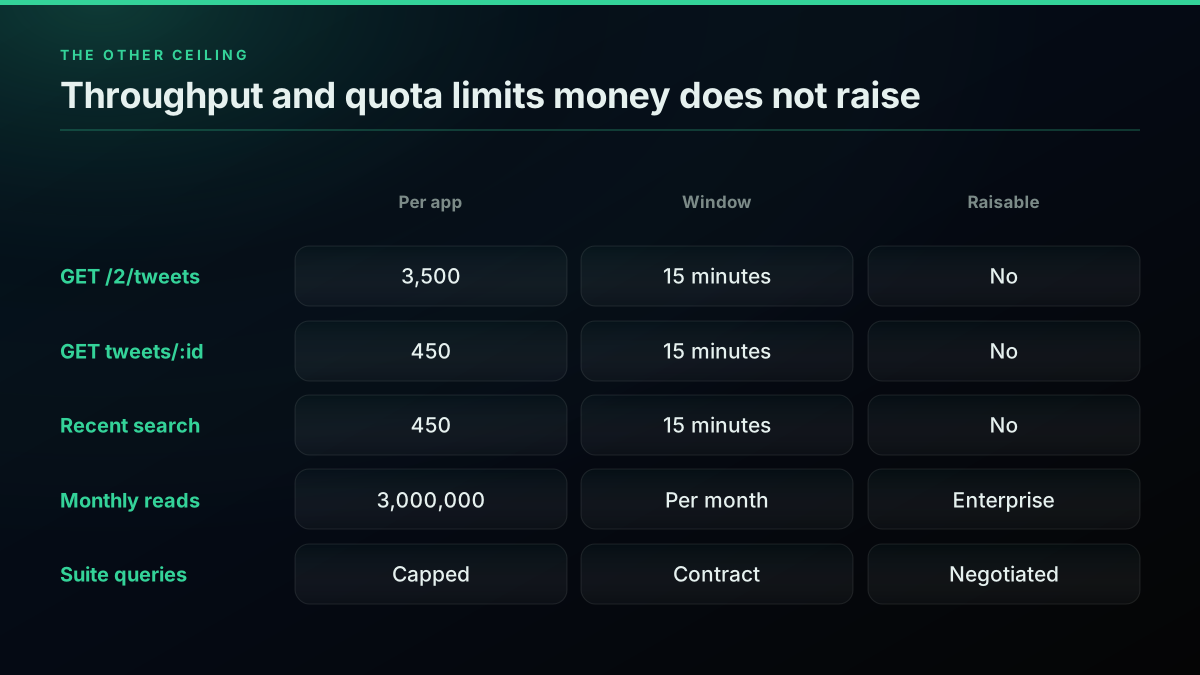
From X's own rate limits reference, read on 2026-09-09, the ceilings that matter to a listening workload are these:
| Endpoint or quota | Per app | Per user | Notes |
|---|---|---|---|
| GET /2/tweets | 3,500 per 15 min | 5,000 per 15 min | Bulk lookup by ID |
| GET /2/tweets/ | 450 per 15 min | 900 per 15 min | Single post lookup |
| GET /2/tweets/search/recent | 450 per 15 min | 300 per 15 min | 10 default, 100 max results, 512 character query |
| Pay-per-usage post reads | 3,000,000 per month | Same | A hard quota, not a throttle |
X states plainly on the same page that rate limits and billing are separate concepts, which is the distinction most budget conversations collapse.
Separately, pay-per-usage plans are capped at 3 million post reads per monthly billing cycle. That is a hard quota rather than a throttle, and it is the point at which a growing listening workload stops being a pay-per-usage question at all.
On the suite side the meter that binds is query volume rather than seats, and it is the thing buyers are advised to ask about explicitly before signing. Seats are visible on the pricing page and query limits are not, so the number that determines whether the tool keeps working at your volume is the number you have to extract from a salesperson.
Our rate limits guide sets out the per-endpoint windows in a comparable unit, the Twitter API rate limit guide works through what each window means for a running pipeline, and the Twitter API reference covers the response shapes each one returns.
Check which ceiling binds first, budget or throughput
On listening workloads the money usually runs out before the rate window does. The limits reference sets out both so you can size the pipeline once.
Query volume caps, the meter that is not on the pricing page
Seats are the visible meter and query volume is the one that actually decides whether a listening tool keeps working at your scale. A seat count is on the pricing page and a query cap is not, which means the number governing your renewal is the number you have to extract from a salesperson before you sign.
The advice practitioners give each other is specific about this. Ask about per-seat pricing and listening query limits, because those are where costs balloon. It is not a warning about the tier you pick, it is a warning that the tier you pick is not the variable. Two teams on identical Standard contracts can have very different experiences if one of them monitors four keywords and the other monitors forty.
The mechanism is the same one that made platform data expensive in the first place. A query is a standing subscription to a slice of the firehose, and the vendor pays per item for what that slice returns. A cap is how a per-seat price survives a per-item input cost, which makes it structural rather than a negotiating tactic.
A metered API inverts the exposure rather than removing it. There is no cap, because there is no subscription to cap, and the cost simply scales with what you pull. That is better when your volume is predictable and worse when it is not, which is why our pay-per-use pricing page publishes the per-call rate rather than a tier, and why the cost calculator asks for volume rather than for a plan.
The comparison question that makes both models legible is the same one either way. What happens to my bill when my mention volume doubles. On a capped suite the answer is a renegotiation, and on a metered API the answer is arithmetic you can do yourself in advance.
Data retention: how far back can you actually search?
Archive depth is the axis nobody prices and it is the one that decides whether a question is answerable at all. A tool that holds 30 days of mentions cannot tell you what happened last quarter at any tier, and a tool that holds 16 years can answer questions no budget makes available elsewhere. This is a capability boundary, not a pricing tier.
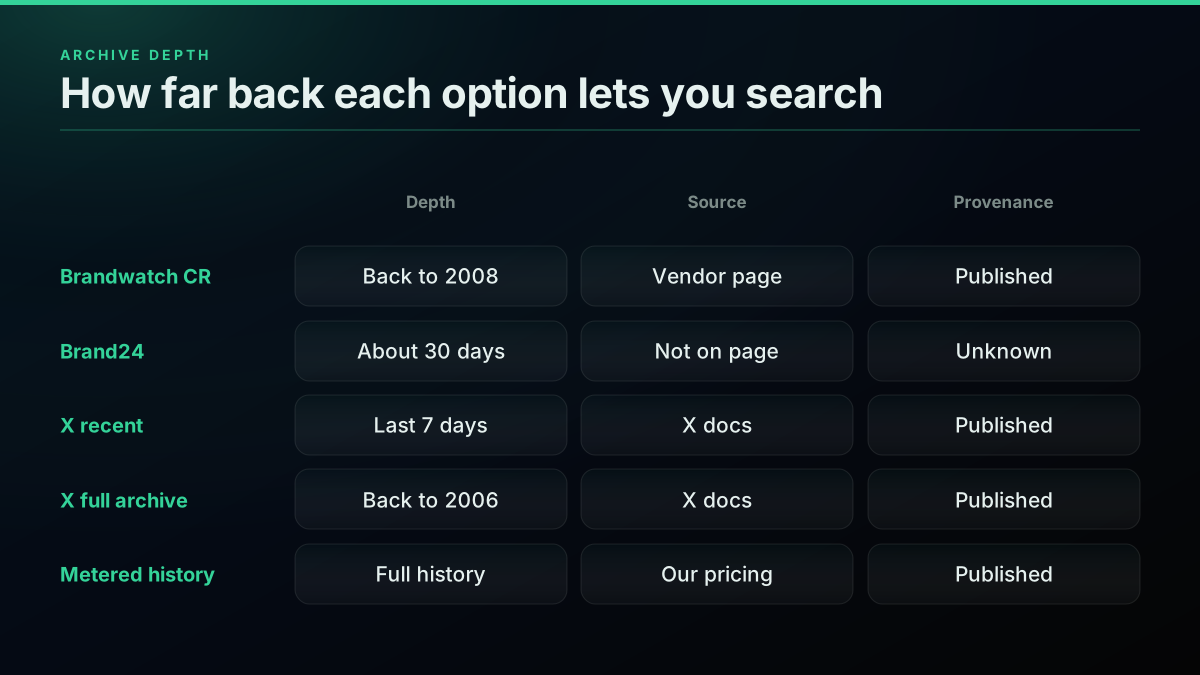
The verified figures: X's recent search endpoint covers the last 7 days and is available to all developers, while full-archive search covers the complete archive back to 2006 and is restricted to pay-per-use and Enterprise customers. Brandwatch's Consumer Research page states 1.4 trillion plus posts from today back to 2008. Both were read from the vendor's own documentation on 2026-09-09.
How far back each option lets you search, and where that figure comes from
| Option | Archive depth | Stated where | Provenance | Source |
|---|---|---|---|---|
| Brandwatch Consumer Research | 1.4 trillion plus posts, back to 2008 | brandwatch.com product page | Vendor's own live page, 2026-09-09 | published |
| Brand24, all tiers | Roughly 30 days of mentions | Not on the pricing page | Practitioner audit, unverified by the vendor | unknown |
| Official X recent search | Last 7 days | docs.x.com search introduction | Vendor's own live docs, 2026-09-09 | published |
| Official X full archive search | Complete archive back to 2006 | docs.x.com search introduction | Vendor's own live docs, 2026-09-09 | published |
| TwitterAPIs full history call | Full account history, priced separately | twitterapis.com/pricing | Our own live pricing page, 2026-09-09 | published |
| Option | Archive depth | Stated where | Provenance |
|---|---|---|---|
| Brandwatch Consumer Research | 1.4 trillion plus posts, back to 2008 | Brandwatch product page | Vendor's own live page, 2026-09-09 |
| Brand24, all tiers | Roughly 30 days of mentions | Not on the pricing page | Practitioner audit, unverified by vendor |
| Official X recent search | Last 7 days, all developers | X search introduction | Vendor's own live docs, 2026-09-09 |
| Official X full archive search | Complete archive back to 2006 | X search introduction | Vendor's own live docs, 2026-09-09 |
| TwitterAPIs full history call | Full account history, priced per call | our pay-per-use pricing | Our own live pricing page, 2026-09-09 |
One correction worth stating, because it is circulating. Practitioner threads describe Brandwatch as holding 1.7 trillion conversations back to 2010. Brandwatch's own live page says 1.4 trillion plus and back to 2008. The vendor is the only system that emits its own archive depth, so the vendor's figure is the one in our table, and the discrepancy is noted rather than quietly reconciled.
Brand24's roughly 30 day window on every tier including Enterprise is widely reported by practitioners and does not appear on brand24.com/pricing, so we carry it tagged unknown rather than published. If archive depth decides your purchase, ask the vendor in writing and do not take the number from a comparison page, including this one.
On the metered side, historical retrieval is a separately priced call rather than a plan feature, which means depth is a per-query cost decision instead of a contract negotiation. What a vendor will say about its own coverage is a separate question from what it delivers, which is why we wrote up Twitter monitoring API coverage honesty rather than taking archive claims at face value.
Data licensing: what may you store, resell or republish?
This is the section that no page on this search result contains, and it is the one that can invalidate an entire architecture after it is built. X's Developer Agreement restricts redistribution of X Content to third parties, and the restriction is specific rather than a general warning: if you provide X Content through an API, you may only distribute Post IDs, Direct Message IDs and User IDs.
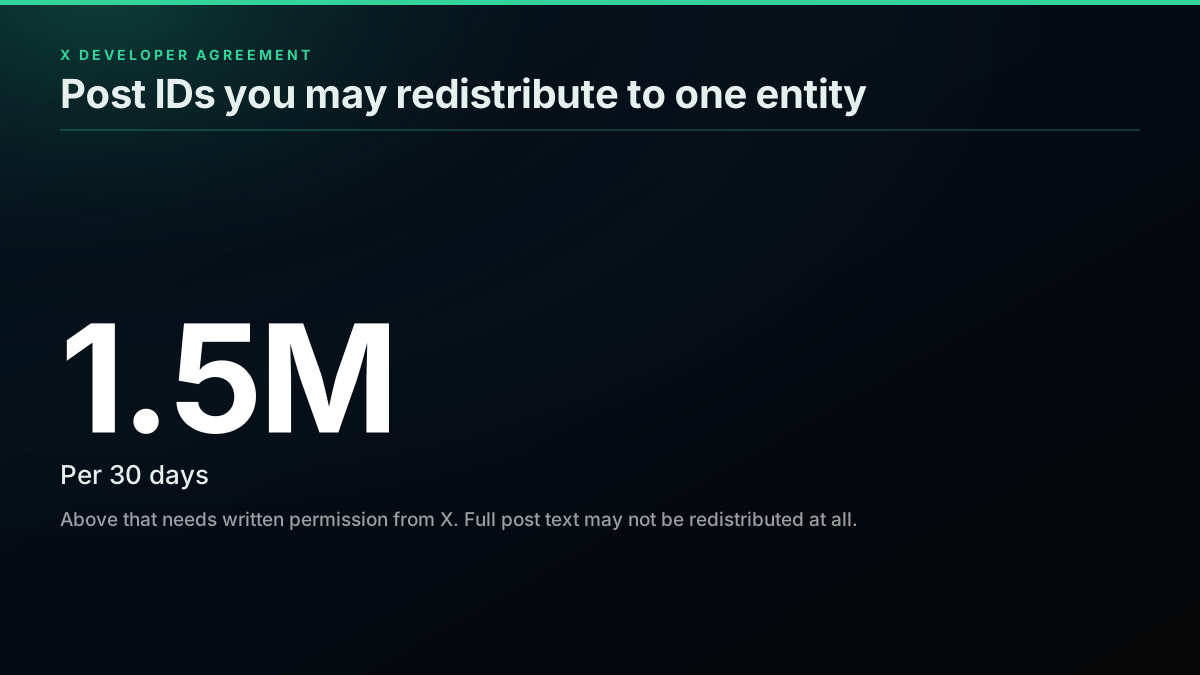
There is a hard ceiling attached. You may not distribute more than 1,500,000 Post IDs to any single entity, counting multiple individuals at one organisation as one entity, within any 30 day period, unless you have written permission from X. That number is in X's own developer agreement and policy, read on 2026-09-09.
The practical consequences are concrete. Rehydration, meaning storing IDs and re-fetching the content when you need it, is the sanctioned pattern for sharing a dataset. Shipping a customer a spreadsheet of full post text is a different act with different terms. A research dataset published for peer review is subject to the same ceiling as a commercial feed.
This applies whichever route you take, which is why it belongs in a buying comparison. Buying a suite does not transfer platform obligations to the vendor for content you then export. Building on an API does not exempt you either. The obligation attaches to the content.
If any part of your plan involves handing post text to somebody outside your organisation, read the agreement before you choose a vendor, because the constraint shapes the architecture rather than the invoice.
The cheapest pay-as-you-go Twitter API. Try it free.
$0.0008 a call, about $0.04 per 1,000 tweets at 20 tweets a page. $0.50 free credits. No credit card required.
Do social media tools charge extra for Twitter or X?
Sometimes, and it is one of the least-quoted line items in a demo. Some scheduling and management tools require you to bring your own paid X API access for Twitter publishing, which arrives as a second bill on top of the seat price. Whether a given tool does this is in its integration terms rather than its pricing page.
The reason is upstream. X's published price sheet charges for both directions now: $0.005 per post resource read and $0.015 per plain post created, with a post containing a URL at $0.200 per request. Any tool that publishes to X on your behalf is paying one of those rates per action, and it either absorbs the cost, prices it into the seat, or passes it to you.
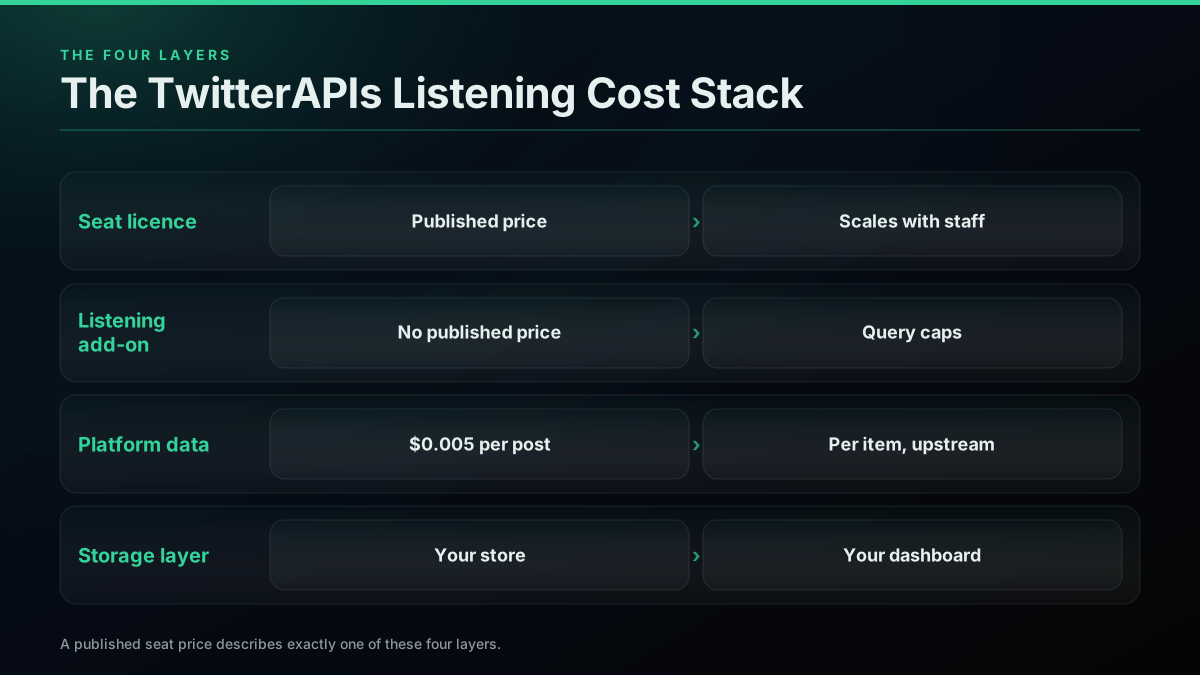
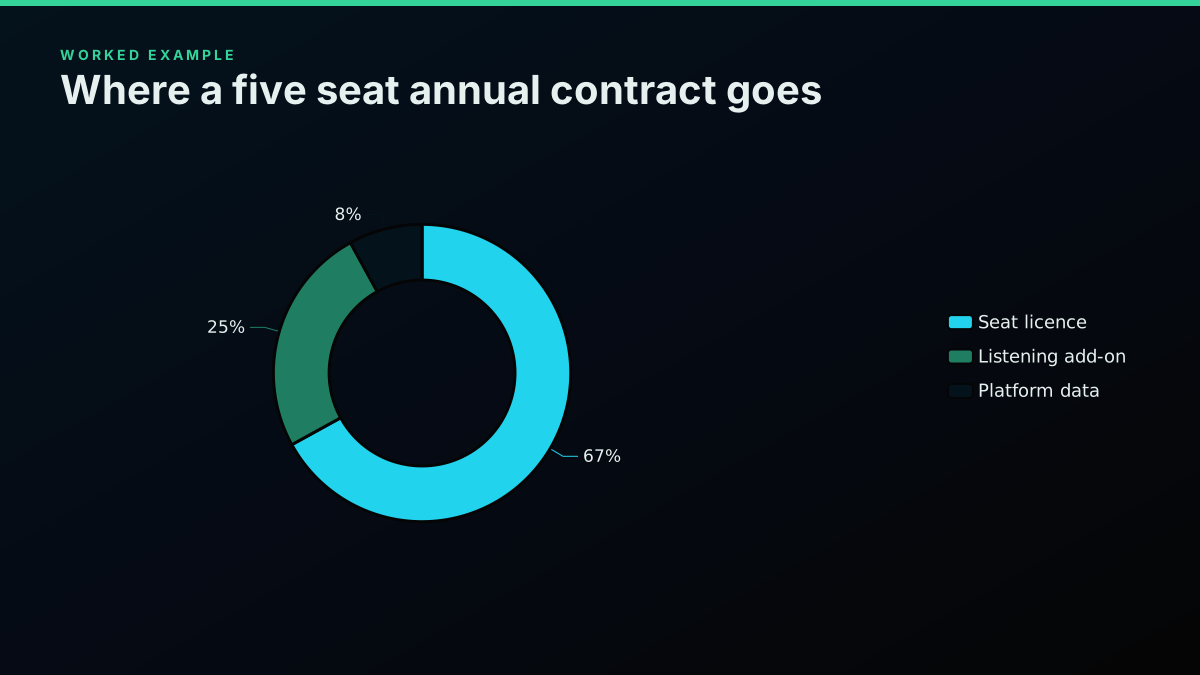
That is the four-layer stack behind a listening invoice: the seat licence, the listening add-on, the platform data charge, and the storage and analysis layer that turns raw mentions into something a person reads. A published seat price covers exactly one of those four, which is why two vendors with similar sticker prices can produce very different invoices.
The diagnostic question for a demo is short. Ask whether Twitter and X publishing requires your own X API credentials, ask what the listening add-on costs at your query volume, and ask what happens to the price when your mention volume doubles. All three answers are usually available and none of them is on the page.
Our connecting X to n8n guide covers the same bring-your-own-credentials problem from the automation side, where it shows up first.
Do I need a Twitter developer account to get Twitter data?
For the official X API, yes, and it is a reviewed process rather than a signup form. X's getting access documentation requires a developer account, an accepted Developer Agreement, a created app and saved credentials before any billed call. For a metered third-party API, no: the vendor holds platform access and issues you a key, so a bearer token in a header is the whole setup.
The difference is worth pricing in time rather than dollars. A developer account application is a gate that can take days and can be refused, and it sits before the first line of code rather than after it. A key issued directly is minutes, which changes what a two-hour evaluation can cover.
On twitterapis.com specifically that means $0.50 of signup credit with no card, which is roughly 625 standard calls, or about 12,500 tweets at a full page. That is enough to run your own real query, count what one page actually returns, and compute your own delivered density before spending anything.
The suites sit in a third position that is easy to miss. You do not need a developer account to use Sprout or Brandwatch, because the vendor holds platform access on your behalf, and that is genuinely part of what a seat pays for. It is also why a suite can quietly develop a bring-your-own-credentials requirement when platform pricing moves.
We covered the access question in full in getting Twitter API data without a developer account, including what the official application actually asks for.
Build versus buy: a raw feed plus your own dashboard
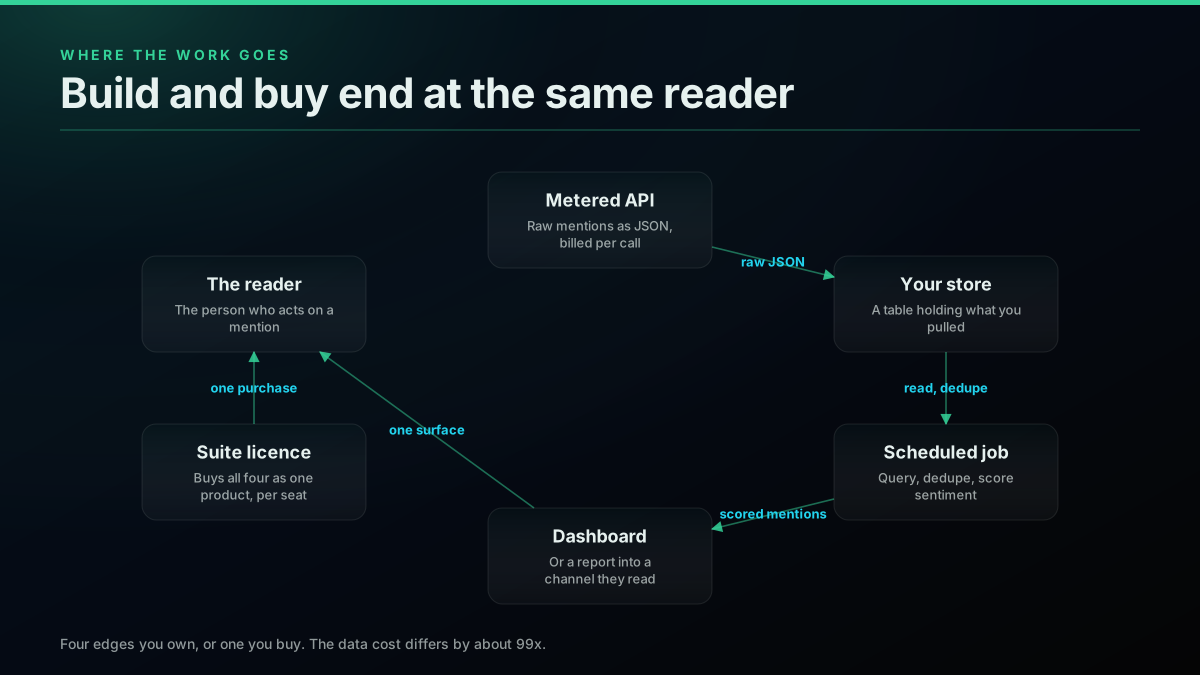
Both routes end at the same person reading the same mention. What differs is how many components you own between the API and that reader, and the honest comparison prices the components rather than pretending they are free. This is where most build-versus-buy arguments go wrong in both directions.
Where the work goes
Build and buy end at the same reader, with a different number of edges in between
The build path is four hops: a metered API returning JSON, somewhere to store it, a scheduled job that queries and dedupes and scores, and a surface a person opens. The buy path is one purchase that provides all four. The data cost difference is roughly 99x at the volume in our worked example, and the component cost difference is whatever your engineering time is worth.
The market has visible opinions about that trade. An automation practitioner posted about replacing an $8,200 social listening system quote with a workflow deployed in minutes, described in one paragraph of requirements.
https://x.com/WorkflowWhisper/status/2015418108929101945
A founder reported building a keyword and competitor monitor across several platforms and running it for around $10 a month against tools he priced at $100 a month and up, and was explicit that he would not sell it because he did not want to own the security surface.
https://x.com/ayushtweetshere/status/2084619613044879735
Both are real and both are partial. The build is cheap to stand up and carries an ongoing owner, and neither post prices the second year. The honest version of the build case is that it wins when the requirement is narrow, stable and read by a small number of people, and loses when it needs approvals, non-technical users or an audit trail.
Migrating off a suite without losing the part that worked
Nobody replaces a suite with an API in one step, and the teams that try usually lose the workflow before they have rebuilt it. The migration that works separates the two purchases and retires them on different dates: the data pull moves first, the workflow moves last or never.
Step one is measuring what you actually retrieve. Export a month of mentions from the incumbent and count them. That number is the denominator for every comparison in this post, and most teams find it is far smaller than the tier they are paying for implies, because a suite prices for the profiles you connect rather than the mentions you read.
The export is a CSV, so counting it and turning it into a unit cost is a few lines:
import csv

with open("incumbent-export.csv", newline="") as f:
    mentions_this_month = sum(1 for _ in csv.DictReader(f))

annual_mentions = mentions_this_month * 12
per_1k = lambda annual_cost: round(annual_cost / annual_mentions * 1000, 2)

print("suite", per_1k(11940), "metered", per_1k(48))
Run it before the parallel test rather than after, because the denominator decides whether the rest of the migration is worth doing at all. Our guide to monitoring Twitter mentions through the API in real time covers the pull side once that number is in front of you.
Step two is running both in parallel for one billing period. Pull the same query through a metered API on free credit, compare the mention sets, and look at what the suite returned that the raw feed did not. Sentiment scores, deduplication and author enrichment are the usual answers, and each one is a component you would need to own.
Step three is deciding where the reader lands. If the answer is a dashboard nobody has built, the migration is not ready. If the answer is a channel the team already reads or a report that already exists, the last hop is a scheduled job rather than a product. The monitoring build versus buy guide walks the same choice through with the engineering estimate attached.
Step four is the contract, and it is the one with a date on it. An annual seat commitment does not stop when you stop opening it, so the realistic saving starts at the next renewal rather than the next sprint. Plan the parallel run to end before that date, not after it.
What this sequence protects against is the failure mode both sides of the argument ignore: cancelling a working workflow to save on a line item, then rebuilding a worse version of it at a higher total cost in engineering time.
What we measured, and how
This section exists so the numbers above can be checked rather than trusted. Every published price in this post was fetched from the vendor's own live page on 2026-09-09 with a desktop user agent, and the same extraction was applied to all of them: script and style blocks removed, remaining markup stripped, dollar figures counted in the rendered text a reader would see.
Written out, the extractor is short enough to re-run against any vendor page in this comparison:
import re, requests

def dollar_figures(url):
    html = requests.get(url, headers={"User-Agent": "Mozilla/5.0"}, timeout=30).text
    html = re.sub(r"<(script|style)\b[^>]*>.*?</\1>", " ", html, flags=re.S)
    text = re.sub(r"<[^>]+>", " ", html)
    return sorted(set(re.findall(r"\$\d[\d,]*(?:\.\d+)?", text)))
The control is the part that makes a zero mean anything. Run it against a page you expect to return figures in the same pass as the page you expect to return none, and print both. A page returning nothing while its control also returns nothing is a broken extractor, not a vendor that publishes no price. Our Twitter API cost benchmark uses the same read-it-live rule on the metered vendors.
The results, in full. Sprout's pricing page returned five distinct figures and its listening feature page returned zero. Brandwatch's pricing page returned zero across 1,037,749 bytes. Hootsuite returned $99, $199 and $399. Brand24 returned $199, $299, $399, $599 and from $1,499. X's pricing documentation returned $0.005 per post resource and $0.010 per user resource. Our own pricing page returned $0.0008, $0.0016, $0.0024 and $0.004 across four call tiers.
The control pair matters more than any individual figure. A page returning zero prices is indistinguishable from a broken extractor unless another page returns prices in the same run. Sprout is that control for Brandwatch, and it fired, so the Brandwatch zero describes the page rather than our tooling.
Everything derived from those rates is labelled derived in the tables, and every annual total is a multiplication against one stated workload of 100,000 mentions a month. Nothing in this post is an estimate presented as a measurement, and the one figure we could not verify, Brand24's archive window, is tagged unknown rather than promoted.
Embeds were hydrated live in the same pass: four X posts through our own tweet detail endpoint, six Reddit threads by post ID, and two YouTube videos through metadata plus oEmbed. The engagement counts quoted are the ones those calls returned on 2026-09-09.
How we got here: the market context behind 2026 listening prices
The market context most comparison pages omit is that the input cost changed underneath every vendor in this category. Before 2023, platform data was effectively free to tool builders. Twitter's API repricing that year, reported by Wired at a $42,000 per month tier with pricing said to start at $500,000 a year for 0.3 percent of posts, ended that for the largest single source of public conversation.
The consequence took three years to reach pricing pages. Every listening tool now pays per item for data it used to receive at no marginal cost, and those charges appear in seat prices, in add-on tiers, in query volume caps, and occasionally as an explicit bring-your-own-credentials requirement. A social tool co-founder summarised the input side bluntly in a practitioner thread: X and Reddit now charge developers per piece of content, Facebook removed its search API years ago, and Instagram only allows hashtag listening.
The second change is who is buying. Data access being metered made it purchasable directly, which created a buyer who never existed before 2023: the team that wants the feed without the workflow. That buyer is unserved by every page ranking for this query, which is the market gap this post occupies.
The third change is still arriving. Answer-engine visibility, meaning whether ChatGPT, Claude, Gemini or Perplexity name your brand, has entered the monitoring shortlist as its own axis alongside classic mention tracking. It is a new column in a category whose pricing pages have not caught up.
https://x.com/Shruti_0810/status/2070847003760947364
Is a social listening tool worth it for a small team?
It is worth it when somebody will open it daily and act on what they find. The self-audit that settles it is a question buyers put to each other rather than to vendors: how often do you actually action listening data rather than merely have it available. If the honest answer is monthly, a per-seat subscription is charging continuously for occasional use.
The unserved segment here is real and specific. A researcher in r/b2bmarketing described looking at tools like Brandwatch and being priced out by the number of accounts they wanted to monitor, with no commercial objective at all. That buyer is not cheap. They are outside the shape the category prices for.
https://www.reddit.com/r/b2bmarketing/comments/1oldrro/social_listening/
The three-question version, which is short enough to answer before a demo. How many people will open this weekly. How many mentions a month do you actually need retrieved. How far back do you need to search. Those three numbers decide it, and only the second appears on any pricing page.
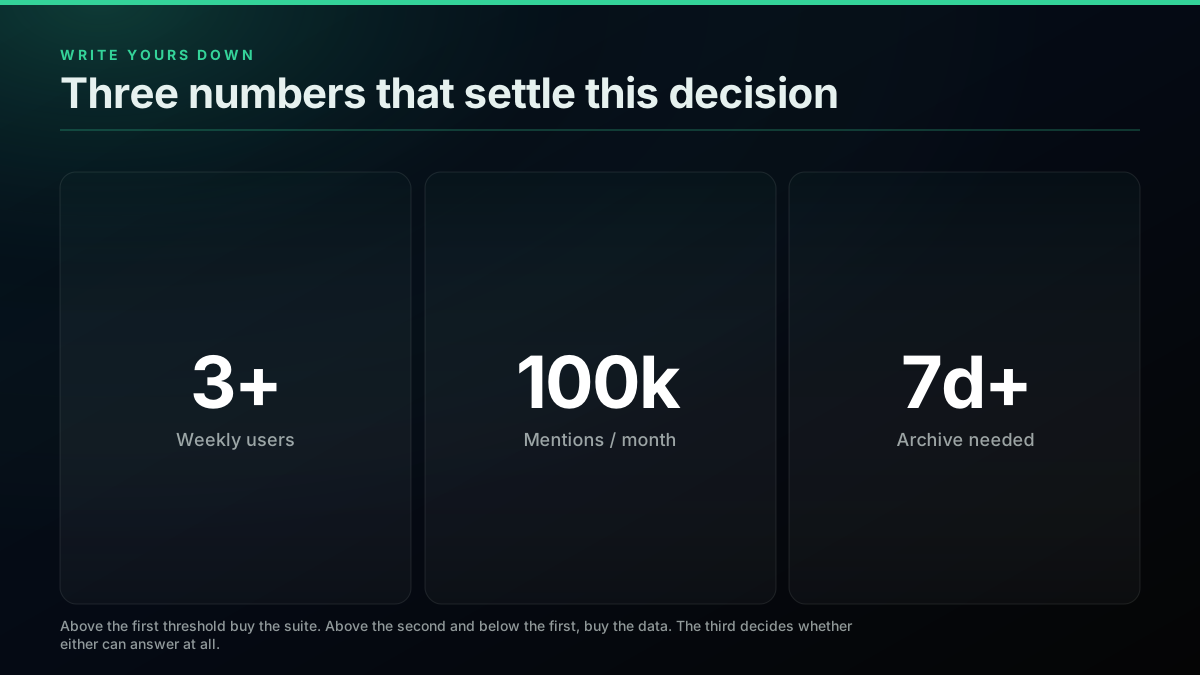
A small team with two weekly users, low mention volume and no historical requirement is usually better served by a scheduled pull into a channel they already read than by seats they will forget to open. A small team doing daily community management with approvals is a suite buyer at any price this category charges.
What happens to unused API credits if I stop using the service?
Two facts govern this and both are true at once, so a comparison that quotes only one is selling. On twitterapis.com the pricing page states that credits never expire, so an unused balance is not consumed by the calendar. The terms of service are stricter about the money: credits are non-refundable once purchased, and unused credits are forfeited on termination.
What bounds the exposure is that there is no minimum spend, so the size of the balance is your decision rather than a contract term. Starting at $0.50 of free credit with no card, then topping up in the increments you actually need, keeps the amount at risk to whatever you chose to put in.
The comparison against an annual seat contract is the relevant one. An annual suite commitment is money spent whether the tool is opened or not, and it renews on a date rather than on usage. A credit balance is money spent that is still available to spend later. Neither is refundable, and only one keeps working when your usage pauses.
We are stating the unflattering half deliberately. The terms are silent on any expiry clock, which is not the same as a promise in either direction, and a vendor that publishes a refund policy is offering something we do not.
Which one should you actually buy?
The decision reduces to three numbers you can write down before the next demo: how many people will use the tool weekly, how many mentions a month you need retrieved, and how far back you need to search. Every option in this comparison wins one of those three cleanly, and none wins all three.
Buy the suite if the first number is above roughly three and the people are non-technical. The inbox, approvals and reporting are the product, the seat price is what they cost, and no metered API replaces them without a build. Sprout at Standard, or Hootsuite at its lower entry price, are the live options with published rates.
Buy a listening product like Brand24 if you need monitoring rather than management and the archive window covers your questions. It is meaningfully cheaper than a management suite plus an unpriced listening add-on, and it does not pretend to be a publishing tool.
Talk to Brandwatch if your questions reach back years, because on its own published capability it is the only option here that can answer them, and accept that a sales call is the only route to a number.
Buy the data directly if the second number is large, the first is small, and you already have somewhere to put the results. That is the case this post exists to price, and at 100,000 mentions a month it is $120 a year of data against $11,940 of seats.
Two more resources worth reading before a renewal call: the Twitter API cost calculator for the metered side of the arithmetic, and the sentiment analysis buyer guide if scoring rather than retrieval is the part you were paying the suite for. The MCP server covers the same data through an agent interface, and tracking tweet performance in real time covers the monitoring loop itself.
https://www.youtube.com/watch?v=pYnEgD1r4EM
https://www.reddit.com/r/SocialMediaMarketing/comments/1pbpgos/what_is_the_best_affordable_social/
// sources
Where these numbers come from
Each row is a figure in this post and the artefact it was read from. Prices and limits on this platform move, so check the date on the source before you plan against it.
- Sprout Social pricing page
- The primary source for every Sprout figure in this post: Essentials $79 per seat per month annual and $99 monthly, Standard $199, Professional $299, Advanced $399, Enterprise quote only, Standard limited to 5 social profiles, and the sentence stating that Premium Analytics and Listening are each available as individual add-ons to the Standard plan and up. Read 2026-09-09.
- Sprout Social listening feature page
- Cited as the negative control for the unpriced-add-on claim: the same extractor that found five dollar figures on the pricing page found zero on this page in the same pass. Read 2026-09-09.
- Brandwatch pricing page
- Source of the single most liftable fact in this comparison: zero dollar figures in the rendered text across 1,037,749 bytes, no tier table, and every button routed to a demo. Read 2026-09-09.
- Brandwatch Consumer Research product page
- Source of the archive-depth figures used in the retention table, 1.4 trillion plus posts and coverage from today back to 2008, and the 496 million new posts a day figure. Also the basis for correcting the 1.7 trillion back to 2010 figure circulating in practitioner threads. Read 2026-09-09.
- X API pay-per-usage pricing
- Source of every official X rate used here, including $0.005 per post resource read, $0.010 per user resource read, $0.015 per plain post created, $0.200 per post created with a URL, and the 3 million post reads per monthly billing cycle cap on pay-per-usage plans. Read 2026-09-09; the page's own schema records a dateModified of 2026-08-13.
- X API search introduction
- Source of the two retention windows in the archive-depth section: recent search covers the last 7 days and is available to all developers, full-archive search covers the complete archive back to 2006 and is limited to pay-per-use and Enterprise customers. Read 2026-09-09.
- X API rate limits reference
- Source of every throughput ceiling quoted in the rate-limits section, including GET /2/tweets at 3,500 requests per 15 minutes per app, GET /2/tweets/:id at 450 per 15 minutes, and recent search at 450 per 15 minutes per app with 10 default and 100 maximum results and a 512 character query length. Read 2026-09-09.
- X Developer Agreement and Policy
- The source for the licensing and redistribution section, including the restriction on redistributing X Content to third parties, the rule that an API may only distribute Post IDs, Direct Message IDs and User IDs, and the ceiling of 1,500,000 Post IDs to any single entity within any 30 day period without written permission. Read 2026-09-09.
- X API getting access
- Backs the statement that the official route requires a developer account, an accepted Developer Agreement, a created app and saved credentials before any billed call, which is the distinction drawn in the developer-account section.
- X Enterprise, GNIP 2.0 overview
- Cited where the post explains what sits above the pay-per-usage cap, including the firehose, decahose and compliance products that pay-per-usage does not include and that no published rate card covers.
- Hootsuite plans page
- Source of the Hootsuite comparison figures used in the cheapest-alternative section: Standard at $99, Professional at $199 and Advanced at $399, with custom Enterprise pricing. Read 2026-09-09, and materially different from the $199 entry figure still repeated in older roundups.
- Brand24 pricing page
- Source of the Brand24 published tiers used in the annual comparison: Individual $199, Team $299, Pro $399, Business $599 and Enterprise from $1,499, on annual billing. Read 2026-09-09.
- Wired, Chris Stokel-Walker, 10 March 2023
- The only citable public figure for X enterprise data pricing, a $42,000 per month tier with pricing reported to start at $500,000 a year for access to 0.3 percent of posts. Used as historical context for why platform data became a line item, explicitly not as a current rate.
- r/SocialMediaMarketing, cross-posting tool test thread
- The highest-engagement first-hand thread on this topic, 39 upvotes and 125 comments when re-read on 2026-09-09. An agency owner testing every suite in turn, quoted for the observation that Sprout's pricing is not competitive and Hootsuite is overpriced. Cited as buyer evidence, never as a source for any price.
- r/marketinteltools, stale pricing audit
- A disclosed site-owner post that re-checked eight tools against current sources between 30 July and 1 August 2026 and found half the widely repeated figures wrong. Cited for the pattern that vendors who publish pricing get quoted accurately and vendors who do not get quoted from a competitor's guess. Labelled as a disclosed commercial post in the body.
- r/sociallistening, Brand24 and Sprout listening thread
- Source of the practitioner observation that Sprout's listening is an add-on and can get expensive quickly, and that AI answer-engine visibility has entered the monitoring shortlist. Cited as demand evidence.
- r/b2bmarketing, research-budget listening thread
- A researcher priced out of Brandwatch for the number of accounts they need to monitor, with no commercial objective. Cited as the clearest statement of the unserved segment this post is written for.
- Speak About Digital, social listening tools comparison, May 2025
- A video walkthrough comparing Brandwatch, Meltwater, Sprout Social, Hootsuite and Brand24, verified live on 2026-09-09 at 7,707 views. Cited as an example of the suite-versus-suite frame that every ranking page on this query uses.
Frequently Asked Questions
Read from sproutsocial.com/pricing on 2026-09-09: Essentials $79 per seat per month on annual billing ($99 billed monthly), Standard $199, Professional $299, Advanced $399, and Enterprise quoted only through a demo. Standard covers 5 social profiles; Professional and above are unlimited. Every figure is per seat, so a five-person team on Standard is $995 a month, or $11,940 a year, before any add-on. Premium Analytics and Listening are separately priced add-ons on Standard and up, and neither carries a published figure.
Two published answers, and they differ by more than 100x. The official X API bills $0.005 per post resource returned, which is $5.00 per 1,000 tweets, read from X's own pay-per-usage price sheet on 2026-09-09. A metered third-party API prices per call instead: $0.0008 a standard call, and a standard read returns up to 20 tweets, so $0.04 per 1,000 tweets on a full page. Real pages are not always full, so the honest delivered band is $0.04 to $0.10.
Unanswerable as published, and that is itself the finding. Sprout's rates are on its pricing page, so a seat-count multiplication gives a number. Brandwatch names no figure anywhere public, so the comparison has a hole in it that only a sales call fills. The one public data point is third-party: an aggregated-contract dataset cited in a practitioner audit puts the median Brandwatch contract near $50,000 a year, which would sit well above a small Sprout Standard team.
Sometimes, and it is rarely quoted in a demo. Some scheduling tools require you to bring your own paid X API access for Twitter publishing, which lands as a second bill on top of the seat price. The underlying reason is that X now charges for the data itself: $0.005 per post read and $0.015 per plain post published, per X's own price sheet. Read the specific tool's X integration terms before budgeting, because that line moves a total more than the tier does.
Count mentions, not calls. Write down the mentions you need retrieved per month, then divide by the items a single call actually delivers to get calls, then multiply by the call rate. Do the same arithmetic for the suite by dividing its annual contract by the mentions it retrieves in a year. Express both as dollars per 1,000 mentions and the comparison becomes like for like. The cost calculator does the second half for the metered side.
On twitterapis.com the pricing page states that credits never expire, so an unused balance is not consumed by the calendar. The terms of service are stricter on the money: credits are non-refundable once purchased, and unused credits are forfeited on termination. Both facts are true at once and they answer different questions. What bounds the exposure is that there is no minimum spend, so you choose the size of the balance, starting at $0.50 of free credit with no card.
Brandwatch publishes no price. We fetched brandwatch.com/pricing on 2026-09-09, stripped the markup and counted dollar figures in the rendered text: zero, across 1,037,749 bytes. The same extractor found five figures on Sprout's pricing page in the same pass, so the tool works and the absence is real. The only way to learn what Brandwatch costs is to enter a sales cycle, which is a planning cost rather than an inconvenience: you cannot budget the middle column of this comparison without booking a call first.
A suite sells a workflow: publishing, a shared inbox, approvals, sentiment scoring and reports that a non-technical team opens daily. It is priced per seat because seats are what consume it. An API sells the data itself, as JSON, with no interface attached, priced per call because calls are what consume it. Neither replaces the other. A suite without users is wasted seats, and an API without somewhere to put the data is a bill for a file nobody reads.
It depends on what you are replacing. If you need the suite workflow, Hootsuite lists Standard at $99, Professional at $199 and Advanced at $399 on its own plans page as of 2026-09-09, below Sprout at the entry tier. If you only need the Twitter and X data, a metered API removes the seat entirely and bills the data at $0.0008 a call. That is a different product, not a discount, and the honest comparison is per 1,000 mentions retrieved, not per seat.
For the official X API, yes. X requires a developer account, an accepted Developer Agreement, a created app and saved credentials before any billed call. For a third-party metered API, no. The vendor holds the platform access and issues you a key directly, so a bearer token in a request header is the entire setup. On twitterapis.com that means $0.50 in signup credit, no card, and roughly 625 standard calls before anything is charged.
It is worth it when a person will open it daily and act on what they see. The self-audit that decides it is a question buyers ask each other out loud: how often do you actually action listening data rather than merely have it available. If the honest answer is monthly, a per-seat suite is charging you continuously for occasional use, and a metered pull into a report you already read is the cheaper shape.
Because you are buying seats, and seats scale with headcount rather than with data. Five people on Standard is $11,940 a year for the same underlying mentions one API key retrieves. The pricing also unbundles: Premium Analytics and Listening are separate add-ons on Standard and up, so the listening capability most buyers arrive for is not in the sticker price. Underneath all of it, platform data now costs the vendor real money, and that cost is passed through.
Check out similar blogs
More guides on the Twitter/X API, scraping, and pricing.
The X Chat API in v2.169: Group Endpoints and What a DM Really Costs
X shipped a full set of X Chat endpoints in API v2.169: groups, admins, invites and members. What you can build on encrypted chat, and the real cost per DM.
Grok Bot Reads X Without API Credits Now. When You Still Need an X Data API
Grok Bot can now search, read and monitor X without X API credits. What the docs confirm, what they leave out, and five jobs that still need an X data API.
What a Twitter Scraper API Bills Per Job: Profiles, Followers, Replies and Search
A rate card for twitter scraper api jobs by data type. What 10,000 profiles, followers, following, replies and search results each bill, on live rates.
TwitterAPIs Is Live on Uneed: A $0.0008 Twitter API With No Developer Account
TwitterAPIs launched on Uneed today. What the pay-per-call Twitter API costs next to the official X API, how a Uneed launch day actually works, and what founders say one delivers.
Build a Crypto Twitter Tracker in Python: Watch a KOL List and Catch Contract Addresses
A runnable Python watcher that polls a named list of crypto accounts, pulls every new post, finds EVM and Solana addresses, and alerts you, with the monthly bill for 25 and 100 accounts.
Watching 50 X Accounts: What Every Poll Cadence Actually Bills
Every monitoring page sells you an interval and calls it real time. None of them prices it. Here is what a one minute, fifteen minute and daily poll across a fixed fifty account roster costs per month, and the route where the watch itself bills nothing.
Why X Advanced Search Misses Posts You Know Exist (2026)
A query that returns nothing is not proof that nothing exists. We searched for 17 posts confirmed to exist, published between 2015 and 2026, and measured which query forms found them and which did not.

X/Twitter Statistics in 2026: What an API Can Actually Measure, and What Nobody Can
Most X statistics roundups re-cite the same handful of numbers. We measured what a public API can and cannot see across 34 accounts, printed the query behind every figure, and traced the rest to their real sources.