GUIDE
Why X Advanced Search Misses Posts You Know Exist (2026)
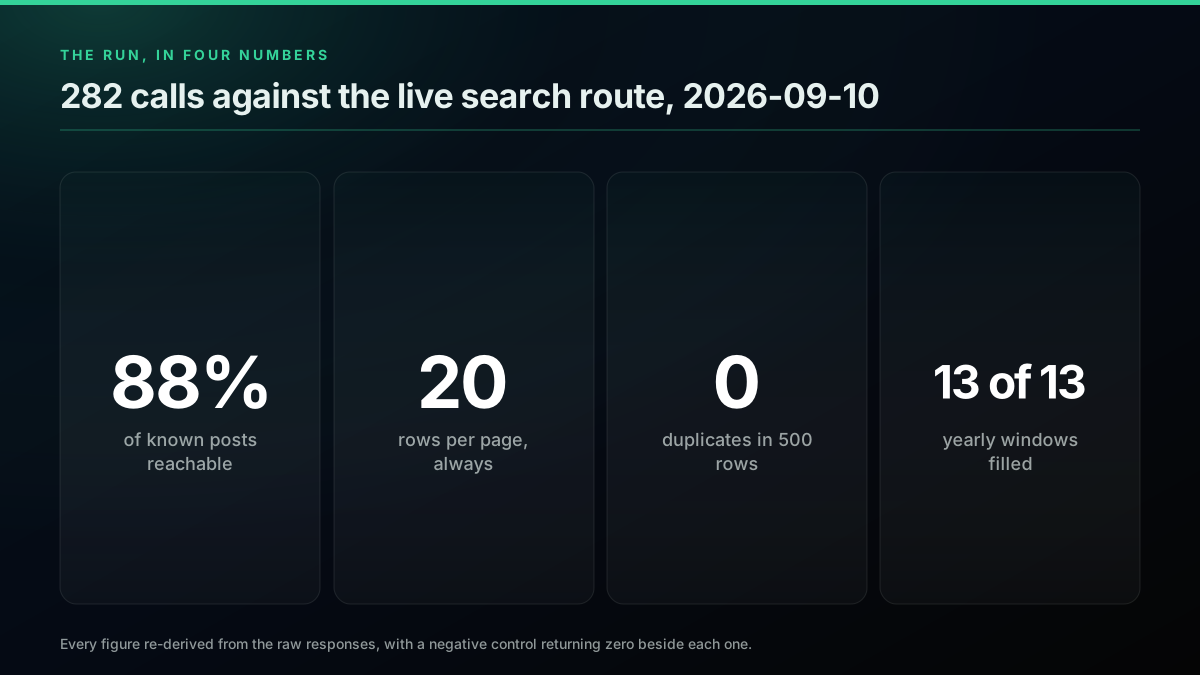
A query that returns nothing is not proof that nothing exists. We searched for 17 posts confirmed to exist, published between 2015 and 2026, and measured which query forms found them and which did not.
Per our own spec, 70 of 121 endpoints bill $0.0008, 24 are free, and 27 sit between $0.0016 and $0.01. Every price ships inside our published OpenAPI document as an x-cost-usd field, so any figure in this post can be checked against the contract that bills it rather than taken on trust.

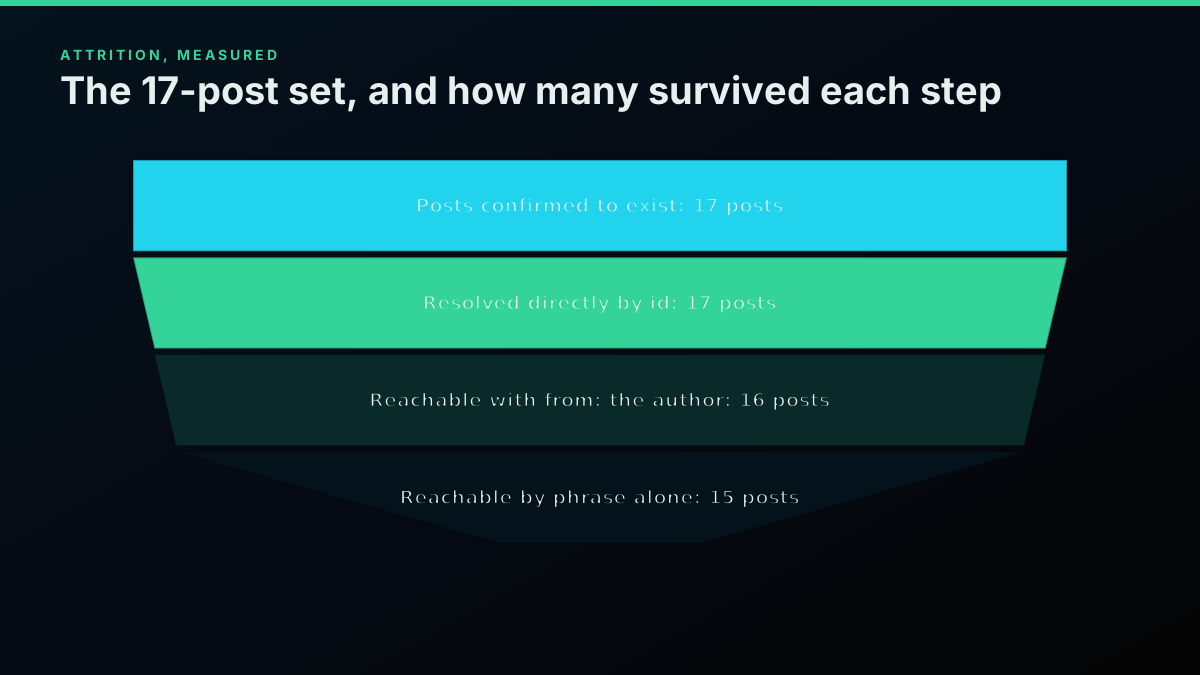
TL;DR: An empty result on X search almost never means the post is gone. We took 17 posts confirmed to exist, published between 2015 and 2026, and searched for each one using a phrase copied out of its own text. 15 came back on a plain search, 16 came back once we named the author with
from:, and exactly 1 was unreachable on every route. Age was not the barrier, and adding a date window changed nothing. The most common cause of an empty result is a query that does not match the post, the second is a page that stops at 20 rows without saying so, and the genuine index miss is the rarest of the three.
You searched for something you watched happen. You remember the wording. You may even remember who posted it. X advanced search returns nothing, and the nothing looks completely authoritative: no error, no warning, no hint that anything was filtered. Just an empty page where a post you are certain about should be.
The instinct at that point is to assume the post is gone, or that the index has quietly dropped everything older than some horizon nobody published. That instinct is usually wrong, and it is wrong in a specific and fixable way.
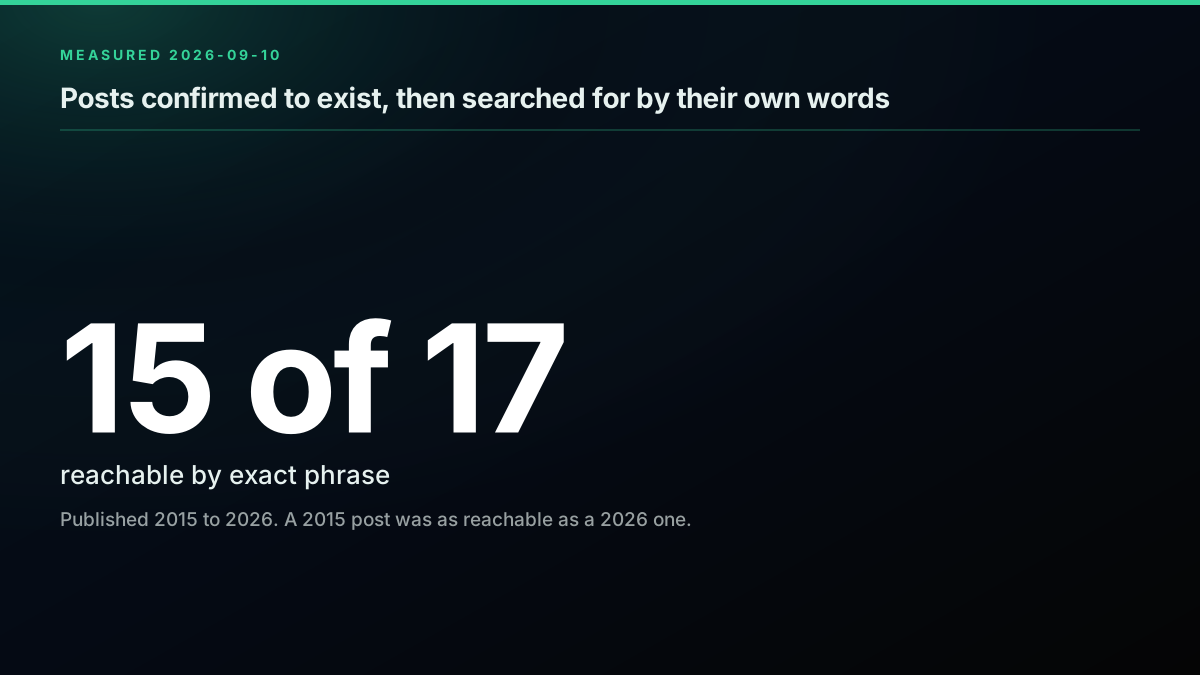
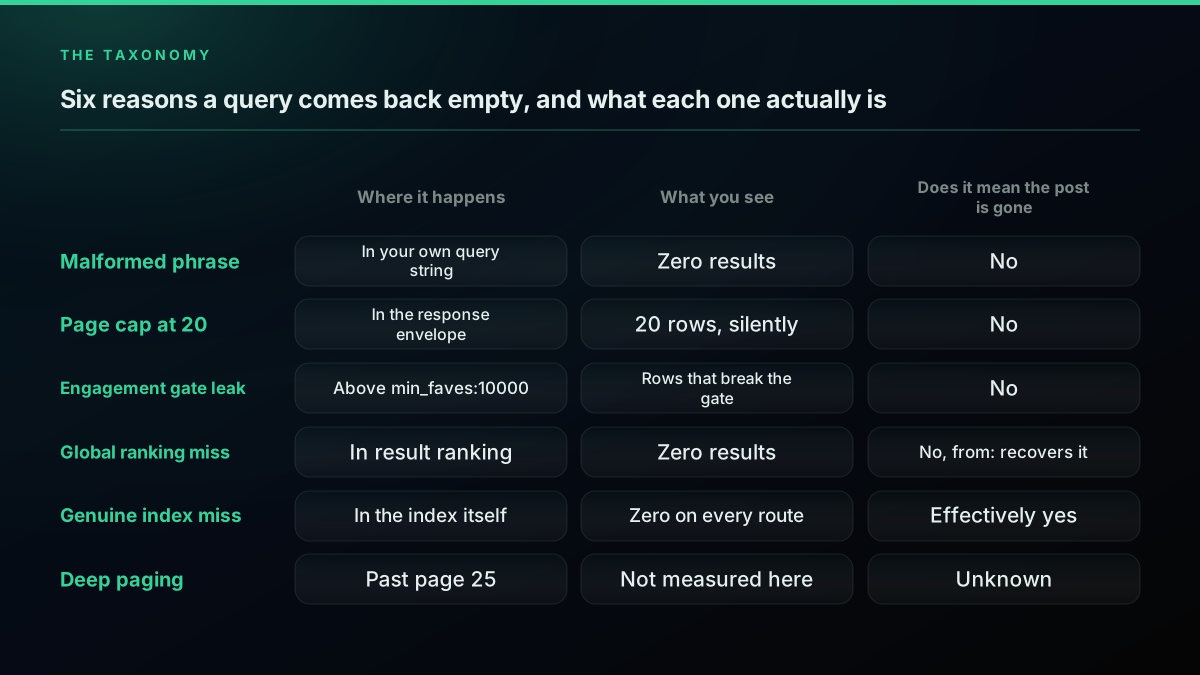
We measured it. Over 282 calls against the live search route on 2026-09-10, we took posts whose existence was established first, by resolving each one's id directly, and then went looking for them by their own words. What comes back is not one failure mode. It is at least six, they have almost nothing in common, and the one everybody talks about turns out to be the rarest.
The path a post takes to reach you
Four places a post can drop out between the index and your screen
What is actually between your query and a result?
Four separate systems, and they fail independently. Most of the confusion in this subject comes from treating X search as one thing, so it is worth naming each layer before naming the mechanisms, because every mechanism below lives in exactly one of them.
Most of the confusion in this subject comes from treating "X search" as a single thing. It is not. There are at least four separate systems between a post being published and that post appearing in your results, and each one can drop it for reasons the others know nothing about.
The index is the store. It decides what is retrievable at all. Its contents are the only thing that "the post is gone" can honestly refer to, and it is the layer people blame first and reach last.
Query parsing turns your string into a set of constraints. This is where quoted phrases become literal match requirements, where from: becomes an author constraint, and where min_faves: becomes a numeric filter. A query that parses successfully but constrains more tightly than you intended produces an empty result that is completely correct and completely useless.
Ranking decides which of the matching posts are worth returning and in what order. A post can satisfy every constraint in your query and still not surface, because ranking is a competition and not a filter. This is the layer that makes from: work when a plain phrase does not: narrowing the candidate pool changes who wins.
Serving is the layer that hands you rows. It owns page size, cursors, timeouts and rate limits. It is also the layer most likely to be lying to you by omission, because a truncated response and a complete one are the same shape.
Those four layers fail independently, and the failure of any one of them produces the identical symptom: an empty page, or a page that looks complete and is not. Nothing in the response tells you which layer you are looking at. That is the whole problem, and it is why the diagnostic ladder at the end of this post is ordered the way it is: each rung eliminates one layer.
There is one more distinction worth drawing before the mechanisms, because it silently invalidates a lot of advice you will read elsewhere. The web search form and the API search routes are not the same surface. They share an index, mostly, but they do not share ranking behaviour, page size, operator support or freshness. X documents the web form on its own advanced search help page and the API operators separately in its build-a-query reference, and the two lists are not identical. Advice written for one and applied to the other is a common source of wasted afternoons. Everything measured in this post was measured against the API path via the advanced search endpoint, and where a claim only holds for one surface, it is labelled.
What does an empty search result actually prove?
An empty result tells you that a particular query, on a particular route, at a particular moment, returned no rows. That is a much narrower statement than "the post does not exist", and the gap between the two is where every hour of frustrated searching goes.
The clearest way to see the gap is to hold the content constant and change the route. A developer on Stack Overflow did exactly that in 2019: same query, same two-day window, same city, three retrieval paths.
Three retrieval paths, one query, three different counts
A developer ran the same query for accidents in Dallas over a two-day window through three routes and got 12 results, 22 results and 3 results. Advanced search returned the fewest of the three, by a factor of seven against the best. The lesson is not that one route is broken, it is that recall is a property of the route and not of the query.
Stack Overflow, 2019-12-26
The number of Tweets are different for each method of searching. Tweepy, using full-archive search, returns 12 Tweets. GetOldTweets3 returns 22 Tweets. And using the Twitter Advanced Search returns 3 Tweets. Is there a reason for the different number of tweets?
Twelve results, twenty-two results, three results. The advanced search surface returned the fewest of the three, by a factor of seven against the best. Nothing about the query changed between those runs. What changed was the index scope and the ranking behaviour of the route, and neither of those is something a better query string can reach.
Sit with the size of that spread for a moment, because it reframes the question. If three routes disagree by a factor of seven on a two-day window in one city, then "how many posts match this query" does not have a single answer. It has one answer per route. Any claim about what X does or does not contain, made without naming the route it was measured on, is unfalsifiable.
This is also why "I checked and it is not there" is such a weak statement in practice, and why it feels so strong when you say it. You checked one route. The route you checked is, on this evidence, plausibly the lowest-recall one available to you.
The reply that question received is the single most useful sentence in this entire subject area:
You're assuming that every search facility will return the same results. In my experience, they usually don't.
That is the correct mental model, and almost nobody holds it. Recall is a property of the route, not of the query.
The measurement, and the part where we got it wrong first
Before the results, the correction, because the correction turned out to be the finding. Our first measurement of X search recall returned 25 percent and was wrong, and it was wrong because of a bug in our own query builder rather than anything about the index. Fixing that bug moved the answer to 88 percent, and the gap between those two numbers is the most useful thing in this post.
Our first pass reported that 3 of 12 posts known to exist were findable by exact-phrase search. A 25 percent recall rate. It was a striking number, it confirmed exactly what the whole internet believes about X search, and it was completely false.
The first version of this measurement was wrong, and the wrong answer was the flattering one. Our first run reported that 3 of 12 posts known to exist were findable, a 25 percent recall rate. It was a great number and it was false. The phrase builder dropped every word of two characters or fewer, so nine of the twelve queries were strings that appear nowhere on X. The control that caught it asked one question: is this phrase literally present in the post? Three of twelve were, and those three were exactly the three that had been found. Three for three. The instrument was measuring its own bug.
The phrase builder took the first eight words longer than two characters. So a post reading Hey @twitter, the Advanced Search is not working. Help. was searched for as Hey twitter the Advanced Search not working Help, a string that appears nowhere on X, because is had been silently deleted. Nine of the twelve queries were strings that do not exist in the posts they were meant to find.
One assertion caught it. Is this phrase a literal substring of the post's own text? Three of twelve were. And those three were exactly the three that had been found. Three for three.
Rebuilt to take a contiguous seven-word run straight out of the text, with the literal-substring check promoted to a precondition, the same experiment on a larger set returns something quite different.
Seventeen posts confirmed to exist, then searched for by their own words
| Route | Posts found | Of | Rate | Source |
|---|---|---|---|---|
| Exact phrase alone | 15 | 17 | 88% | measured |
| Exact phrase plus a two-year date window | 15 | 17 | 88% | measured |
| Exact phrase plus from: the author | 16 | 17 | 94% | measured |
| Direct id resolution | 17 | 17 | 100% | measured |
Reachability by query form
Posts recovered by each route, out of 17 known to exist
| Point | Value (posts) |
|---|---|
| Exact phrase alone | 15 posts |
| Phrase plus date window | 15 posts |
| Phrase plus from: author | 16 posts |
| Direct id resolution | 17 posts |
Fifteen of seventeen on a plain exact phrase. Sixteen of seventeen once the author is named. Twenty-five percent and eighty-eight percent are the same experiment, on the same index, four hours apart. The only thing that changed was whether the question was well formed.
That is not a footnote about our methodology. It is the most useful thing we learned, because the exact same failure is happening in your search box. A phrase you retyped from memory, or copied with a smart quote that became a straight quote, or trimmed a stray word from, is a phrase that matches nothing. And the empty page it produces looks precisely like an index miss.
Every number here has a nonsense query sitting next to it. A search that returns zero proves nothing until you have shown the same instrument returning rows for something real and zero for something invented. Ours did both on every pass: a nonsense token returned 0 rows and a plain query returned 20. Without that pair, an empty result is equally good evidence for an absent post and for a broken client.
Mechanism one: your query does not match the post
The most common reason X advanced search returns nothing is that the query does not match the post, not that the post is missing. Exact-phrase matching on X is literal and character-exact, so a single retyped word, a curly apostrophe or a stray full stop is enough to reduce a valid search to zero results. This is the most common cause and the least discussed, because it is unflattering and because nobody can see it happening.
X exact-phrase matching is literal. "the advanced search is broken" and "the advanced search is broken." and "the advanced search was broken" are three different queries, and at most one of them matches any given post. Punctuation you did not notice, a word you paraphrased, an emoji sitting in the middle of the string, a curly apostrophe from a word processor: each one is enough.
The people hitting this are not careless. They are frequently the most search-literate people in the room.
Twitter search is a dumpster fire. Finding something that I know exists on twitter because I saw earlier is nearly impossible, even if know exactly who tweeted it. Am I doing it wrong or is it as bad as I think?
That is a product lead for a major browser, publicly asking whether the problem is him. It is not. But note the direction of the doubt, because it is the same direction almost everyone's doubt runs: assume the query is wrong, then give up and assume the index is wrong, and never actually distinguish the two.
Here is how to distinguish them, and it takes about fifteen seconds:
- Copy a phrase out of the post itself if you can see it anywhere, a screenshot, a quote, an archive, a different client. Never retype it.
- Keep it short. Six to eight words is plenty and every extra word is another chance to mismatch.
- Drop the quotes entirely on the first attempt. An unquoted query is far more forgiving and tells you whether the tokens are in the index at all.
If an unquoted query finds it and a quoted one does not, your phrase is the problem and the post is fine.
Here is the same check as a single call you can paste. It takes a phrase and reports whether the route can see it at all, quoted and unquoted, so the two cases are separated in one run rather than confused in your head:
curl -s -G "https://api.twitterapis.com/twitter/tweet/advanced_search" \
  -H "Authorization: Bearer $TWITTERAPIS_KEY" \
  --data-urlencode 'query="advanced search" lang:en' \
  --data-urlencode 'product=Latest' \
  --data-urlencode 'count=200' \
| python3 -c 'import json,sys; d=json.load(sys.stdin); print("rows:", len(d.get("tweets") or []), "more:", bool(d.get("next_cursor")))'
Run it once with the quotes inside query and once without. Two empty results means the tokens are genuinely not being matched. One empty and one populated means your phrase is over-constrained, which is the good outcome, because it is entirely under your control.
A few specific phrase traps worth knowing, all of which produce a silent zero:
- Smart quotes. A phrase copied out of a document editor carries curly apostrophes, U+2019 rather than the plain U+0027. They look nearly identical in a search box and they are different bytes, so a phrase carrying one will not match a post carrying the other.
- Trailing punctuation inside the quotes.
"is not working."requires the full stop to be present in that position. - Line breaks. A post that wraps across lines does not contain the space you typed where the break was.
- Mentions and hashtags. These tokenise differently from plain words, and including one inside a quoted phrase is a common way to over-constrain without noticing.
- Length. Every additional word multiplies the chance of one mismatch, and one mismatch is the same as twenty.
The general rule that falls out of all five: the shortest distinctive phrase wins. Six words that you are certain about beat fifteen you are mostly certain about, every time.
If you are searching for accounts rather than posts, note that this is a different route with different behaviour, covered in finding users by keyword, and a phrase failure there has a different cause. The community also maintains an operator catalogue that is more complete than the official documentation on which operators still fire, which is worth checking before concluding an operator is broken.
Mechanism two: the page stops at twenty and does not mention it
X search returns 20 rows per page regardless of the page size you request, and nothing in the response tells you the number was overridden. A caller who asks for 200 rows, receives 20, and reads the array without checking its length is looking at a tenth of the available result set and has no signal that anything is missing. This one is not subtle once you see it, and it is invisible until you do.
We asked for 200 rows. Five times, on five unrelated queries.
Rows returned when 200 rows were requested
| Query | Requested | Returned | Delivered share | Source |
|---|---|---|---|---|
| twitter api | 200 | 20 | 10% | measured |
| python | 200 | 20 | 10% | measured |
| openai | 200 | 20 | 10% | measured |
| climate | 200 | 20 | 10% | measured |
| javascript | 200 | 20 | 10% | measured |
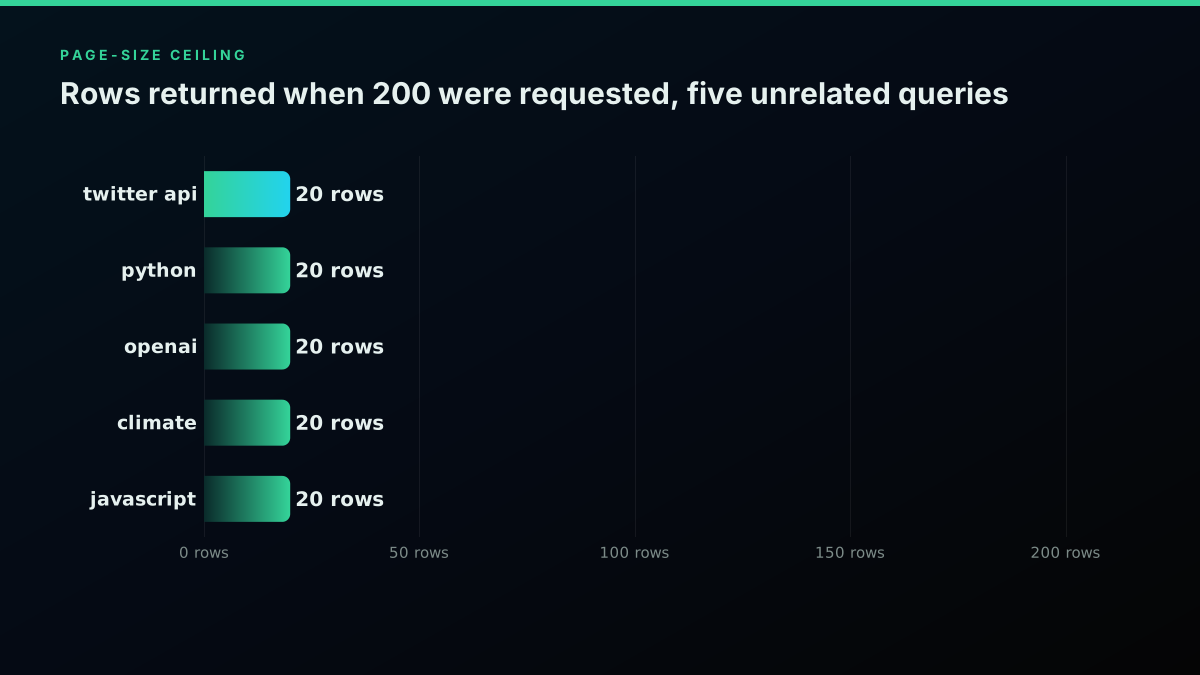
Twenty rows, every time. Nothing in any response indicated the requested page size had been overridden, capped, or ignored. If you request 200 and read the array you get back without checking its length, you are looking at ten percent of what you asked for and no part of the system has told you so.
Users see the same ceiling from the other side, and they describe its shape precisely:
A result set that stops on a round number is a pagination fact, not a relevance fact
One user in the r/Twitter thread reported seeing about 20 results in the Latest tab and nothing after. A genuinely exhausted result set does not land on a page boundary. When the tail stops at exactly one page, the reader has hit the page size rather than the end of the data, and our own measurement puts that page size at 20 rows on five of five queries.
r/Twitter, corroborated by our own 2026-09-10 run
That detail matters more than it looks. A genuinely exhausted result set does not stop on a round number. When your tail ends at exactly one page, you have hit the page size, not the end of the data. The fix is to page the cursor until it returns empty, and the cost of doing so is trivial, which we will price in a moment.
The correct shape for any pull you intend to trust is a cursor loop, and there are two details in it that people routinely get wrong. The first is stopping on row count rather than on the cursor. The second is accumulating into a list rather than a dictionary keyed by post id, which means a repeat silently inflates your total instead of collapsing into itself.
import os, requests

KEY = os.environ["TWITTERAPIS_KEY"]
BASE = "https://api.twitterapis.com"

def search_all(query, product="Latest", max_pages=25):
    """Page until the cursor runs out. One page is 20 rows, not your count."""
    seen, cursor, pages = {}, None, 0
    while pages < max_pages:
        params = {"query": query, "product": product, "count": 200}
        if cursor:
            params["cursor"] = cursor
        r = requests.get(f"{BASE}/twitter/tweet/advanced_search",
                         headers={"Authorization": f"Bearer {KEY}"},
                         params=params, timeout=60)
        r.raise_for_status()
        body = r.json()
        rows = body.get("tweets") or []
        pages += 1
        for t in rows:
            seen[t["id"]] = t          # keyed by id, so a repeat cannot inflate the count
        cursor = body.get("next_cursor")
        if not rows or not cursor:     # terminate on the cursor, never on a row count
            break
    return list(seen.values()), pages

posts, pages = search_all('"advanced search" lang:en', max_pages=5)
print(f"pages={pages} unique_posts={len(posts)}")
Running that against five pages returns pages=5 unique_posts=100, which is the arithmetic you would expect from a 20-row page and no duplicates. The max_pages cap matters: without one, a cursor chain that never reports exhaustion will run until something else stops it, and something else is usually your credit balance.
Note the second thing that loop gives you for free. Because it accumulates into a dictionary keyed on post id, the difference between pages * 20 and len(seen) is a duplicate count you did not have to write a separate check for. If those two numbers ever diverge, you have found a cursor problem, and you have found it as a number rather than as a suspicion.
Cursor semantics differ per route, so if you are paging something other than search, read how pagination works for the route you are actually on. The same loop shape in other languages ships in the Python SDK and the Node SDK, and the quickstart has a runnable version if you would rather not write it yourself.
Mechanism three: engagement gates, which work until suddenly they do not
Engagement gates on X search are applied precisely at ordinary thresholds and leak at extreme ones. At min_faves:100, min_faves:1000 and min_faves:10000 every row we received satisfied the filter, with the lowest value sitting just above the number requested each time. Above ten thousand the filter starts letting rows through, silently, and the row count alone cannot tell you it is happening. min_faves: and min_retweets: are the operators people most suspect of being silently ignored. We checked, and the checking is itself instructive.
Counting rows at each threshold returns 20 every time. At min_faves:100, 20 rows. At min_faves:100000, 20 rows. Read as a count, that looks exactly like an operator being thrown away.
A row count could not answer the engagement-gate question. Counting rows at each threshold returned 20 every time, including at 100000. Read as a count, that says the gate is ignored. Reading the favourite count off every row says the opposite: the gate is exact up to 10000 and only leaks above it. The count and the classification disagreed, and only one of them was about the thing we were asking.
Reading the actual favorite_count off every returned row says the opposite.
Rows that broke the engagement gate they were filtered by
| Tab | Gate | Returned | Satisfying | Violating | Lowest value seen | Source |
|---|---|---|---|---|---|---|
| Latest | min_faves:100 | 20 | 20 | 0 | 104 | measured |
| Latest | min_faves:1000 | 20 | 20 | 0 | 1,005 | measured |
| Latest | min_faves:10000 | 20 | 20 | 0 | 10,191 | measured |
| Latest | min_faves:100000 | 20 | 19 | 1 | 161 | measured |
| Top | min_faves:100000 | 19 | 13 | 6 | 5,718 | measured |
| Latest | min_retweets:10000 | 20 | 14 | 6 | 2,704 | measured |
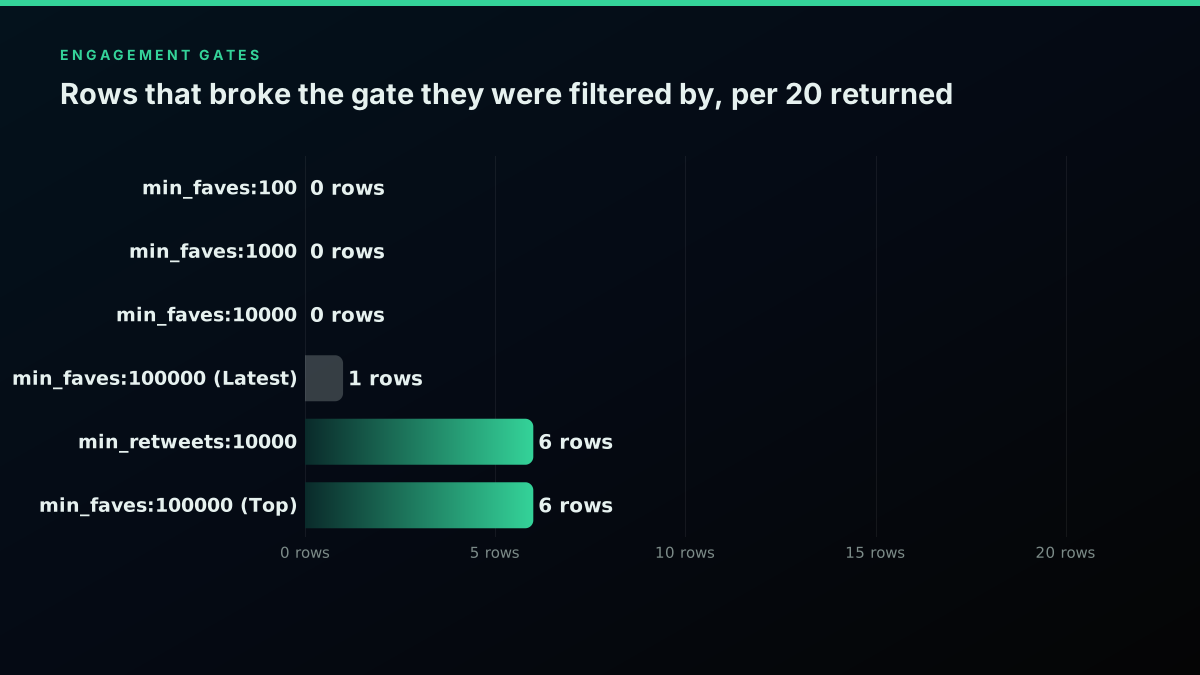
The gate is not ignored. It is exact, and impressively so: at min_faves:100 the lowest value returned was 104, at min_faves:1000 it was 1,005, at min_faves:10000 it was 10,191. Each time the floor sits just above the number requested, which is what a correctly applied filter looks like.
Then it degrades. At min_faves:100000, one row in twenty broke the gate on the Latest tab, and six of nineteen broke it on Top. min_retweets:10000 let six rows through. The degradation is silent, and Top leaks considerably harder than Latest.
The practical consequence is narrow but real: if you are filtering at an extreme threshold, verify the rows you get back rather than trusting the filter. And if you are filtering at ordinary thresholds, the operator is doing its job and is not the reason your search is empty.
There is a second, more common way engagement gates make posts disappear, and it has nothing to do with leaking. It is that the gate is doing exactly what you asked and you asked for the wrong thing. min_faves:100 on a technical query in a small community will empty your result set completely, not because the operator is broken but because almost nothing in that niche clears one hundred favourites. The post you are looking for may have eleven.
This is the single easiest failure to self-inflict, because engagement gates feel like quality filters and behave like hard constraints. A useful habit: never add an engagement gate on the first attempt. Run the query bare, look at the actual engagement distribution of what comes back, and only then pick a threshold that the population you are searching can actually clear.
The same reasoning applies to lang:, which is a quieter version of the same trap. Language detection on short posts is unreliable, and a post with three words and a link may not be tagged with the language you expect. If your query has a language filter and returns nothing, drop the filter before drawing any conclusion.
Mechanism four: ranking, which is not the same thing as the index
One post in our set was invisible to its own exact phrase and appeared immediately when we added from: and the author's handle. Same phrase, same index, same moment. The only difference was scoping the query to one account.
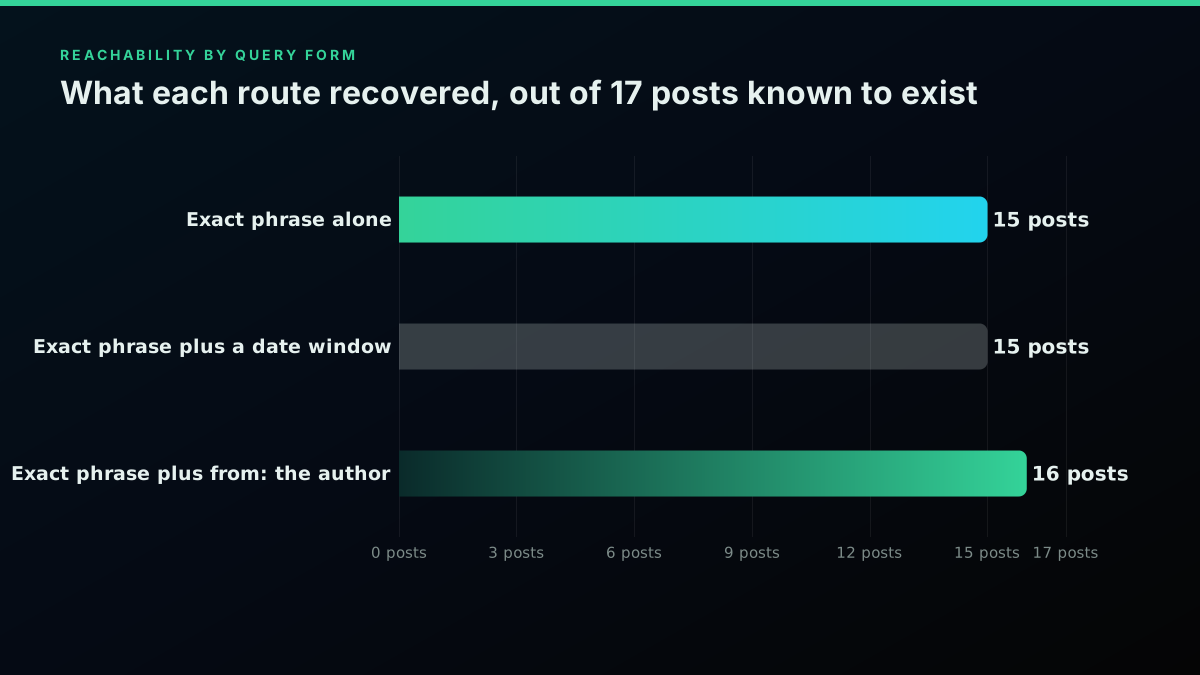
That is a ranking behaviour, not an index behaviour. The post was there the whole time. It simply did not surface in a global result set, and scoping the query small enough made it surface.
This is also the honest version of the workaround people trade in forums:
I've sort of found a way, you have to go to your main profile page and search from there and it will search for your posts with the keywords. Unfortunately not everything pops up like before.
Note the second sentence, because it is the part usually dropped when this advice gets repeated. Profile-scoped search returns more. It does not return everything. That is the shape of every workaround in this space, and anyone presenting one as a complete fix is overselling it.
Third-party clients inherit the same recall, because they read the same index
A user who lost the ability to find posts older than about a month noted that other clients failed identically, because they query the same backend. Switching client is therefore not a recall strategy. Changing the route, from a ranked search surface to a direct id lookup or a different index scope, is.
r/Twitter, 2026-06-22
Switching to a different client will not help you here, because the clients read the same index. Changing the route will.
Start building with TwitterAPIs
$0.0008 a call, about $0.04 per 1,000 tweets at 20 tweets a page. $0.50 free credits. No credit card required.
Which operator is emptying my results?
Each operator fails in a way specific to it, and the failure signature differs enough that you can usually name the culprit without testing all of them. This is the reference we wish had existed while debugging the run above.
Operators are the most common source of self-inflicted empty results, and each one fails in a way specific to it. This is the reference we wish had existed while debugging the run above.
Quoted phrases require a literal, contiguous, character-exact match. Every trap listed earlier applies here, and this is the operator responsible for the majority of the failures we caused ourselves. Failure signature: zero results, and the unquoted version of the same query works.
from: and to: resolve against a handle at query time. They are exact, they are not fuzzy, and they break permanently on a rename with no error. Failure signature: zero results for an account you can see posting, and the profile page shows posts that the query does not return.
since: and until: are date bounds and they are inclusive at one end and exclusive at the other, which catches people out at window boundaries. A one-day window is frequently narrower than the poster's timezone makes it look, so a post you believe is on the 3rd may be indexed on the 2nd or the 4th. Failure signature: zero results for a window that should obviously contain the post, fixed by widening the window by a day on each side. Note that on our sample date windows did not improve recall in general, but they can absolutely destroy it when set too tight.
min_faves: and min_retweets: are numeric floors, applied precisely at ordinary thresholds and leakily at extreme ones, as measured above. Their most common failure is not leaking, it is being set above what the population can clear. Failure signature: zero results that populate the moment you remove the gate.
lang: depends on automatic language detection, which is unreliable on short text. Failure signature: zero results for a post you can read in the language you filtered for.
filter: and -filter: include or exclude classes of post such as replies, links and media. -filter:replies is a very common way to accidentally exclude the exact post you want, because a large share of conversation on X happens in replies. Failure signature: zero results for something you remember as part of a thread.
Boolean grouping with OR and parentheses widens rather than narrows, and is one of the few operators that is hard to over-constrain with. Our own test grew a chain to 26 operands with no collapse.
The full operator syntax, with runnable examples for each one, is in the search operator reference, and date-window mechanics specifically are covered in the search by date guide.
The pattern across all of them is the same, and it is worth stating as a rule: every operator is a constraint, and constraints only ever remove rows. An empty result on a query with four operators is four separate hypotheses about why, and the only efficient way to test them is to remove all four and add them back one at a time. That takes five calls, costs well under a cent, and replaces an afternoon of guessing with a definite answer.
What if the post really is unreachable by search?
Suppose you have run the whole ladder. The phrase is copied verbatim, the operators are stripped, from: is scoped, the cursor is paged, and the id resolves cleanly. The post exists and search will not return it. What then?
The honest answer is that your options narrow considerably, and none of them is a search query.
Change the route. This is the highest-yield move and the one the Stack Overflow comparison already demonstrates: three routes, three counts, a factor of seven between the best and worst. If one search surface cannot see a post, another may. That is not a workaround, it is the direct consequence of recall being a property of the route.
Go to the account rather than the index. Timeline retrieval is a different path from search, with different scoping and different ranking. A post that a global search will not surface frequently sits in plain sight on the author's own timeline, which is exactly the mechanism behind the profile-search workaround people trade in forums, and exactly why that workaround returns more without returning everything. For a complete sweep of one account, downloading the full tweet history is the route built for it.
Go to the conversation. If the post is a reply, thread retrieval reaches it by conversation id rather than by matching text, which sidesteps the entire query-parsing and ranking layer. This matters more than it sounds: the one class of missing post that X staff acknowledged in the developer report above was specifically self-replies inside a thread. If the missing post is a reply to you rather than by you, mentions retrieval is the route, and it has its own documented gaps.
Use the id you already have. If you got the id from anywhere at all, a link, a screenshot, an archive, a log, then you never needed search in the first place. Search is a way of discovering ids. Once you have one, it is the slowest possible route to the post behind it.
Accept the archive. Where none of the above reaches it, an independent copy is the only remaining answer. One user in the r/Twitter thread described searching the same keywords in their own community's message archive and finding every post that X had told them did not exist. That is not a clever trick, it is the ordinary consequence of holding your own data. If posts matter to your work, retrieving and storing them while they are reachable is cheaper than trying to recover them later, by a wide margin.
Is there really a thirty-day limit on X search?
Many users report being unable to find anything older than about thirty days on X search, across every client they try. Our measurement on the API route did not reproduce that horizon: yearly windows returned full pages back to 2014 and individual posts from 2015 were retrievable by phrase. One report deserves separate treatment, because it is specific, it is repeated, and our measurement appears to contradict it.
Multiple users describe being unable to find anything older than roughly a month, with a handful of exceptions, starting at a particular point in time and affecting every client they tried. That is a precise claim: not degraded relevance, a horizon.
Our run did not reproduce it. Yearly windows returned full pages back to 2014, and individual posts from 2015 were retrievable by phrase. Those two findings cannot both be describing the same surface at the same time, which leaves a small number of possibilities, and it is more useful to name them than to pick a winner.
It may be surface-specific, affecting the web search form while the API path is unaffected. It may have been a time-bounded incident that has since been resolved, since those reports cluster rather than spreading evenly. It may be account-scoped or region-scoped, which would explain why some users see it and others never do. Or it may depend on the query shape in a way neither we nor they have isolated.
What we can say is bounded and worth saying anyway: on the API search route, on 2026-09-10, there was no thirty-day horizon. If you are hitting one, the route you are hitting is not the route we measured, and that is itself the most useful diagnostic information in this section.
Mechanism five: account state, which is the one that really does remove posts
Account state is the one mechanism in this post that genuinely removes posts from X search results while leaving them retrievable by id. A rename breaks from: queries permanently, and going protected withdraws posts from the public index entirely. Age is not what removes posts from search. Account state is, and the two get confused constantly because they correlate.
A post from 2015 in our set was as reachable as one from 2026. What changes over eleven years is not the index's memory, it is the probability that something happened to the account: renamed, protected, suspended, deleted. Each of those has a different effect, and the rename case has a mechanism worth knowing.
Indeed, when you do advanced search in twitter, it doesn't show the previous tweets that has tweeted with previous username, that's why this program can't get that tweets. So this is actually twitter's problem, not this program's.
That diagnosis comes from a library maintainer's issue thread, and it is unusually precise about the mechanism.
A rename breaks from: because search resolves handles, not identities
A library maintainer traced missing results to account renames: the profile page still shows the old posts under the new handle, but a from:oldhandle query does not return them. The actionable form of this is to key every stored query on the numeric user id, which survives a rename, rather than on the handle, which does not.
GitHub issue on GetOldTweets3, 2020-05-13
Search resolves from: against the handle. When an account changes handle, a from:oldhandle query stops matching posts that the profile page still happily displays. The posts did not move. The pointer did.
The fix is direct: key on the numeric user id wherever the route lets you, because the id survives a rename and the handle does not. If you have stored queries, saved searches or monitoring rules built on handles, they are decaying quietly right now, and nothing will tell you when one breaks.
That last sentence is worth taking literally, because handle-keyed decay is the most expensive failure in this whole post and the only one that gets worse while you are not looking.
A monitoring rule watching from:somecompany does not error when the account becomes somecompany_hq. It returns zero results, forever, and zero results is exactly what a quiet week looks like. The rule reports healthy. The dashboard is green. Nobody finds out until someone asks why there has been no coverage of a company that has been posting daily for three months.
The defensive pattern is to resolve handles to ids once, store the id, and re-verify the mapping on a schedule rather than trusting it. Getting a user id is one call, and there is a lookup tool if you only need to do it occasionally:
curl -s -G "https://api.twitterapis.com/twitter/tweet/detail" \
  -H "Authorization: Bearer $TWITTERAPIS_KEY" \
  --data-urlencode 'id=1683986575196028929' \
| python3 -c 'import json,sys; d=json.load(sys.stdin); print("resolved:", d.get("id"))'
An id lookup is the cheapest possible liveness check on a stored reference, and it has the property that matters here: it either returns the thing or it does not, with no ranking in between to muddy the answer.
The broader rule, which applies well past X: never key a long-lived query on a mutable identifier. Handles, usernames, display names and vanity URLs are all labels their owners can change at will. Numeric ids are identities. If your pipeline stores the label and not the identity, it will break silently on a schedule set by strangers.
The two failure modes this section describes, an account changing handle and an account going protected, share an important property that separates them from every other mechanism in this post: they are the only ones where "the post is not in your results" is genuinely the correct answer, and no query rewriting will or should recover it.
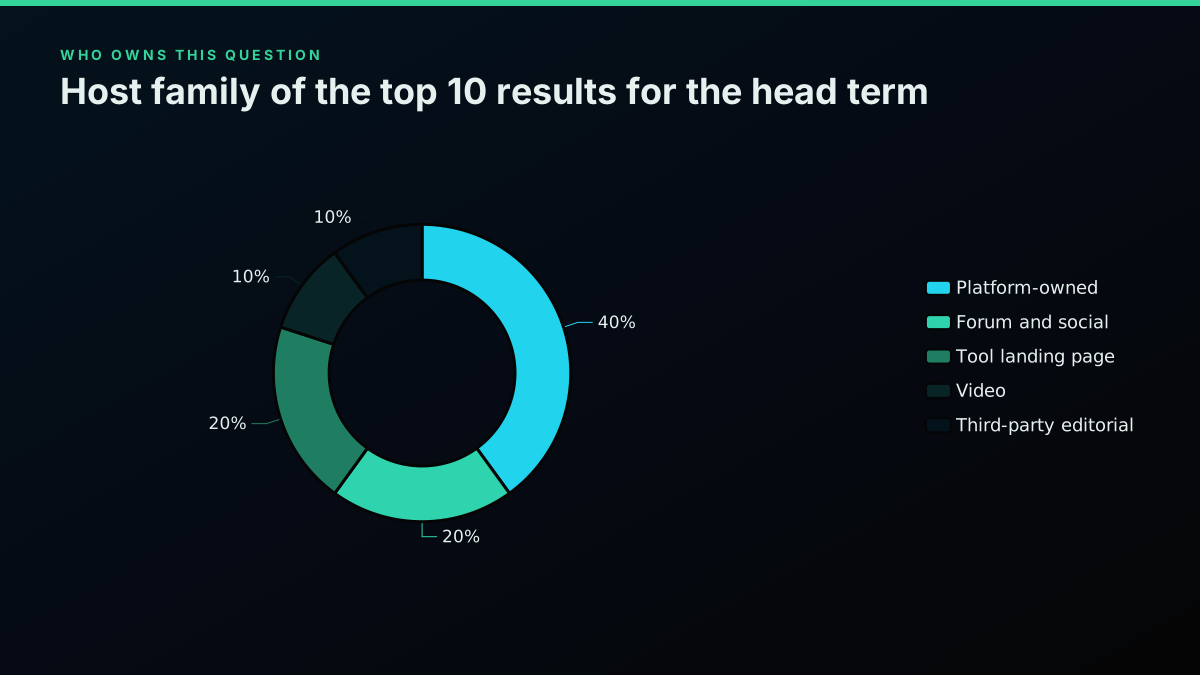
That distinction also explains something about the SERP for this question. Of the 10 pages currently answering it, 4 are run by the platform itself, 2 are forum or social threads, 2 are landing pages for search tools, 1 is a video and 1 is independent editorial. Platform documentation describes the intended behaviour of these operators rather than their measured behaviour. Both are useful. They are not the same document, and the gap between them is where every one of these mechanisms lives.
We read all 10 of those pages before writing this one. The longest runs 6,587 words and answers the "not working" question in a single FAQ line. The strongest of them opens by asserting that temporary glitches cause over 40 percent of search failures, a figure with no method attached to it. Across all 10, the number of pages carrying a single measured recall figure is 0, the number discussing cursor behaviour on deep pulls is 0, and the number distinguishing the API path from the web form is 0. That is not a criticism of the writers. It is a description of an open question that nobody had bothered to measure, which is why we spent 282 calls measuring it.
Mechanism six: two surfaces from the same company, disagreeing
Two X-operated search endpoints can return opposite answers for the same post with the same operators, which means the gap is index scope rather than query shape. A developer demonstrated this with a published conversation id, and X staff acknowledged the report the same day. This is the rarest mechanism in our data and the least fixable from your side.
I've noticed a degraded performance with the recent search endpoint missing tweets /2/tweets/search/recent specifically tweets that are self-replies in a thread
When X staff acknowledge a report, the gap is index scope rather than query shape
A developer posted a query returning no results on the recent-search endpoint and a result on the full-archive endpoint, with an identical conversation id and identical operators. X staff replied the same day that they were looking into it. Two endpoints run by the same company disagreeing about one post is not something a better query can fix.
X developer community, 2026-05-13
Same operators, same conversation id, two endpoints operated by the same company, opposite answers. X staff acknowledged the report the same day. The class of post going missing was specific: self-replies inside a thread.
The developer-side version of the same problem is even starker:
The request status is 200, but the meta information in the response shows a count of 0.
An HTTP 200 carrying a result count of zero is, at the client, completely indistinguishable from a true negative. Your code cannot tell the difference. Neither can you. And in that report the post was provably there, because it renders in the app.
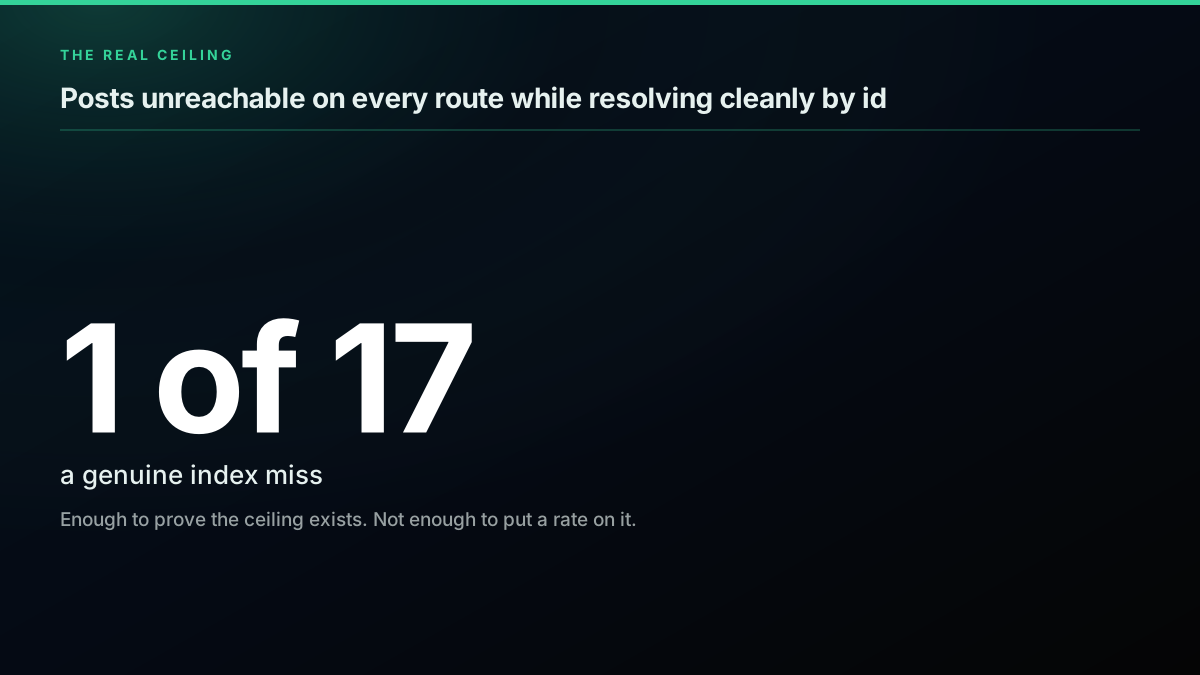
In our own set, exactly one post of seventeen was unreachable on every route while resolving cleanly by its id. That is enough to establish that the ceiling is real. It is nowhere near enough to put a rate on it, and we are not going to.
Seventeen posts is a demonstration, not a rate. One post in our set was unreachable on every route while resolving cleanly by id. That proves the ceiling is real. It does not tell you how often it bites, and this post does not claim it does. Anyone quoting a percentage for index misses on a sample this size is reading further than the data goes.
Four things everyone repeats that we could not reproduce
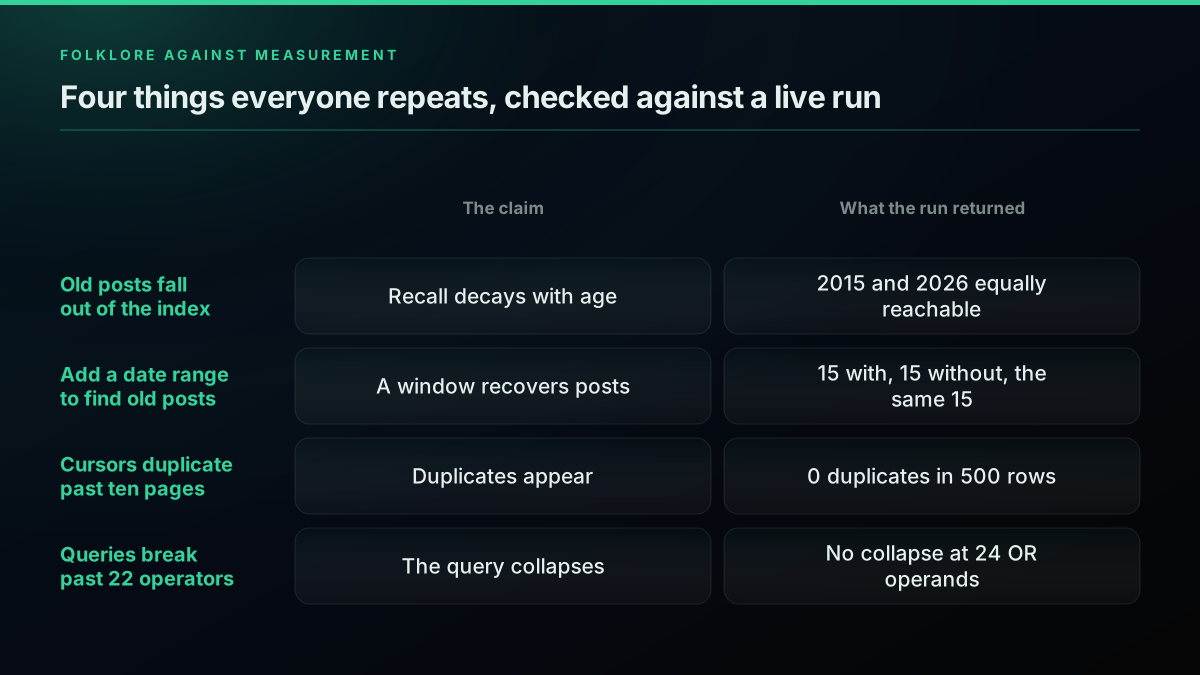
Half of the value of a measurement run is what it refutes. Every claim below is repeated across the pages currently ranking for this query, and none of them survived contact with a live run.
Folklore against measurement
Four claims everyone repeats, each checked against a live run
| Recall decays with age | A date window recovers posts | Cursors duplicate past ten pages | Queries break past 22 operators | |
|---|---|---|---|---|
| What the claim predicts | Older posts return less | More posts with the window | Repeats appear in deep pulls | The result set collapses |
| What we measured | 2015 as reachable as 2026 | 15 with, 15 without, same 15 | 0 duplicates in 500 rows | No collapse at 24 operands |
| Verdict on our sample | Not reproduced | Not reproduced | Not reproduced | Not reproduced in this form |
| What is true instead | Account state changes, not age | Windows help throughput, not recall | Stable to at least 25 pages | Untested past 26 operands |
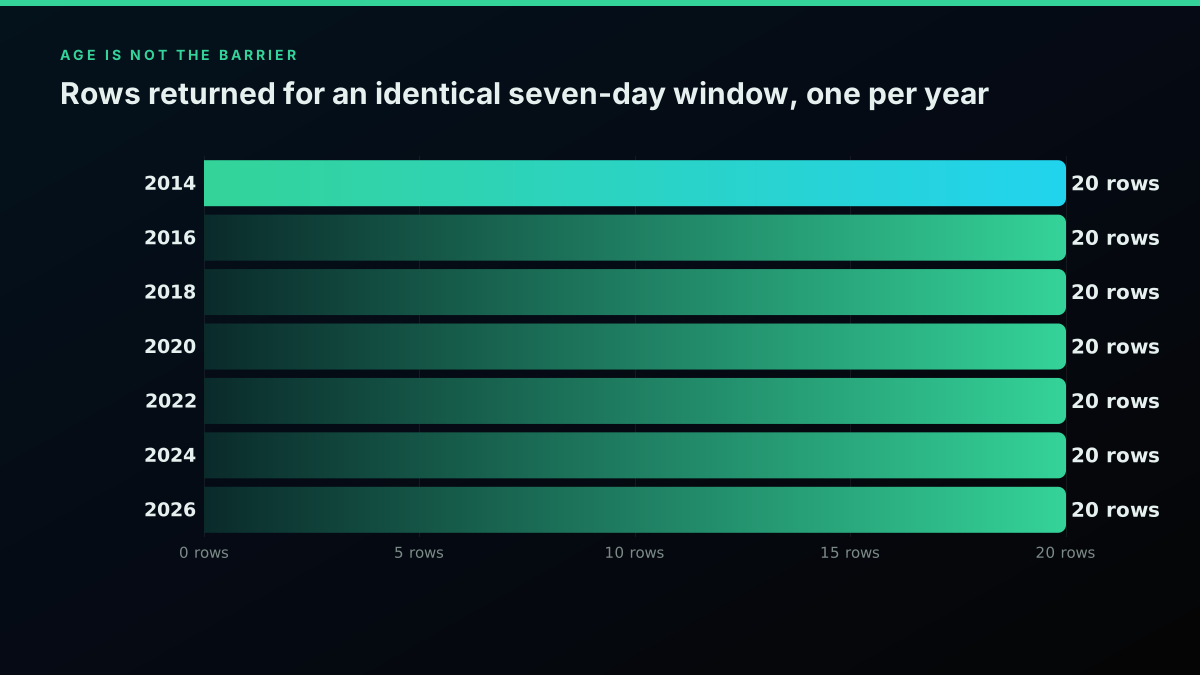
Recall does not decay with age. We ran an identical seven-day January window once per year from 2014 to 2026. Every single one returned a full page.
An identical seven-day window, run once per year
| Window | Rows returned | Page filled | Source |
|---|---|---|---|
| 2014-01-01 to 2014-01-08 | 20 | yes | measured |
| 2016-01-01 to 2016-01-08 | 20 | yes | measured |
| 2018-01-01 to 2018-01-08 | 20 | yes | measured |
| 2020-01-01 to 2020-01-08 | 20 | yes | measured |
| 2022-01-01 to 2022-01-08 | 20 | yes | measured |
| 2024-01-01 to 2024-01-08 | 20 | yes | measured |
| 2026-01-01 to 2026-01-08 | 20 | yes | measured |
A date window did not recover anything. Fifteen posts found with a two-year window, fifteen without, and the same fifteen both times.
The most repeated fix in this space did nothing. Adding a date window is the top recommendation on almost every page that ranks for this query. In our run it changed recall by zero: 15 posts found with it, 15 without, and the same 15 both times. Date windows earn their place for splitting large pulls into slices that page cleanly, which is a throughput property, not a recall one.
This one deserves emphasis because it is the top recommendation on nearly every page that ranks for this query. On our sample it moved recall by exactly zero. Date windows are genuinely useful for slicing a large pull into chunks that page cleanly, which is a throughput benefit. They are not a recall technique.
Cursors did not start duplicating. We paged one query twenty-five times.
One cursor chain, walked to twenty-five pages
| Metric | Value | Source |
|---|---|---|
| Pages walked | 25 | measured |
| Rows returned | 500 | measured |
| Unique post ids | 500 | measured |
| Duplicate rows | 0 | measured |
| Chain still reporting more results | yes | measured |
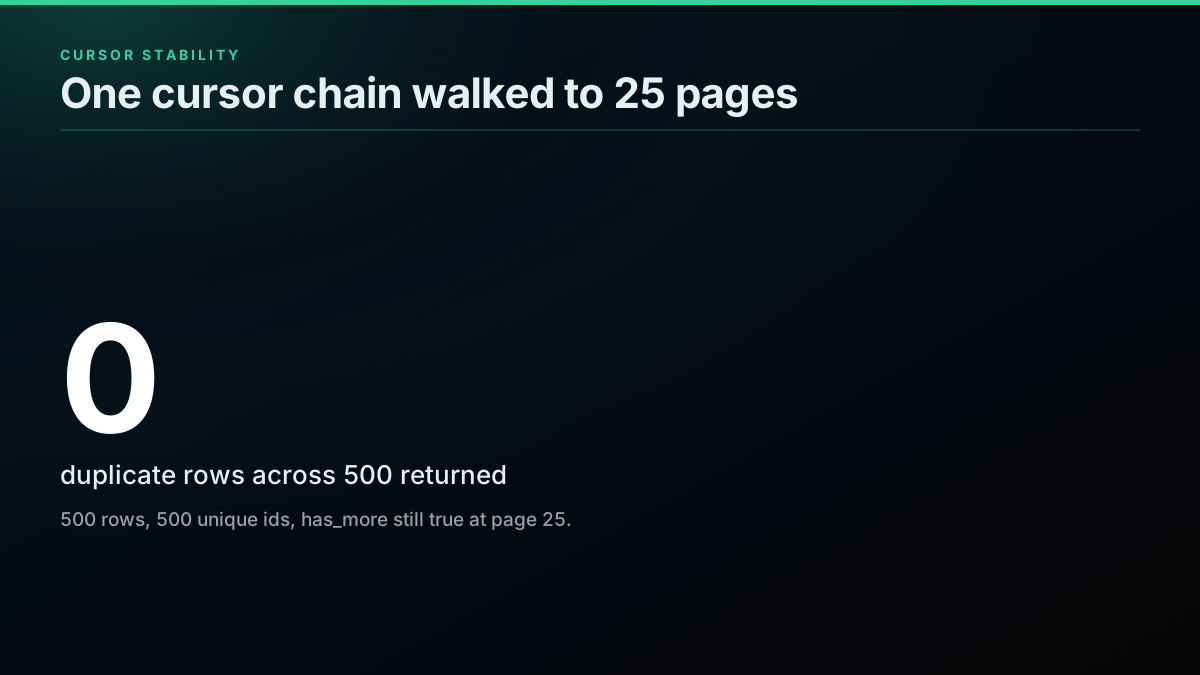
Five hundred rows, five hundred unique ids, zero duplicates, and the cursor still reporting more results available when we stopped. The claim that a chain becomes unreliable past roughly ten pages did not reproduce. Stated at the strength the evidence supports: that is one chain, walked to 500 rows, and it says nothing about page 200.
Long queries did not collapse. We grew an OR chain one operand at a time.
Rows returned as an OR chain grows one operand at a time
| Operands | Query length in characters | Rows returned | Source |
|---|---|---|---|
| 1 | 17 | 20 | measured |
| 8 | 99 | 20 | measured |
| 16 | 185 | 20 | measured |
| 20 | 228 | 20 | measured |
| 22 | 250 | 20 | measured |
| 23 | 259 | 20 | measured |
| 24 | 271 | 20 | measured |
| 26 | 291 | 20 | measured |
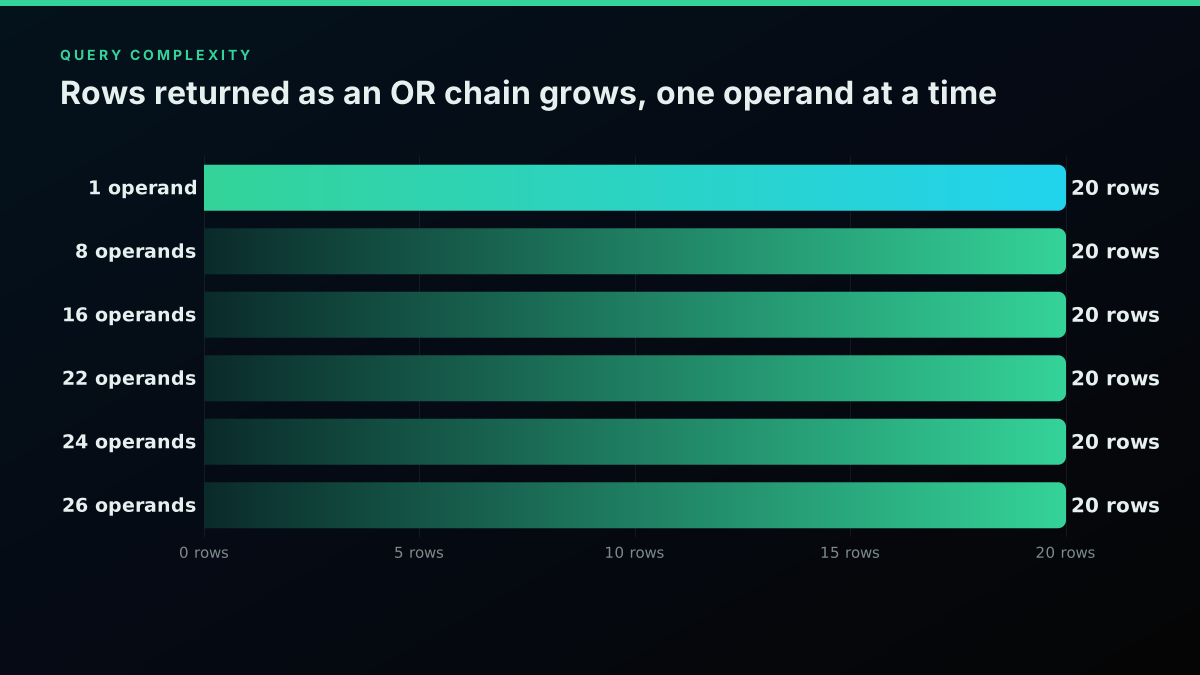
No collapse anywhere from one operand to twenty-six, including past the twenty-two to twenty-three ceiling that gets quoted constantly. The honest scope limit: OR operands inside one group may not be what that folklore counts as operators, so we have tested one specific form of the claim and not all of them.
The one thing users report that we cannot explain
The most-repeated complaint about X search is not that it returns nothing, it is that it returns different things on repeated identical runs. We did not reproduce that nondeterminism in our own testing, where every query returned a stable result set within a session, and we are recording that honestly rather than quietly dropping the one report that did not fit. Not everything resolved cleanly.
It is mildly infuriating just how bad the X search has become. It will tell you there are no results for something YOU KNOW EXISTS until randomly on the fifth or sixth time you hit Search it goes "oh yeah here is an incomplete list of results".
Users report the same query answering differently on repeated runs
The most quoted complaint in this space is not that search is empty, it is that search is inconsistent: no results on the first few attempts, then a partial list. That shape points at a serving-path or timeout behaviour rather than at index contents, and it is why a single empty response should never be treated as a settled answer.
X, 2026-02-09
We did not reproduce this, and we are not going to pretend otherwise. Every one of our queries returned the same result set on repeat within a session. But the report shape is consistent enough across enough independent users that dismissing it would be its own kind of dishonesty, and it points at serving-path or timeout behaviour rather than at index contents.
The practical takeaway is narrow and worth having anyway: a single empty response is weak evidence. Run it twice.
The cheapest pay-as-you-go Twitter API. Try it free.
$0.0008 a call, about $0.04 per 1,000 tweets at 20 tweets a page. $0.50 free credits. No credit card required.
What should I check first when a search comes back empty?
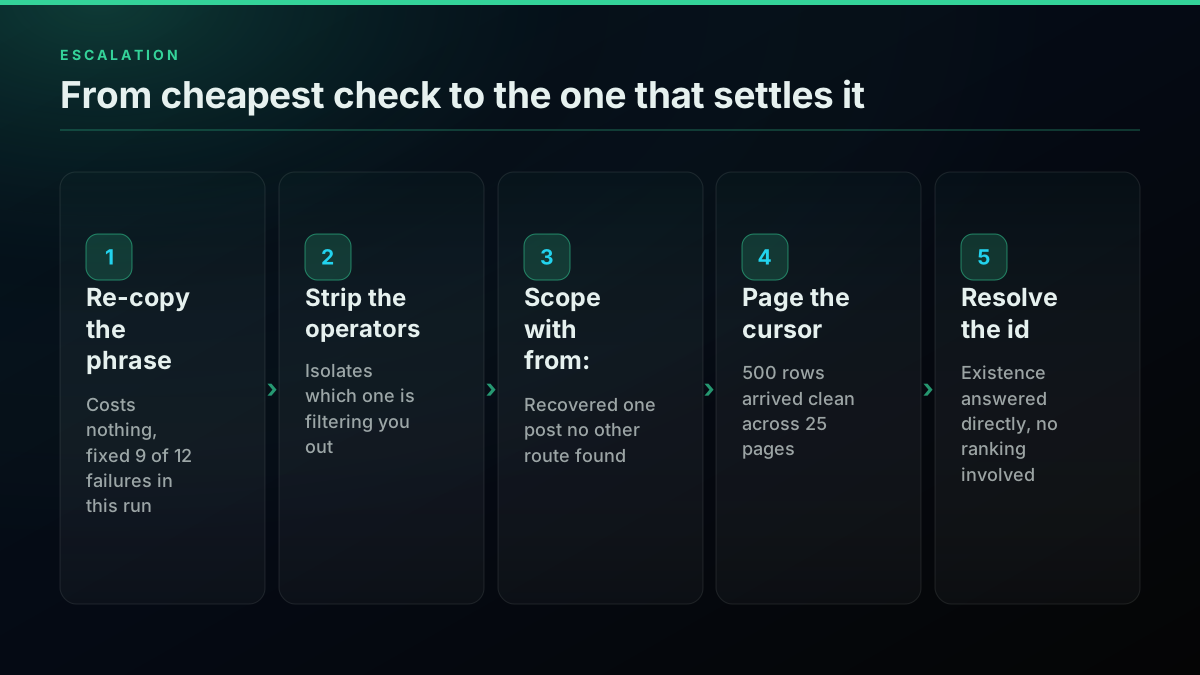
Work the ladder below from the top. Each rung is cheaper than the one under it and each eliminates a whole class of cause, so by the time you reach the bottom the remaining explanation is the only one left standing rather than the first one you guessed.
The diagnosis ladder
What to check, in the order that resolved the most failures first
Fixed by re-copying the phrase: 9 of 12 · Recovered by adding from:: 1 of 17 · Genuine index miss: 1 of 17
☑ Paste a phrase copied verbatim from the post, never one you retyped · ☑ Strip every operator, then add them back one at a time · ☑ Add from: and the author handle, which recovered a post nothing else found · ☑ Page the cursor rather than reading the first 20 rows · ☑ Resolve the post id directly, which answers existence with no ranking involved · ☐ Only after all five, treat it as a genuine index miss (One post in seventeen reached this step)
Ordered by how often each step was the answer during our 2026-09-10 run of 282 calls. The 9 of 12 figure is from the first, faulty pass of the experiment, where a malformed phrase builder produced nine unmatchable queries; it is quoted here because it is the best available measure of how often a bad phrase is the whole problem.
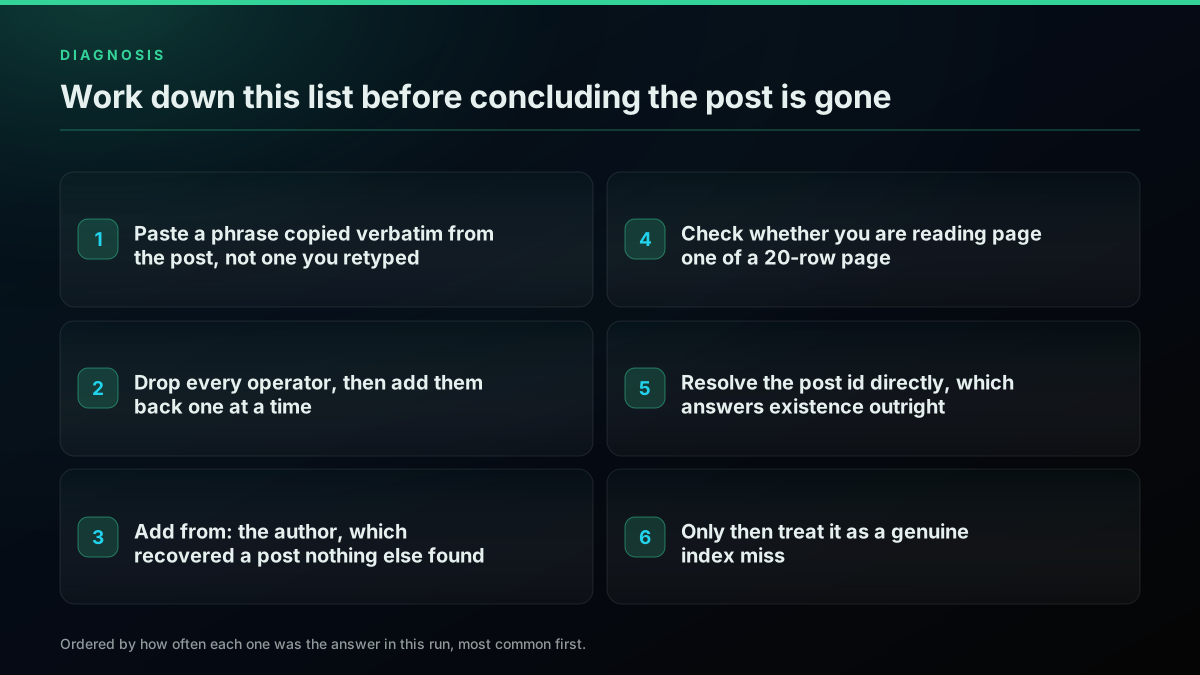
Work down it. Each step is cheaper than the one below it, and each rules out a whole class of cause.
- Re-copy the phrase. Verbatim, from the post if you can reach it at all. This resolved nine of twelve failures in our first pass.
- Strip every operator, then add them back one at a time. This isolates which operator is filtering you out, and it takes four attempts rather than a guess.
- Scope with
from:and the handle. This recovered a post that nothing else in our set found. - Page the cursor. Twenty rows is a page, not an answer.
- Resolve the post id directly. This is the one check that ends the argument.
The id lookup is the only check that cannot be confounded. Search involves parsing, ranking and relevance. An id lookup involves none of them. When you need to know whether a post exists rather than whether it ranks, resolve the id. In our run 20 of 20 harvested ids resolved cleanly, which made every subsequent search failure attributable to the search path rather than to the data.
That last step is worth dwelling on. Search involves parsing, ranking and relevance scoring, and each of those is a place your result can be lost. An id lookup involves none of them. It answers the existence question outright. In our run, 20 of 20 harvested ids resolved cleanly, which is what let us attribute every subsequent search failure to the search path rather than to the data.
If the id resolves and the search does not find it, the post exists and something between the index and your result set is hiding it. If the id does not resolve either, the post is genuinely gone. No other check draws that line.
How do I stop a pipeline from reporting a silent zero?
Make it record its own denominator, fail loudly on an empty result, carry controls that must fire, and key on identity rather than labels. Four properties, none of them sophisticated, and a pipeline missing all four looks exactly like one that has them until the day somebody checks.
Everything above is diagnosis, which is what you need when a specific post is missing. If you are building something that retrieves at volume, the requirement is different: you need the system to tell you when it is incomplete, rather than presenting a partial answer as a whole one.
Four properties separate a pipeline you can trust from one that merely runs.
It records its own denominator. Every pull should store how many pages it walked, how many rows arrived, and whether the cursor was exhausted or the page cap was hit. A result set with no record of how it terminated is not a dataset, it is an anecdote. When someone later asks whether a gap in your data is real or an artefact, this is the only field that answers.
It fails loudly on an empty result rather than treating it as a valid zero. This is the single highest-value change most pipelines can make. An empty response from a query that has historically returned rows is far more likely to be a broken query, a renamed handle or a throttle than a genuine absence of matching content. Treating it as a legitimate zero is how a dead monitor stays green for months.
It carries controls. Every scheduled retrieval job should run at least one query whose answer is known and non-empty, alongside the queries whose answers it does not know. If the control returns nothing, the run is void and should be discarded rather than recorded. Without a control, a total outage and a quiet day produce identical output.
It keys on identity, not on labels. Post ids and numeric user ids, never handles, never display names, never phrasing you typed by hand.
Those four are not sophisticated, and the reason they get skipped is not difficulty. It is that a pipeline missing all four looks exactly like a pipeline that has all four, right up until the day someone checks.
There is a fifth property worth adding if your data has any research or reporting use downstream: preserve the query alongside the results. A stored result set whose exact query string, route, operators and timestamp are not recorded next to it cannot be re-run, cannot be audited, and cannot be corrected when one of the mechanisms in this post turns out to have been biting the whole time. That is precisely the situation our own first measurement was in, and the only reason we caught it is that the query was recorded and could be inspected.
Do I need every matching post, or just one?
None of this means every pull needs to be exhaustive, and most do not. What matters is knowing which of the three kinds you are running, because a presence check, a sample and a census have completely different stopping rules and completely different tolerances for the mechanisms described above.
A presence check asks whether something exists at all. It is satisfied by one hit and needs no paging. For this, the id lookup or a single scoped query is the whole job, and worrying about page size is wasted effort.
A sample asks what a topic looks like. It is satisfied by enough rows to be representative, and the important property is that the sample is not systematically biased by the route. This is where the Top and Latest distinction matters most: Top is engagement-ranked, so a sample drawn from it is a sample of popular posts, not of posts. If you draw from Top and report on the topic, you have measured popularity and called it prevalence.
A census asks for everything matching a query. This is the only one that genuinely requires cursor exhaustion, a recorded denominator, and an honest account of where it stopped. It is also the one where every mechanism in this post compounds, and the only one where the difference between 12, 22 and 3 results decides whether your conclusion is right.
The arithmetic of a census is worth doing before you start one. At 20 rows per page, a 10,000-post census is 500 calls, which is 40 cents at the standard rate and roughly 14 minutes at a conservative 1 call per 1.7 seconds. A 100,000-post census is 5,000 calls and 4 dollars. Neither number is the problem. The problem is that a census which silently stopped at page 25 costs exactly the same as one that ran to exhaustion, and produces a dataset that is 500 rows instead of 100,000 with nothing in it saying so.
Most people asking "why does search miss posts" are running a presence check and reasoning about it as though it were a census. The post they cannot find is one post. The question is whether it exists, not whether the index is complete, and those are answered by completely different checks.
How much does it cost to check whether a post really exists?
Under half a cent for the whole ladder at published pay-per-call rates. That number matters less than what it implies: the cheapest way to answer the question definitively costs less than a rounding error, and almost nobody does it, because an empty page feels like an answer already.
What the checks cost
Pricing the diagnosis at published pay-per-call rates
Standard call: $0.0008 · Full diagnosis, five checks: $0.004 · Free credits at signup: $0.50
☑ One search call at the standard read rate · ☑ One id resolution at the standard read rate · ☑ Free credits cover roughly 625 calls, so the ladder runs about 125 times over · ☑ Paging a 500-row pull costs 25 calls, or two cents
An illustration applying the published standard read rate of $0.0008 per call to the five-step ladder described in this post, not a customer invoice. Rates are the current published pay-per-use figures at the time of writing and are subject to change.
At the published standard read rate of $0.0008 per call, the whole five-step ladder is under half a cent. Paging a 500-row pull is 25 calls, which is two cents. The $0.50 in free credits that lands on a new account with no card covers roughly 625 calls, which runs the full diagnosis about 125 times over.
The point is not the pricing. The point is that the cheapest possible way to answer "is this post actually gone" costs less than a rounding error, and almost nobody does it, because the empty page feels like an answer.
Full per-endpoint rates are on the pricing page, with the per-call breakdown at Twitter API pricing, and the cost calculator will size a specific workload. If you are budgeting a large historical pull, the rate limits guide covers the throughput ceiling that shapes how long it takes rather than what it costs. There is also a free tier if you only need to run the ladder a few times.
What does a search control harness look like?
Pick a few queries whose answers you already know, run them on the same schedule as the real work, and treat a control failure as a reason to throw the run away. Fifteen lines of code, two calls per run, and it converts the most dangerous failure in retrieval into a loud one.
Everything above is a one-off diagnosis. If search recall matters to you repeatedly, the highest-value thing you can build is not a better query, it is a harness that tells you when your queries have stopped working.
The design is deliberately boring. Pick a handful of queries whose answers you know, run them on the same schedule as your real work, and treat a control failure as a reason to discard the run rather than as a curiosity:
import os, requests

KEY = os.environ["TWITTERAPIS_KEY"]
BASE = "https://api.twitterapis.com"

def rows(query, product="Latest"):
    r = requests.get(f"{BASE}/twitter/tweet/advanced_search",
                     headers={"Authorization": f"Bearer {KEY}"},
                     params={"query": query, "product": product, "count": 200},
                     timeout=60)
    r.raise_for_status()
    return len(r.json().get("tweets") or [])

def run_is_valid():
    """Both controls must fire or the run is void, not merely disappointing."""
    positive = rows("twitter api")          # must return rows
    negative = rows("zzqq9931notathingxyz") # must return zero
    ok = positive > 0 and negative == 0
    print(f"positive={positive} negative={negative} valid={ok}")
    return ok

if not run_is_valid():
    raise SystemExit("controls failed, discarding this run")
That is roughly fifteen lines and it converts the single most dangerous failure in retrieval, a silent zero, into a loud one. Two calls per run at the standard read rate is under a fifth of a cent.
The same idea in Node, for pipelines that live there:
const KEY = process.env.TWITTERAPIS_KEY;
const BASE = "https://api.twitterapis.com";

async function rows(query, product = "Latest") {
  const url = new URL(`${BASE}/twitter/tweet/advanced_search`);
  url.searchParams.set("query", query);
  url.searchParams.set("product", product);
  url.searchParams.set("count", "200");
  const res = await fetch(url, { headers: { Authorization: `Bearer ${KEY}` } });
  if (!res.ok) throw new Error(`HTTP ${res.status}`);
  const body = await res.json();
  return (body.tweets || []).length;
}

const positive = await rows("twitter api");
const negative = await rows("zzqq9931notathingxyz");
console.log({ positive, negative, valid: positive > 0 && negative === 0 });
And the reachability check itself, which is the one worth running against any stored reference you depend on:
for id in 1683986575196028929 1316887097899405312; do
  code=$(curl -s -o /dev/null -w '%{http_code}' -G \
    "https://api.twitterapis.com/twitter/tweet/detail" \
    -H "Authorization: Bearer $TWITTERAPIS_KEY" \
    --data-urlencode "id=$id")
  echo "$id -> $code"
done
If a stored id stops resolving, you have lost the post and you now know the date it happened. If it resolves and your search does not find it, you have a retrieval problem rather than a data problem, and everything in this post applies.
Which retrieval problem am I actually having?
Search recall is one of a family of problems on X, and several of the others produce symptoms close enough to be mistaken for this one. Use the short map below to work out which question you are really asking before you spend another afternoon on the wrong one.
Search recall is one of a family of retrieval problems on X, and several of the others produce symptoms close enough to be confused with this one. The short map, so you can tell which post you actually need:
If the result set is empty but the call failed. An error is not an empty result, and a client that swallows status codes turns one into the other. The error code reference covers what each status actually means, and what rate limited means covers the specific case that most often masquerades as no data.
If results stop partway through a large pull. That is paging rather than recall, and the mechanics differ per route. Start with how pagination works and the rate limit guide if the pull is long enough to hit a window.
If you are pulling one account's whole history. Search is the wrong tool. Scraping tweet history and exporting followers both use account-scoped routes that avoid the ranking layer entirely.
If the post you want is a reply. Thread reconstruction is its own problem, covered in fetching a full thread, and it is the route that reaches the self-reply class X staff acknowledged as missing from recent search.
If the post is genuinely deleted. Recovering a deleted tweet sets out what is and is not possible, and the honest answer is narrower than most people hope.
If you are choosing a stack rather than debugging one. The library comparison in Tweepy against Twikit against snscrape is the starting point, what happened when Twikit broke is the cautionary half, and how to scrape tweets is the general overview.
If you are writing the retrieval code now. The Python tutorial and the Node tutorial both include working paging loops, and the complete API tutorial covers authentication and response shapes end to end.
If the question is cost rather than recall. Paging everything is the correct default and it does have a price. Twitter API cost is the general treatment, cost by workload sizes specific job shapes, and what a million-tweet dataset costs is the worked example for a full census.
If you are searching by hashtag or by date specifically. Both have their own quirks: hashtag search and searching by date.
If you are monitoring rather than searching. Monitoring has a coverage question of its own, and it is the same class of problem one layer up. Monitoring coverage honesty is the direct treatment, and monitoring mentions in real time is the practical build.
The thread running through all of them is the one this post opened with. Every retrieval route has a recall profile, none of them advertises it, and the only way to know yours is to measure it against something whose answer you already have.
How was this measured, exactly?
Every figure in this post came from live calls made on one day against one documented route, with both controls printed on every pass. The method is set out in full below so that any number here can be re-derived, or refuted, by anyone willing to spend an afternoon and about a dollar.
The numbers in this post are worth exactly as much as the method behind them, so here is the method.
The route. Every measurement was taken against the advanced_search and tweet/detail routes on twitterapis.com, on 2026-09-10, across 282 calls in four batches. No figure here was read from a cache, a vendor report or a previous run.
The controls. Every batch carried both. A nonsense token returned 0 rows on every pass. A plain high-frequency query returned 20 rows on every pass. Both are printed here rather than asserted, because a search returning zero proves nothing until you have shown the same instrument returning rows for something real and zero for something invented. A clean zero with no control beside it is not evidence, and the whole reason our first pass was wrong is that it had a positive control and no assertion that the query was well formed.
The reachability set. Seventeen post ids published between 2015 and 2026. Each one was resolved directly through the detail route before any search ran, so existence was established independently of anything the search path did. A seven-word contiguous phrase was then taken verbatim from each post's own text, asserted to be a literal substring of that text, and searched three ways: bare, with a two-year date window, and with from: and the author handle. Rows failing the literal-substring assertion were voided rather than counted as misses. Zero rows were voided in the final run.
What we deliberately did not measure. Rate-limit truncation, protected and suspended account behaviour, the web UI's ranking, and cursor stability past 500 rows. None of these appear as claims anywhere above, and where a mechanism is discussed without a number attached, that is why.
What the sample supports and does not. Seventeen posts is a demonstration that the ceiling exists. It is not a rate, and nothing in this post quotes one. Thirteen date windows, one cursor chain and eleven query lengths are similarly small. Every table carries its own sample size and its own methodology note for exactly this reason: so a reader can see the boundary of each claim without taking our word for where it sits.
The corroborating corpus. Alongside the measurements, we read 15 verbatim public reports of this failure across 5 platforms, drawn from 61 comment objects on the primary complaint thread of which 55 were usable, plus 2 developer-forum threads, 2 Stack Overflow items and 2 GitHub issues. 3 of the 15 argue the opposite case, that the behaviour is intentional, user error, or already solved by a workaround, and those 3 are quoted here rather than filtered out.
The exact call budget. 83 calls in the first measurement batch, 36 in the engagement-gate classification pass, 41 in the first reachability run, and 122 in the corrected one, for 282 total. At the standard read rate that whole body of evidence cost about 23 cents.
The reachability set in numbers. 18 candidate ids were assembled and 1 was a duplicate, leaving 17. 0 failed to resolve. 0 rows were voided by the literal-phrase precondition in the corrected run, against 9 voided in the first. The phrase length was fixed at 7 words for every post so that query specificity could not vary between them, and the date windows tested were 2 years wide, centred on the year of publication. The oldest post in the set was published in October 2015 and the newest in June 2026, a span of 3,897 days, and the median publication year was 2023.
The engagement distribution behind the gate table. On the unfiltered Latest query the median favourite count was 0, the minimum 0 and the maximum 1. On the unfiltered Top query the median was 630, the minimum 66 and the maximum 7,655. Those two rows are the same query on the same index seconds apart, which is the cleanest illustration in the run of ranking mode changing what you see far more than any operator does.
Reproducing it. Every experiment here is a handful of calls against a documented route, and the 625 or so calls that free signup credits buy cover the entire run twice over. If any figure in this post is wrong, it is wrong in a way you can demonstrate in an afternoon for under a dollar, which is the property we care most about.
So is the post gone, or is your query wrong?
On the evidence here, almost always the query. Six mechanisms produce an empty result, five of them are recoverable from your side, and the genuine index miss that everybody reaches for first turned out to be the rarest of the six in a set where every post was known to exist.
The empty page is not the finding. It is the beginning of the question.
Six mechanisms produce it. Five of them are recoverable from your side, and the most common one is a phrase that does not match. One of them, a genuine index miss, is real and rare, and it took a seventeen-post set with every id pre-resolved to isolate a single instance of it.
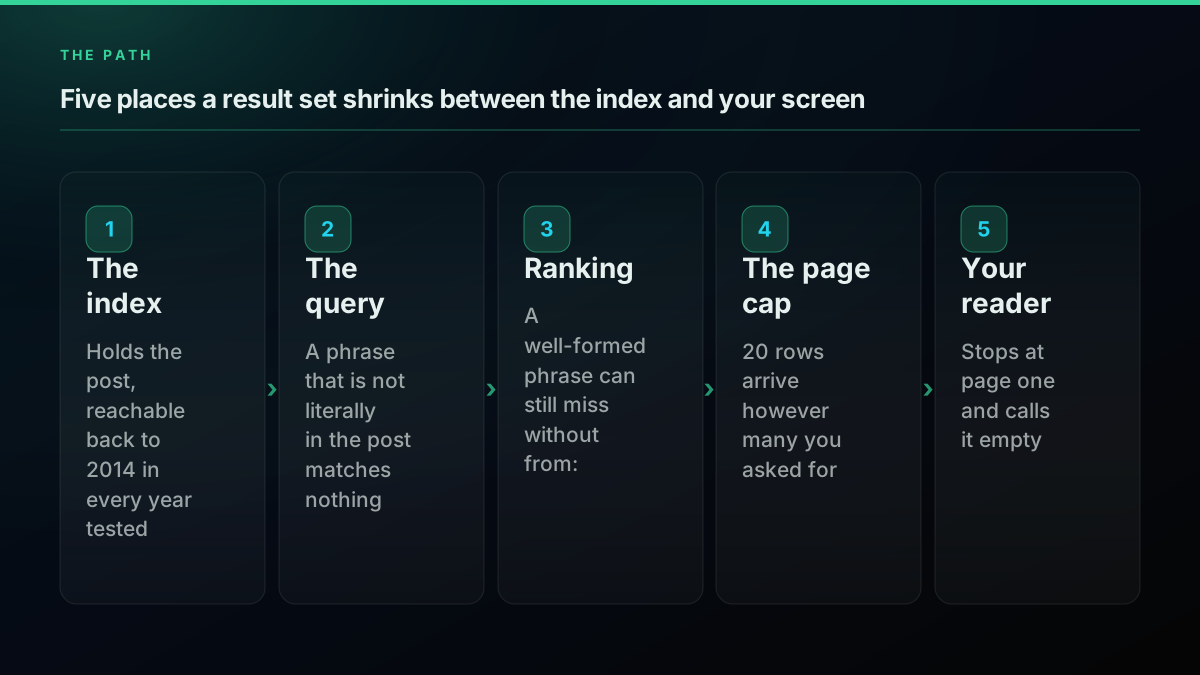
The wider lesson generalises past X entirely. Our own first measurement of this returned 25 percent and was a bug. The number was specific, it was plausible, and it agreed with what everyone already believed, which is exactly why it took a deliberate control to catch. When a search returns nothing, the cheapest hypothesis is almost never the index. It is the question.
Here is the thread that holds the top organic position for this exact complaint, if you want to see the failure shapes in the wild:
https://www.reddit.com/r/Twitter/comments/1rq2wf0/xtwitters_advanced_search_function_has_been/
And the version of the complaint that gets repeated most often, which is about inconsistency rather than emptiness:
https://x.com/TXMCtrades/status/2020843669096690039
The same reflex, from someone who builds search-adjacent product for a living:
https://x.com/SeanOnTwt/status/1261029326490755072
There is a walkthrough of the consumer-side fixes if the web form specifically is what is failing for you, which covers the settings and filter causes this post deliberately does not:
https://www.youtube.com/watch?v=JEbNKOHfi7M
And the case that started us testing query length, where a long operator chain returns nothing:
https://x.com/oikophile/status/1683986575196028929
If you want to run the ladder yourself against a route where the page size, the cursor and the id lookup are all documented and priced per call, the advanced search endpoint is the one every measurement in this post was taken against, and the API docs cover the response shape field by field. If you are choosing a route rather than debugging one, the API alternatives comparison lays out what each surface actually returns, and the MCP server exposes the same routes to an agent if that is where your retrieval lives.
You can sign up and run all 282 of these calls for less than a dollar, or read the pricing first. Either way, the next time a search comes back empty, check the question before you blame the index.
// sources
Where these numbers come from
Each row is a figure in this post and the artefact it was read from. Prices and limits on this platform move, so check the date on the source before you plan against it.
- X advanced search operator reference
- The platform's own help page for the advanced search form, used as the reference for which operators the web surface exposes.
- X API build-a-query operator documentation
- The official operator list for the v2 search endpoints, used to check which operators exist on which route.
- Recent search missing tweets, X developer community
- The developer report of one query returning no results on recent search and a result on full archive, with a staff acknowledgement the same day.
- Missing mentions on the users mentions endpoint, X developer community
- The report of HTTP 200 responses carrying a result count of zero for mentions that render in the app.
- Three retrieval paths returning three different counts, Stack Overflow
- The question comparing full-archive search, a scraping library and the advanced search UI on one identical query.
- Account rename removing posts from from: search, GitHub
- The issue tracing missing results to handle changes, and proposing that queries key on the numeric user id instead.
- Community operator catalogue
- The community-maintained catalogue of X search operators, cross-checked against the operator behaviour described here.
- X advanced search broken thread, r/Twitter
- The complaint thread that holds the first organic position for this query, used as the primary source of user-reported failure shapes.
Frequently Asked Questions
In most cases the query is the problem rather than the index. When we searched for 17 posts confirmed to exist, 15 came back on a plain exact-phrase search, and the failures traced to phrases that had been retyped rather than copied. A phrase that differs from the post by a single small word matches nothing, and the response looks identical to a genuine absence. Check the phrase against the post first, then strip every operator, then scope the query with from: and the author's handle. Only after all three should you treat it as a real index miss.
It did not in our run. The same 15 of 17 posts were found with and without a two-year date window, and it was the same 15 posts both times. This is the single most common piece of advice on the pages that rank for this query, and on our sample it moved recall by zero. A date window is useful for splitting a large pull into slices that page cleanly, which is a throughput benefit rather than a recall benefit.
It works, and it is precise, up to a point. At min_faves:100, min_faves:1000 and min_faves:10000 every returned row satisfied the gate, with the lowest value sitting just above the threshold each time at 104, 1005 and 10191. Above that it degrades: at min_faves:100000 one row of twenty broke the gate on the Latest tab and six of nineteen broke it on Top. A row count alone cannot tell you this, because the count was 20 at every threshold including the ones that leaked.
We grew an OR chain one operand at a time from 1 to 26 and saw no collapse anywhere in that range, including past the 22 to 23 ceiling that is often quoted. Every step returned a full page. Note the scope limit honestly: OR operands inside a single group may not be what that folklore counts as operators, so this refutes the claim only in the form we tested.
Because they read different index scopes. A developer reported a query returning no results on the recent-search endpoint and a result on the full-archive endpoint, with the same operators and the same conversation id, and X staff acknowledged the report the same day. When two surfaces operated by the same company disagree about one post, the disagreement is about index coverage rather than about your query, and no amount of rewriting the query will close it.
Not on the API path we measured. An identical seven-day window run once per year returned a full page of results for every year from 2014 through 2026, 13 of 13, and a post from 2015 was as reachable as one from 2026. The widely repeated claim that recall decays with age did not reproduce. What does change with age is the likelihood that the account has been renamed, protected or deleted, and each of those removes the post from search while leaving it retrievable by id.
Because 20 is the page size the search backend returns, whatever you ask for. We requested 200 rows on five unrelated queries and received exactly 20 every time. Nothing in the response says the number was overridden. If you read the first page and stop, you are seeing one page of an arbitrarily long result set and calling it the whole answer. Page the cursor until it comes back empty.
Not in the chain we walked. We paged one query 25 times and received 500 rows carrying 500 unique ids, zero duplicates, with the cursor still reporting more results available. The claim that a cursor chain becomes unreliable past roughly ten pages is widely repeated and did not reproduce here. That is a refutation of one specific claim on one chain, not a guarantee about every query.
Resolve the post id directly. An id lookup answers the existence question outright and involves no ranking, no relevance scoring and no operator parsing. If the id resolves and the search does not find it, the post exists and something between the index and your result set is hiding it. If the id does not resolve either, the post is genuinely gone. This is the one check that cannot be confounded by query shape.
It can, and the mechanism is specific. Search resolves from: against the handle, so when an account changes handle, a from:oldhandle query stops matching posts the profile page still displays. The fix is to key on the numeric user id rather than the handle wherever the route allows it, because the id is stable across renames and the handle is not.
Check out similar blogs
More guides on the Twitter/X API, scraping, and pricing.

Build vs Buy: Should You Build Your Own Twitter/X Monitoring Tool? (2026)
Buying a listening seat costs $29 to $2,000 a month depending on the vendor. Building costs real engineering hours plus a data bill. Here is the real math behind the twitter monitoring tool build vs buy decision, priced both ways.
How to Track a Tweet's Performance in Real Time with the X API
Poll a tweet's engagement counts over time with the X API, compute a views-to-likes ratio, and read the quote-tweet layer to tell an organically growing launch tweet from a boosted one. Tested Python and curl.

How to Search Tweets by Date on X in 2026 (Operators, API, and the Limits Nobody Documents)
How to search tweets by date on X in 2026: the since:/until: operators, the API parameters, and the exact historical limits X's own docs bury, tested live against a real endpoint.

What "Rate Limited" Actually Means on X (Every Limit, Measured)
"Sorry, you are rate limited" is one message covering two different systems: a consumer action ceiling and a developer API window. Here is what the term means, the current numbers for both, where it came from, and how long it actually lasts.

Delete All Your Tweets With the X API (2026): Runnable Code, the 3,200 Ceiling, and Real Costs
How to bulk delete tweets through an API instead of a subscription tool: the enumerate-then-delete loop in Python, X's 3,200 history ceiling, the archive-export route past it, and what 1,000 deletions actually cost.
Auto-Posting to Twitter (X) in 2026: 7 Scheduler Tools vs the API, Priced Per Tweet
Every way to auto post to Twitter (X) in 2026, priced in one honest unit: cost per tweet. Seven scheduler tools with live pricing, X's own per-post API rate, the volume where each route wins, and what X's automation rules actually forbid.
Twitter Scraping in Python (2026): Pick a Route Before You Write Code
Four ways to collect X data in Python, priced honestly: the official X API v2 pay-per-use rate, an account-pool scraper, a headless browser, and a managed read API. What each one actually costs to run for a year.

The Twitter API Developer Reference (2026): Endpoints, Rate Limits, Error Codes and Pagination
A single indexed reference for the Twitter/X API in 2026: the endpoint catalog, how authentication and bearer tokens work, the rate limits behind every 429, what error codes 401, 403, and 429 mean, cursor pagination, response shapes, and the real per-call cost of each call.